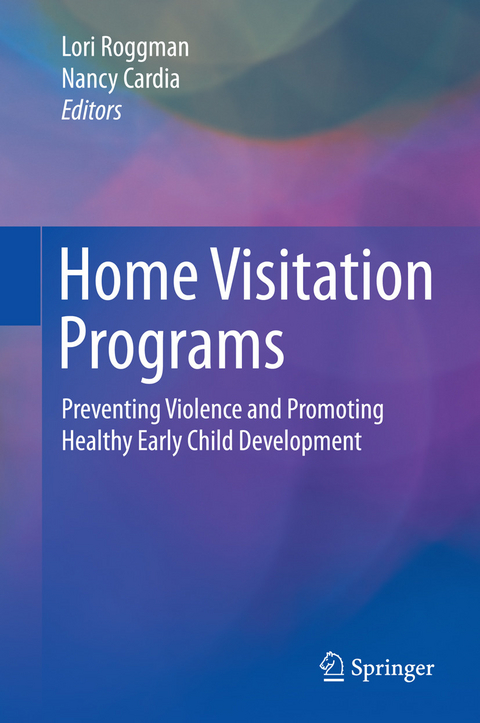
Home Visitation Programs (eBook)
XVI, 232 Seiten
Springer International Publishing (Verlag)
978-3-319-17984-1 (ISBN)

Among the featured topics:
- Home visitation as a primary prevention tool for violence.
- Developmental parenting home visiting to prevent violence.
- Supporting the paraprofessional home visitor.
- Engagement and retention in home visiting child abuse prevention programs.
- Addressing psychosocial risk factors among families in home visiting programs.
- Home visitation programs in the United States, Latin America, and the Caribbean.
Home Visitation Programs: Preventing Violence and Promoting Healthy Early Child Development is an essential resource for researchers, graduate students and professionals in child and school psychology, social work, educational policy, family advocacy and public health.
Lori Roggman, Ph.D., is Professor in the Department of Family, Consumer, and Human Development at Utah State University. She studies parenting and early intervention in relation to children's early social, cognitive, and language development. Dr. Roggman's career began as a Head Start home visitor and continued as a trainer and consultant for practitioners in infant/toddler and early childhood programs. She has conducted research on early parenting and on home visiting interventions to support parenting in Early Head Start and similar programs and she co-authored Developmental Parenting: A Guide for Early Childhood Practitioners. She co-developed the PICCOLO scale using 4,500 observations of parenting interactions to develop a valid, reliable, easy-to-use measure for both researchers and practitioners that gauges affection, responsiveness, encouragement and teaching. She also co-developed the Home Visit Rating Scales of home visiting quality. She has served in several technical advisory groups developing methods and measures to study services for families of infants, toddlers and young children.
Nancy Cardia, Ph.D., is Professor and Deputy Coordinator of the Center for the Study of Violence and coordinator of the activities of knowledge transfer. She represents the center as a Collaborating Centre of the World Health Organization (WHO) in the issue of Prevention of Violence at the Department of Prevention of Violence and Injuries. She has organized the series of books, Police and Society, and the series Human Rights Education. Dr. Cardia is a member of the Editing Committee of the World Report on Violence against Children (UN / UNICEF), author of a book about murders of children in Brazil (WHO/PAHO). She compiled the module of youth violence: causes and prevention for the WHO TEACH-VIP and produced, for the PAHO / GTZ, a study on how to prevent youth violence and promote healthy development. She is general coordinator of the pilot deployment of the program of domestic visitation for adolescent mothers and their children: a program to promote healthy development and prevent violence and is also the coordinator of research on exposure to violence and its impact on attitudes, values, norms regarding violence, human rights, justice and democracy.
Lori Roggman, Ph.D., is Professor in the Department of Family, Consumer, and Human Development at Utah State University. She studies parenting and early intervention in relation to children’s early social, cognitive, and language development. Dr. Roggman’s career began as a Head Start home visitor and continued as a trainer and consultant for practitioners in infant/toddler and early childhood programs. She has conducted research on early parenting and on home visiting interventions to support parenting in Early Head Start and similar programs and she co-authored Developmental Parenting: A Guide for Early Childhood Practitioners. She co-developed the PICCOLO scale using 4,500 observations of parenting interactions to develop a valid, reliable, easy-to-use measure for both researchers and practitioners that gauges affection, responsiveness, encouragement and teaching. She also co-developed the Home Visit Rating Scales of home visiting quality. She has served in several technical advisory groups developing methods and measures to study services for families of infants, toddlers and young children.Nancy Cardia, Ph.D., is Professor and Deputy Coordinator of the Center for the Study of Violence and coordinator of the activities of knowledge transfer. She represents the center as a Collaborating Centre of the World Health Organization (WHO) in the issue of Prevention of Violence at the Department of Prevention of Violence and Injuries. She has organized the series of books, Police and Society, and the series Human Rights Education. Dr. Cardia is a member of the Editing Committee of the World Report on Violence against Children (UN / UNICEF), author of a book about murders of children in Brazil (WHO/PAHO). She compiled the module of youth violence: causes and prevention for the WHO TEACH-VIP and produced, for the PAHO / GTZ, a study on how to prevent youth violence and promote healthy development. She is general coordinator of the pilot deployment of the program of domestic visitation for adolescent mothers and their children: a program to promote healthy development and prevent violence and is also the coordinator of research on exposure to violence and its impact on attitudes, values, norms regarding violence, human rights, justice and democracy.
Preface 5
Acknowledgments 7
Contents 8
About the Editors 10
About the Authors 11
Part I 15
Introduction to Home Visiting and its Challenges 15
Chapter-1 16
Introduction: Home Visitation as a Primary Prevention Tool for Violence 16
References 20
Chapter-2 22
The Four Challenges of Home Visitation Programs: Alcohol and Substance Abuse, Intrafamiliar Violence, and Mental Disorders 22
References 24
Part II 25
Home Visiting Programs and Practices: Research and Evaluation 25
Chapter-3 26
Home Visiting to Enhance Child Development in the Context of Violence: Possibilities and Limitations 26
Violence Exposure and Aggression 27
Using Family Interventions to Reduce Violence and Aggression 29
The Potential of Home-Visiting Effectiveness to Prevent Maltreatment 30
Established Home-Visiting Programs that Promote Parenting and Child Development 31
Promising Research on Home Visiting to Improve Parenting and Child Development 34
Ways to Expand and Improve Home Visiting in International Contexts 36
Conclusion 38
References 38
Chapter-4 46
Developmental Parenting Home Visiting to Prevent Violence: Monitoring and Evaluating 46
Logic Model of Developmental Parenting Home Visiting 47
Environmental Stress and Aggression in Early Childhood 49
Maltreatment 49
Parent Depression and Substance Abuse 50
Poverty 50
Parenting and Stress 51
Research on Parenting to Support Child Development and Resilience 51
Warmth 53
Responsiveness 53
Encouragement 54
Cognitive Stimulation 54
Parenting as a Focus of Home Visiting 54
Evidence for a Developmental Parenting Home visiting Approach 55
Developmental Parenting Home visit Practices 56
Relationships Focused on Child Development 57
Responsiveness to Family Strengths 57
Facilitation of Developmental Parenting 58
Collaboration 58
Parent Engagement 59
Monitoring and Evaluating a Developmental Parenting Home visit Program 60
Monitoring Home visiting Practices 60
Training and Supporting Home Visitors 60
Measuring Home visiting Practices 61
Evaluating Child Outcomes 62
Evaluating Parenting Outcomes 63
Conclusion 64
References 64
Chapter-5 74
Developing the Home Visiting Workforce 74
Nina and Abbey 74
The Profession of Early Childhood Education Home Visiting 76
Training Home Visitors 76
A Developmental Trajectory for Training 77
Training to Build a Secure Base 80
Core Training Content: Nine Learning Strands 81
Child Development 82
Skillful Use of Self 83
Stages of the Helping Relationship 85
Adolescent and Parental Development 87
Parenting in the Context of Family History, Systems, and Dynamics 88
Communicating with Parents 90
Parental Problem-Solving 91
Accessing and Coordinating Community Resources 92
Professional and Personal Self-Care 92
The Power of Training 93
References 94
Chapter-6 96
Supporting the Paraprofessional Home Visitor 96
The Paraprofessional as Home Visitor 97
The Importance of the Helping Relationship 101
The Personal–Professional Relationship 103
Challenges of the Personal Relationship 105
Support for the Paraprofessionals 106
Conclusion 108
References 109
Chapter-7 111
Engagement and Retention in Home Visiting Child Abuse Prevention Programs 111
Introduction of Study of Program Engagement 111
Methods of Study of Program Engagement 114
Results of Study of Program Engagement 117
Introduction for Study of Program Retention 118
Methods for Study of Program Retention 120
Conclusion 124
Limitations 124
References 125
Chapter-8 128
Addressing Psychosocial Risk Factors Among Families Enrolled in Home Visitation:Issues and Opportunities 128
Identification of Psychosocial Risk Factors by Home Visitation Programs 129
Enhancing Home Visitors’ Capacity to Address Psychosocial Risks Among their Clients 132
Augmenting HV Program Models to Address Psychosocial Risk Factors 137
Summary and Future Directions 139
References 140
Chapter-9 144
Considerations on the Implementation, Innovation, and Improvement of Evidence-Based Home Visiting Programs 144
What Is the Evidence for Home Visiting? 146
Evidence-Based Practice 146
Evidence-Based Practice in Home Visiting 147
Innovation in Home Visiting 150
From Innovation to Practice 152
Implementation Science 153
Data Availability 154
Supervision and Coaching 155
Continuous Quality Improvement 157
Conclusions 158
References 159
Part III 163
Home Visiting Programs Outside the USA 163
Chapter-10 164
Home Visitation Programs for Early Child Development: Experiences in Latin America and the Caribbean 164
Experiences in Latin American and Caribbean Countries 170
Chile 170
Uruguay 171
Cuba 172
Ecuador 173
Guatemala 173
Mexico 174
Colombia 174
Argentina 176
Peru 177
Bolivia 178
Honduras 178
Jamaica 180
Brazil 181
Program Infância Saudável (The Healthy Childhood Program) 187
Conclusion 191
References 191
Chapter-11 197
Home Visiting Interventions to Promote Values That Support School Success 197
Home–School Relations 198
Home-Visiting Approach 199
Project One: Somerville 201
Project Two: East Boston 204
Project Three: Pastores, Guatemala 207
Children’s School 209
Parental Education and the Mothers’ Group 209
Nutrition and Preventive Health Services 210
Conclusions 211
References 212
Chapter-12 214
The Roving Caregivers Program: A Caribbean Model 214
Early Childhood Development (ECD) in the Caribbean 215
The Roving Caregivers Program (RCP)—A Caribbean Model 216
Theoretical Foundations of the RCP 219
Childhood Development 219
Cultural Relevance 219
Prevention 221
RCP Major Working Principles 221
The Role of the Rover 222
RCP Impact Study 223
Potential Application of RCP in Different Contexts 224
Partnership Opportunities for the RCP Model 225
Conclusion 226
References 227
Chapter-13 230
The Investment in Home Visit Programs in Rural Indigenous Communities as a Strategy to Grant a Good Start in Life for Young Children 230
References 235
Index 236
| Erscheint lt. Verlag | 17.9.2015 |
|---|---|
| Zusatzinfo | XVI, 232 p. 20 illus. |
| Verlagsort | Cham |
| Sprache | englisch |
| Themenwelt | Geisteswissenschaften |
| Medizin / Pharmazie ► Medizinische Fachgebiete ► Psychiatrie / Psychotherapie | |
| Sozialwissenschaften ► Pädagogik ► Sozialpädagogik | |
| Schlagworte | Child protection services • Community Involvement • Developmental parenting home visiting • Early childhood home-based services • Family and mental illness • Family and sexual violence • Home visitation for violence prevention • Home visitation in Latin America • Home visitation in the United States • Home visitation programs for infants • Home visitation programs for school success • Home visitation programs for young children • Infant and toddler family services • International family services for early childhood • Parenting programs and early childhood • Prevention of Child Maltreatment • Promotion of infant toddler development • Promotion of infant toddler health • Psychosocial risks for home visiting clients |
| ISBN-10 | 3-319-17984-5 / 3319179845 |
| ISBN-13 | 978-3-319-17984-1 / 9783319179841 |
| Informationen gemäß Produktsicherheitsverordnung (GPSR) | |
| Haben Sie eine Frage zum Produkt? |
 PDF (Wasserzeichen)
DRM: Digitales Wasserzeichen
Dieses eBook enthält ein digitales Wasserzeichen und ist damit für Sie personalisiert. Bei einer missbräuchlichen Weitergabe des eBooks an Dritte ist eine Rückverfolgung an die Quelle möglich.
Dateiformat: PDF (Portable Document Format)
Mit einem festen Seitenlayout eignet sich die PDF besonders für Fachbücher mit Spalten, Tabellen und Abbildungen. Eine PDF kann auf fast allen Geräten angezeigt werden, ist aber für kleine Displays (Smartphone, eReader) nur eingeschränkt geeignet.
Systemvoraussetzungen:
PC/Mac: Mit einem PC oder Mac können Sie dieses eBook lesen. Sie benötigen dafür einen PDF-Viewer - z.B. den Adobe Reader oder Adobe Digital Editions.
eReader: Dieses eBook kann mit (fast) allen eBook-Readern gelesen werden. Mit dem amazon-Kindle ist es aber nicht kompatibel.
Smartphone/Tablet: Egal ob Apple oder Android, dieses eBook können Sie lesen. Sie benötigen dafür einen PDF-Viewer - z.B. die kostenlose Adobe Digital Editions-App.
Buying eBooks from abroad
For tax law reasons we can sell eBooks just within Germany and Switzerland. Regrettably we cannot fulfill eBook-orders from other countries.
aus dem Bereich