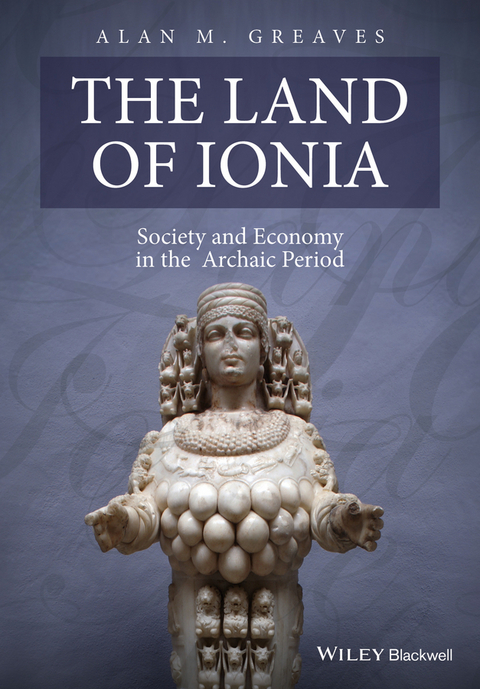
The Land of Ionia (eBook)
John Wiley & Sons (Verlag)
978-1-119-06234-9 (ISBN)
Alan Greaves is Lecturer in Archaeology at The University of Liverpool. He is the author of Miletos: A History (2002) and the editor of the volume Transanatolia (2007). He has also written numerous articles on Bronze Age-Iron Age archaeology in Turkey, Ionia, and Greek Colonization.
List of illustrations viii
List of tables x
Preface xi
Acknowledgments xiv
Prologue xvi
1 FINDING IONIA 1
Introduction 1
The Source Materials 2
Excavation and Publication 22
Conclusions 26
2 CONSTRUCTING CLASSICAL ARCHAEOLOGIES OF IONIA 27
Introduction 27
Traditional Approaches to Classical Archaeology in Ionia 28
The German and Turkish "Schools" of Archaeology 32
Annaliste Perspectives on Archaeology 36
A New Approach to the Land of Ionia 39
Conclusions 43
3 A DYNAMIC LANDSCAPE 45
Introduction 45
Ionia's Geographical Zones 46
Landscape Dynamism 57
The Ionian Landscape and Ionian Identity 65
Conclusions 67
4 THE WEALTH OF IONIA 69
Introduction 69
Modes of Primary Production 71
Modes of Processing 79
Modes of Exchange 84
Ionia and World Systems 89
Conclusions 91
5 THE CITIES OF IONIA 95
Introduction 95
A Brief Survey of the Ionian Cities 96
Other Settlements in Ionia 107
The Size and Distribution of Poleis within Ionia 110
François de Polignac in Ionia 112
The City and Ionian Identity 115
Conclusions 118
6 THE IONIANS OVERSEAS 120
Introduction 120
Source Materials 121
Interpreting the Evidence 129
Colonial Interactions 131
Models of Ionian Colonization 137
Conclusions 143
7 THE IONIANS AT WAR 145
Introduction 145
Geographical Settings 147
Archaeological Contexts and Materials 148
Literary Sources 154
Discussion: Issues in Source Materials 156
The Fortification of Ionia 156
Naval Warfare 164
Mercenaries 166
Conclusions 168
8 CULTS OF IONIA 171
Introduction 171
Geographical Evidence 172
Archaeological Evidence 174
Contents vii
Literary and Epigraphic Evidence 179
Discussion of Source Materials 180
The Sacred Ways of Ionia 180
"Foreign" Influences on Ionian Cult 193
Burial Practices in Ionia 197
Conclusions 199
9 THE ORNAMENTS OF IONIA 201
Introduction 201
"Art" and Landscape 203
Ionia's Lost "Art" Treasures 203
"Art" and Literature 207
"Connoisseurship" of Ionian Pottery 207
"Reading" Ionian "Art" 214
Conclusions 218
10 WHO WERE THE IONIANS? 219
Introduction 219
Herodotos' Ionia 219
The Myth of the Ionian Migration 222
Ionian Identity and Archaeology 225
Conclusions 227
Epilogue 231
Glossary of ancient Greek [and modern Turkish] terms used in the text 233
Bibliography 235
Index 255
1
Finding Ionia
Introduction
Ionia in the Archaic period was at the core of the Greek world that centered on the Aegean Sea and it played a pivotal role in the events documented in the most important surviving historical work of that period: Herodotos’ Histories. Consequently, in modern times Ionia attracted the attention of antiquarians and archaeologists from an early date and at the key sites of Ephesos and Miletos there have now been near-continuous archaeological excavations for over a century.
Considering this long history of exploration and research, when one begins to study the Archaic period of Ionia by conducting a critical review of the available archaeological source materials, the results are surprisingly, and remarkably, disappointing. Despite the size and crucial importance of this region in the ancient world, and despite its long history of research, the published archaeological information available is of mixed quantity and value and must often be handled with care. A similar review of the available literary and epigraphic evidence reveals that there is little hard evidence to be found here either.
Today there are important ongoing excavations using modern field methods of excavation and analysis at several sites in Ionia, yet the fact remains that the majority of our archaeological knowledge as yet still comes from those excavations that were conducted in an earlier era, often without systematic methods of recording. But as archaeological methods and the kind of questions we are seeking to ask of the material have developed, so the results of these old excavations are less able to answer them. For example, early archaeologists rarely logged and identified the animal bones from their excavations because they were interested in artworks, such as sculpture, and did not yet recognize that faunal evidence could tell us so much about past diets, environments, and human practices. Yet the systematic analysis of animal bones from a recently excavated sanctuary in Ionia, the Sanctuary of Aphrodite on Zeytintepe, Miletos, has been very illuminating and has told us a great deal about sacrificial practices at this site, for which there are no written records.1
It has long been recognized that the very act of excavation destroys that which we dig and therefore, once a site has been dug by archaeologists, it has been destroyed.2 The need to create, and make public, systematic records of what is found during excavations is therefore paramount. However, a recent development in the theoretical understanding of the nature of archaeological evidence has been the recognition that the very act of excavating and recording is, in itself, based on interpretative decisions by the excavator.3 That is to say that we, the archaeologists, create what we find by the choices we make about where and how to dig. Most archaeological evidence is therefore subjective, not objective, in nature.4
With this in mind, if we are ever to be able to make use of the large body of material from previous excavations, it is necessary to appreciate the motivations, interests, and methods of those previous generations of archaeologists who worked in Ionia in order to begin to compensate for biases that may be inherent in the archaeological record as a result. By understanding their objectives, we can begin to understand their methods and put them into a proper context for the age in which they operated. These objectives affected which sites they chose to excavate, the methods they chose to use, which artifacts they chose to keep (or publish) and which they chose to discard (or leave unpublished).
If the objectives of previous generations of archaeologists affected how the archaeological materials from Ionia were found, then they have also affected how they were interpreted. The aim of Classical archaeology has often been to establish, wherever possible, connections between the material remains of the Greek and Roman cultures and their literary and historical legacy. However, in our eagerness to make such connections, we can sometimes make associations between the archaeological evidence and passages of ancient history which might subsequently be interpreted differently, or indeed challenged.5
The Source Materials
There are three main categories of source material traditionally used by Classical archaeologists in their attempt to reconstruct ancient societies and their histories, namely archaeology, ancient literary sources, and epigraphy. The remainder of this chapter will review the quantity and nature of these sources as they exist from Ionia before discussing how these might be used and combined to deepen our understanding of society in ancient Ionia in subsequent chapters.
Archaeology
As a region, Ionia has exceptional potential for archaeological research. It is home to a number of exceptionally well-preserved archaeological sites, the most notable being New Priene6 and Ephesos. At both of these sites, there are ruins so perfectly preserved that visitors can imagine what it must have been like to inhabit the ancient city and walk down those same streets. The ruins of these places, and those of others in the region, are so exceptionally preserved because of certain physical characteristics within the landscape of Ionia itself.
Figure 1.1 General view of Ephesos.
The most famous archaeological sites in the world are often those that have captured a “snapshot in time,” usually as the result of some natural disaster. Pompeii, Herculaneum, and Akrotiri on Santorini were preserved because they were buried by volcanic ash in a sudden catastrophic event. In Ionia, Ephesos is one such site. Here, the central part of the excavated area seen by tourists, the Library of Celsus and the Street of the Curetes, was buried by a landslide that covered the ruins in a great depth of soil and resulted in remarkable preservation (Figure 1.1). The ancient city was located between two hills – Panayır Dağı, to the north, and Bülbül Dağı, to the south – from which the landslide apparently originated. Landslides are often triggered by seismic events like earth tremors, which are common across Ionia.7 The hilly terrain and seismic nature of Ionia therefore combined to contribute to creating the superb preservation conditions seen at Ephesos. A catastrophic flood appears to have destroyed the eighth-century BC Temple of Artemis at Ephesos, and important finds, including a number of amber beads, were protected by the resulting layer of soft sand that covered its ruins.8
Figure 1.2 Alluvium at Magnesia.
Close to Priene are another set of exceptional ruins – at Magnesia on the Maeander. Although Magnesia was not named as one of the Ionian dodekapolis in the Archaic period, its ruins are worth noting here because it is in a similar geographical zone to other sites in Ionia. Unlike New Priene and Ephesos, Magnesia does not sit immediately under a large hill. Instead, the site is in the low-lying valley bottom and consequently it has been covered in silt from the Büyük Menderes river system. The ruins of Magnesia are in such an excellent state of preservation because they became rapidly covered by a great depth of alluvium (Figure 1.2). Remarkable features of Magnesia that have been preserved in this way include the inscribed slabs of the agora (market place), the Temple of Artemis, and the famous Skylla capital. The alluviation of the Büyük Menderes may also have been responsible for covering over the ruins of Old Priene, so much so that despite exhaustive research the location of the Archaic period settlement has yet to be securely identified.9 If the current attempts at finding the ruins by means of geophysical survey are successful and the city is ever excavated, its ruins may prove to be in the same state of preservation as those of Magnesia.
The alluvial action of the Büyük Menderes River has also led to the preservation of the ruins of Ionia in other, less obvious, ways. The progradation (i.e. silting-up) of the bays on which the great cities of Ionia stood and the resulting swamps made these cities uninhabitable and isolated them from the sea. This meant that the cities were often abandoned, never to be reoccupied on a large scale. Without later settlement phases smothering the classical ruins it has been possible for archaeologists to uncover the complete plans of cities such as Ephesos, whereas excavating and exploring contemporary cities such as Athens are complicated by the presence of modern settlement. The alluviation also left the cities a long way from the coast. This meant that their abandoned ruins could not be easily robbed for stone and the blocks carried away by sea. In the case of Myous, the abandoned city was probably plundered for stone in antiquity and the archaeological remains at the site today are negligible.10 The sea also played an important role in Charles Newton’s work when he was collecting sculptures from the Turkish coast for the British Museum during the mid-nineteenth century. He deliberately began his excavations at Knidos in the theater because of its proximity to the sea and the ease with which its sculptures could therefore be removed.11 Any visitor to the British Museum’s Great Court will immediately be struck by the enormous size and weight of the Knidos lion that Newton retrieved. Such audacious acquisition of sculptures was only possible because of that site’s proximity to the...
| Erscheint lt. Verlag | 29.7.2015 |
|---|---|
| Sprache | englisch |
| Themenwelt | Literatur |
| Geschichte ► Allgemeine Geschichte ► Vor- und Frühgeschichte | |
| Geschichte ► Allgemeine Geschichte ► Altertum / Antike | |
| Geisteswissenschaften ► Geschichte ► Regional- / Ländergeschichte | |
| Geisteswissenschaften ► Sprach- / Literaturwissenschaft ► Anglistik / Amerikanistik | |
| Geisteswissenschaften ► Sprach- / Literaturwissenschaft ► Literaturwissenschaft | |
| Sozialwissenschaften ► Soziologie ► Gender Studies | |
| Schlagworte | Ancient & Classical History • Antike • Antike u. klassische Geschichte • Classical Studies • Humanistische Studien • Ionia, Ancient Anatolia, Ancient Turkey, Archaic Ionia |
| ISBN-10 | 1-119-06234-9 / 1119062349 |
| ISBN-13 | 978-1-119-06234-9 / 9781119062349 |
| Informationen gemäß Produktsicherheitsverordnung (GPSR) | |
| Haben Sie eine Frage zum Produkt? |
 EPUB (Adobe DRM)
Kopierschutz: Adobe-DRM
Adobe-DRM ist ein Kopierschutz, der das eBook vor Mißbrauch schützen soll. Dabei wird das eBook bereits beim Download auf Ihre persönliche Adobe-ID autorisiert. Lesen können Sie das eBook dann nur auf den Geräten, welche ebenfalls auf Ihre Adobe-ID registriert sind.
Details zum Adobe-DRM
Dateiformat: EPUB (Electronic Publication)
EPUB ist ein offener Standard für eBooks und eignet sich besonders zur Darstellung von Belletristik und Sachbüchern. Der Fließtext wird dynamisch an die Display- und Schriftgröße angepasst. Auch für mobile Lesegeräte ist EPUB daher gut geeignet.
Systemvoraussetzungen:
PC/Mac: Mit einem PC oder Mac können Sie dieses eBook lesen. Sie benötigen eine
eReader: Dieses eBook kann mit (fast) allen eBook-Readern gelesen werden. Mit dem amazon-Kindle ist es aber nicht kompatibel.
Smartphone/Tablet: Egal ob Apple oder Android, dieses eBook können Sie lesen. Sie benötigen eine
Geräteliste und zusätzliche Hinweise
Buying eBooks from abroad
For tax law reasons we can sell eBooks just within Germany and Switzerland. Regrettably we cannot fulfill eBook-orders from other countries.
aus dem Bereich