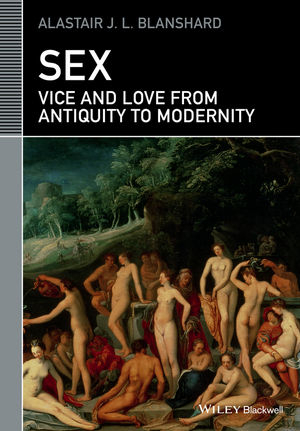
Sex (eBook)
John Wiley & Sons (Verlag)
978-1-119-06253-0 (ISBN)
Alastair J. L. Blanshard is a senior lecturer in Classics & Ancient History at the University of Sydney. He is the author of Hercules: A Heroic Life (2005).
List of Illustrations ix
Preface xi
Part I Roman Vice 1
1 Introduction 3
2 Naked Bodies 7
An Introduction (less than successful) to the Naked Body 7
The Naked Body in Greece 14
Naked Romans 21
The Love of Art and the Art of Love 28
3 Obscene Texts 34
Illustrating the Unspeakable 34
Talking Dirty 40
4 Erotic Rites 48
The Myth of the Orgy 48
Locating the Erotic in Roman Religion 55
5 Imperial Biography 65
The Private Lives of the Caesars 65
Explaining Roman Gossip Culture 79
Part II Greek Love 89
6 Introduction 91
What is 'Greek Love'? Scenes from a Courtroom I 92
7 Greece 97
The Loves of Hellas 97
The Platonic Vision 99
8 Rome and the West 109
Greece under Rome and Rome under Greece 109
Greek Love Burns Briefly, but Brightly 119
9 Renaissance and Enlightenment 124
Giving Birth in the Beautiful 124
The Pursuit of Love 135
10 Nineteenth Century and Beyond 143
Greek Love Triumphant 143
Sapphic Love 149
A Mixed Legacy: Greek Love in the Twentieth and Twenty-First Centuries 159
11 Epilogue 164
Scenes from a Courtroom II 164
Notes and Further Reading 166
Bibliography 190
Index 205
Preface
Factoid n. Something that becomes accepted as a fact, although it is not (or may not be) true; spec. an assumption or speculation reported and repeated so often that it is popularly considered true; a simulated or imagined fact.
The Oxford English Dictionary lists the earliest reference of the word ‘factoid’ as occurring in a 1973 essay by Norman Mailer on Marilyn Monroe. It is no accident that ‘factoid’ should be coined to analyze one of the most eroticized and fantasized figures of the twentieth century. For when it comes to the topic of sex, the combination of illicit thrills, prurient fascination, and a desire for the personal and the private means that critical faculties get all too often thrown out the window and we find ourselves unable to resist a juicy story, no matter how improbable.
This book is a story about fantasy and the reality that lurks behind these fantasies. It is a history of facts and factoids. Its subject matter is the erotic desires that have been projected onto the cultures of classical antiquity. This work examines the impact that sexual fantasies about the classical world have had on western culture. Authors, artists, politicians, philosophers, and moralists have all turned to the classical world in a search to understand erotic desire. The classical world has regularly been invoked both as the home of sexual freedom and a haven for unnatural perversity. This monograph aims to examine the ways in which cultures have used classical erotica to locate and articulate their own erotic discourse. It attempts to unearth the various investments that cultures and individuals have made in antique sexual pleasure. It examines the ways in which the classical world has provided a mask for the dissimulation of acts of power as regulations of pleasure.
A history of classically inspired erotic imaginings provides a fruitful location for the discussion of the important role that imagined versions of antiquity have played in shaping notions about sexuality, guilt, desire, and love. This book seeks to juxtapose these fantasies with the reality of classical life. Not only does a narrative about sex in antiquity bring into relief the fantastic aspects of later constructions, but it also allows us an opportunity to observe the way in which the classical world exists in dynamic tension with the modern. Ideas about one impact on the other. In undertaking this task, this work hopes to make a contribution to two distinct conversations.
The first is a conversation about the role of sex and sexuality in western culture. One of the important theoretical breakthroughs made in the twentieth century was the realization that sex was more than just a mechanical act. There might be a biological imperative behind it, but this was not the only, or indeed the most important, factor conditioning sexual behavior. Sex is a story about culture as well as nature. This has ushered in a whole new understanding of the role and significance of sex.
Sex has been written into history. We can now examine the ways in which sexual behavior has been buffeted by social forces. Sex and the discourse surrounding it respond to political, economic, and ideological conditions. Very little about sex is now taken as immutable. The status of sex varies according to time and place. It comes into view as a category worthy of comment as a result of the actions of agents. Sex gains importance because it is a place where so many ideas about gender, the body, ethnicity, the nature of pleasure, and the purpose of life come together and coalesce. For these reasons, sex and the discussion of sex have proved useful mechanisms for gaining an insight into different cultures, especially those cultures where sexual activity has been excessively regulated or occupies a central position in the construction of identity (‘you can tell who I am, by who I sleep with’).
In addition to the history of sex, this work hopes to make a contribution to the burgeoning field of classical reception studies. Reception studies is located broadly within the tradition of the ‘history of ideas’ and traces the impact of the cultures of Greece and Rome on later cultures. There has always been an interest in tracing the influence of the antique past onto the modern. Within German scholarship, the study of the ‘afterlife’ (Nachleben) or ‘reception history’ (Rezeptionsgeschichte) are well-established areas of scholarship. What distinguishes classical reception studies from previous incarnations such as ‘the study of the classical tradition’ is a change in sensibility. Reception studies is less interested in quantifying high culture’s debt to ancient Greece or Rome. Rather than establishing pedigrees for great names, it is more interested in developing genealogies of ideas in which concepts mutate, evolve, or, sometimes, completely fail to have any epigone at all. It is democratic in the sense that it takes an interest in all fields of human endeavor, and feels happy to run the coarse against the refined to see what happens. It is a field of study that regards comic books and computer games as suitable objects of study as much as opera or old master paintings. Reception studies cuts across disciplinary boundaries, and draws upon the critical tools developed in disciplines such as film studies, art history, philosophy, gender studies, cultural history, performance studies, and the history of medicine.
The structure of this book is divided into two parts, ‘Roman Vice’ and ‘Greek Love’. On the surface, this division perpetuates a clichéd distinction about the immorality of Rome and the restrained virtue of Greece. It also feeds into another division, the split between heterosexuality and homosexuality. Since the very inception of the term, ‘Greek love’ has stood for the attraction between men whereas the key signifier of the sexuality of Rome has come to be the orgy, a queer encounter admittedly, but in which one of the many types of mingling that occurs is a mingling of genders. ‘Gay’ orgies always need to be identified as such. Like sex itself, the orgy has a tendency to be coded straight.
Binary divisions make a good place for starting a discussion about culture because they are so often used as a way of ordering the world. They get tangled up in each other. It is too easy to explain one binary distinction in terms of another. What’s the difference between men and women? Well, it’s like the difference between night and day, hot and cold, wet and dry, reason and madness, Greece and Rome. The arrangements are arbitrary, but they gain weight through repetition.
Yet, it is not the intention of this work to repeat clichés or perpetuate stereotypes about ways of viewing. While it is certainly worth exploring the reasons why Rome came to regularly stand for lasciviousness and viciousness in a way that Greece rarely did, it is also equally important to note those occasions when these divisions broke down or were not observed. For example, Roman ‘vice’ has a lot to tell us about the history of homosexuality, just as the story of Greek ‘love’ is crucial to an understanding of the development of the discourse around debauchery. For all the apparent clichés, it soon becomes clear that the idea that you could maintain a strict division between a Greek and Roman discourse in relation to sex turns out to be a fantasy in its own right.
It is for this reason, amongst others, that the book begins with a discussion of ‘Roman’ material before ‘Greek’. In the world of sex nothing ever plays straight and lines of influence become blurred and intermingle. One of the features of sexuality as a field of discourse is the way in which it encourages a riotous ludic disposition in its interlocutors. In discussions of sex, adherence to laws of strict chronology, attention to considerations of genre, and a critical sense of disbelief about the implausible or the impractical are oft put aside. People are eclectic in their usage of allusions. Greece may have primacy in time and, arguably, in prestige, but those positions are often reversed when it comes to discussions of sex. Roman material often provides the starting point and the matrix for understanding sexual activity with an invocation of Greek material only added as subsidiary or decorative supplement.
One other reason, apart from a desire to highlight clichés, for invoking the terms ‘vice’ and ‘love’ is that I want to use them in a particular technical sense and that is to signify two different modes of reception. One of the aspects that makes the reception of antiquity so fascinating as a phenomenon is the way in which it is possible to tell the story of the transmission of an idea in two different ways. One method is as a sustained encounter over time in which each subsequent engagement reacts to, and builds upon, all previous encounters. It’s a form of romance, a form of love. The other way is where an aspect of antiquity enters, apparently unmediated, straight into the cultural bloodstream. I say ‘apparently unmediated’ because a complete lack of mediation is an impossibility. Every encounter with antiquity always arrives pre-framed. Yet, there is a mode of engagement that ‘feels’ unmediated. A moment when you experience the sense that you are working without a tradition; that the ancient world is speaking to you directly. It’s the moment of the arrival of Plato in Renaissance Florence or the unearthing of an erotic picture in Pompeii or the...
| Erscheint lt. Verlag | 28.7.2015 |
|---|---|
| Reihe/Serie | Classical Receptions |
| Classical Receptions | Classical Receptions |
| Sprache | englisch |
| Themenwelt | Literatur ► Klassiker / Moderne Klassiker |
| Geschichte ► Allgemeine Geschichte ► Vor- und Frühgeschichte | |
| Geschichte ► Allgemeine Geschichte ► Altertum / Antike | |
| Geisteswissenschaften ► Geschichte ► Regional- / Ländergeschichte | |
| Geschichte ► Teilgebiete der Geschichte ► Kulturgeschichte | |
| Geisteswissenschaften ► Sprach- / Literaturwissenschaft ► Anglistik / Amerikanistik | |
| Geisteswissenschaften ► Sprach- / Literaturwissenschaft ► Latein / Altgriechisch | |
| Geisteswissenschaften ► Sprach- / Literaturwissenschaft ► Literaturwissenschaft | |
| Sozialwissenschaften ► Soziologie | |
| Schlagworte | Antike • Classical Studies • Geschichte • History • History Special Topics • Humanistische Studien • Reception of the Ancient World • Rezeption der Antike • Sex, history of sex, classical reception, Greek sexuality, Roman sexuality, Greek love • Spezialthemen Geschichte |
| ISBN-10 | 1-119-06253-5 / 1119062535 |
| ISBN-13 | 978-1-119-06253-0 / 9781119062530 |
| Informationen gemäß Produktsicherheitsverordnung (GPSR) | |
| Haben Sie eine Frage zum Produkt? |
 EPUB (Adobe DRM)
Kopierschutz: Adobe-DRM
Adobe-DRM ist ein Kopierschutz, der das eBook vor Mißbrauch schützen soll. Dabei wird das eBook bereits beim Download auf Ihre persönliche Adobe-ID autorisiert. Lesen können Sie das eBook dann nur auf den Geräten, welche ebenfalls auf Ihre Adobe-ID registriert sind.
Details zum Adobe-DRM
Dateiformat: EPUB (Electronic Publication)
EPUB ist ein offener Standard für eBooks und eignet sich besonders zur Darstellung von Belletristik und Sachbüchern. Der Fließtext wird dynamisch an die Display- und Schriftgröße angepasst. Auch für mobile Lesegeräte ist EPUB daher gut geeignet.
Systemvoraussetzungen:
PC/Mac: Mit einem PC oder Mac können Sie dieses eBook lesen. Sie benötigen eine
eReader: Dieses eBook kann mit (fast) allen eBook-Readern gelesen werden. Mit dem amazon-Kindle ist es aber nicht kompatibel.
Smartphone/Tablet: Egal ob Apple oder Android, dieses eBook können Sie lesen. Sie benötigen eine
Geräteliste und zusätzliche Hinweise
Buying eBooks from abroad
For tax law reasons we can sell eBooks just within Germany and Switzerland. Regrettably we cannot fulfill eBook-orders from other countries.
aus dem Bereich