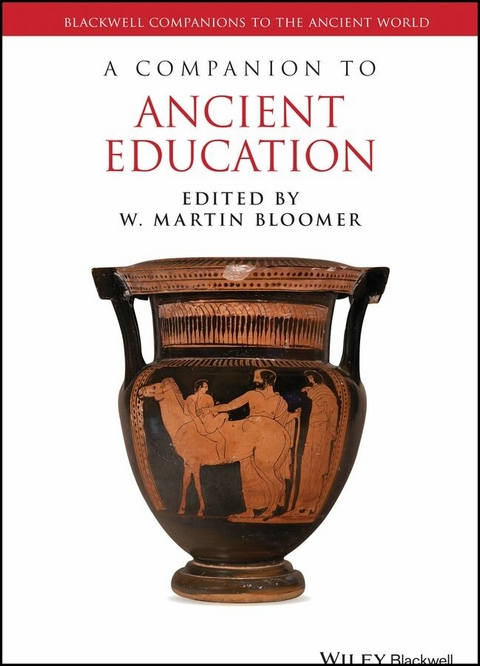
A Companion to Ancient Education (eBook)
John Wiley & Sons (Verlag)
978-1-118-99741-3 (ISBN)
A Companion to Ancient Education presents a series of essays from leading specialists in the field that represent the most up-to-date scholarship relating to the rise and spread of educational practices and theories in the ancient Greek and Roman worlds.
- Reflects the latest research findings and presents new historical syntheses of the rise, spread, and purposes of ancient education in ancient Greece and Rome
- Offers comprehensive coverage of the main periods, crises, and developments of ancient education along with historical sketches of various educational methods and the diffusion of education throughout the ancient world
- Covers both liberal and illiberal (non-elite) education during antiquity
- Addresses the material practice and material realities of education, and the primary thinkers during antiquity through to late antiquity
W. Martin Bloomer is Professor of Classics and Director of the Ph.D. Program in Literature at the University of Notre Dame. His publications include Valerius Maximus and the Rhetoric of the New Nobility (1993), Latinity and Literary Society at Rome (1997), The Contest of Language (2005), and The School of Rome (2011).
A Companion to Ancient Education presents a series of essays from leading specialists in the field that represent the most up-to-date scholarship relating to the rise and spread of educational practices and theories in the ancient Greek and Roman worlds. Reflects the latest research findings and presents new historical syntheses of the rise, spread, and purposes of ancient education in ancient Greece and Rome Offers comprehensive coverage of the main periods, crises, and developments of ancient education along with historical sketches of various educational methods and the diffusion of education throughout the ancient world Covers both liberal and illiberal (non-elite) education during antiquity Addresses the material practice and material realities of education, and the primary thinkers during antiquity through to late antiquity
W. Martin Bloomer is Professor of Classics and Director of the Ph.D. Program in Literature at the University of Notre Dame. His publications include Valerius Maximus and the Rhetoric of the New Nobility (1993), Latinity and Literary Society at Rome (1997), The Contest of Language (2005), and The School of Rome (2011).
Notes on Contributors viii
Introduction 1
W. Martin Bloomer
PART I Literary and Moral Education in Archaic and Classical Greece 5
1 Origins and Relations to the Near East 7
Mark Griffith
2 The Earliest Greek Systems of Education 26
Mark Griffith
PART II Accounts of Systems 61
3 Sophistic Method and Practice 63
David Wolfsdorf
4 Socrates as Educator 77
David K. O'Connor
5 Spartan Education 90
Anton Powell
6 Athens 112
David M. Pritchard
7 Hellenistic and Roman Philosophy 123
Gretchen Reydams?-Schils
PART III The Spread and Development of Greek Schooling in the Hellenistic Era 135
8 Learning to Read and Write 137
William A. Johnson
9 School Structures, Apparatus, and Materials 149
Raffaella Cribiore
10 The Progymnasmata and Progymnasmatic Theory in Imperial Greek Education 160
Robert J. Penella
11 The Ephebeia in the Hellenistic Period 172
Nigel M. Kennell
12 Corporal Punishment in the Ancient School 184
W. Martin Bloomer
PART IV The Roman Transformation 199
13 Etruscan and Italic Literacy and the Case of Rome 201
Daniele F. Maras
14 Schools, Teachers, and Patrons in Mid?-Republican Rome 226
Enrica Sciarrino
15 The Education of the Ciceros 240
Susan Treggiari
16 Late Antiquity and the Transmission of Educational Ideals and Methods: The Greek World 252
Elzbieta Szabat
17 Late Antiquity and the Transmission of Educational Ideals and Methods: The Western Empire 267
Ilaria L. E. Ramelli
PART V Theories and Themes of Education 279
18 The Persistence of Ancient Education 281
Robin Barrow
19 The Education of Women in Ancient Rome 292
Emily A. Hemelrijk
20 The Education of Women in Ancient Greece 305
Aleksander Wolicki
21 Isocrates 321
James R. Muir
22 Plutarch 335
Sophia A. Xenophontos
23 Quintilian on Education 347
W. Martin Bloomer
24 Challenges to Classical Education in Late Antiquity: The Case of Augustine of Hippo 358
Hildegund Müller
PART VI Non?-Literary and Non?-Elite Education 373
25 Education in the Visual Arts 375
J. J. Pollitt
26 Mathematics Education 387
Nathan Sidoli
27 Musical Education in Greece and Rome 401
Stefan Hagel and Tosca Lynch
28 Medicine 413
Herbert Bannert
29 Sport and Education in Ancient Greece and Rome 430
Sarah C. Murray
30 Roman Legal Education 444
Andrew M. Riggsby
31 Toys and Games 452
Leslie J. Shumka
32 Slaves 464
Kelly L. Wrenhaven
33 Masters and Apprentices 474
Christian Laes
34 Military Training 483
Preston Bannard
Index 496
Notes on Contributors
Preston Bannard earned his MA in Classics from the University of Virginia after graduating from Princeton University. He currently teaches Latin at The Baldwin School in Bryn Mawr, Pennsylvania, and serves as the Department Chair for Foreign Languages.
Herbert Bannert teaches Greek and Latin literature and culture at the University of Vienna, Austria. His research interest ranges over Greek epics from Homer to Nonnus of Panopolis, Greek tragedy, ancient historiography, and ancient texts on medicine and alimentation. Recent publications include introductions to Homeric poetry (Homer, Hamburg: Rowohlt Verlag, eighth edition 2005; Homer lesen, Stuttgart-Bad Cannstatt: frommann-holzboog 2005) and a new German translation and interpretation of Sophocles’ Oedipus Tyrannus (Sophokles, König Ödipus: Vatermörder und Retter der Polis, Vienna 2013).
Robin Barrow read Classics and Philosophy at the University of Oxford. He has a PhD from the University of London for his thesis on Plato’s moral and political philosophy and its consequences for education. He has taught both classics and philosophy throughout his career as Assistant Master at the City of London School, Reader at the University of Leicester, and Professor at Simon Fraser University. He is the author of more than twenty-five books and one hundred articles in the fields of classics, philosophy, and education. He was Dean of Education at Simon Fraser University from 1992 to 2002. In 1996 he was elected a Fellow of the Royal Society of Canada.
W. Martin Bloomer is Professor of Classics and director of the PhD in Literature program at the University of Notre Dame. He is a scholar of Roman literature, ancient rhetoric, and the history of education. His books include Valerius Maximus and the Rhetoric of the New Nobility (Chapel Hill 1993), Latinity and Literary Society at Rome (Philadelphia 1997), The Contest of Language (Notre Dame 2005), and The School of Rome (University of California Press 2011).
Raffaella Cribiore is Professor of Classics at New York University. She is a specialist in education in the Greek and Roman worlds, papyrology, and ancient rhetoric. She has written three books on ancient education: Writing, Teachers and Students in Greco-Roman Egypt (Atlanta 1996); Gymnastics of the Mind: Greek Education in Hellenistic and Roman Egypt (Princeton 2001), which won the prestigious Goodwin Award of the American Philological Association in 2004; and The School of Libanius in Late Antique Antioch (Princeton 2007). She also coauthored with R.S. Bagnall the book Women’s Letters in Ancient Egypt: 300 BC-AD 800 (Ann Arbor 2006). Her last book came out at the end of 2013 with Cornell University Press: Libanius the Sophist: Rhetoric, Reality and Religion in the Fourth Century.
Mark Griffith is Professor of Classics, and of Theater, Dance, and Performance Studies, at the University of California, Berkeley. He received his PhD in Classics from Cambridge University. He has worked primarily on Greek drama, with commentaries on Prometheus Bound and Antigone (Cambridge 1999), a book on Aristophanes’ Frogs (Oxford 2013), and numerous articles. He has also published articles on Hesiod, Greek lyric poetry, and ancient Greek education, and is currently working on the sociology of ancient Greek music.
Stefan Hagel, classicist, software designer, and Musical Archaeologist, holds a research post at the Austrian Academy of Sciences. Recent publications include Ancient Greek Music: A New Technical History (Cambridge 2009).
Emily A. Hemelrijk is a professor of Ancient History at the University of Amsterdam. Her research focuses on Roman women. Recent books include Matrona Docta: Educated Women in the Roman Elite from Cornelia to Julia Domna (London 1999/2004) and—with Greg Woolf—the edited volume on Women and the Roman City in the Latin West (Leiden 2013). She is currently preparing a monograph on Hidden Lives—Public Personae. Women and Civic Life in Italy and the Latin West during the Roman Principate.
William A. Johnson, Professor of Classical Studies at Duke University, works broadly in the cultural history of Greece and Rome. He has lectured and published on Plato, Hesiod, Herodotus, Cicero, Pliny (both Elder and Younger), Gellius, Lucian, and on a variety of topics relating to books and readers, both ancient and modern. Recent work has focused on establishing deep contextualization for specific ancient reading communities, with particular attention to the relationship between literary texts and social structure. His books include Readers and Reading Culture in the High Empire, A Study of Elite Reading Communities (Oxford 2010); Ancient Literacies (with Holt Parker; Oxford 2009); and Bookrolls and Scribes in Oxyrhynchus (Toronto 2004).
Nigel M. Kennell is the author of The Gymnasium of Virtue (Chapel Hill 1995) and Spartans (Chichester 2010). He has published numerous articles on Spartan history and Greek citizen training systems. He has held research positions with the Institute for Advanced Study at Princeton, the Collège de France, and All Souls College, Oxford. After working for ten years as an instructor at the International Center for Hellenic and Mediterranean Studies in Athens, Greece, and as a member of the American School of Classical Studies at Athens, he is presently associated with the Department of Classical, Near Eastern and Religious Studies at the University of British Columbia.
Christian Laes is Associate Professor of Ancient History at the University of Antwerp (Belgium), and Adjunct Professor of Ancient History at the University of Tampere (Finland). He has published five monographs, three edited volumes and over sixty international contributions on the human life course in Roman and Late Antiquity. Childhood, youth, old age, family, marriage and sexuality as well as disabilities are the main focuses of his scholarly work. From 2014–2016, he is a Senior Fellow at the Institute of Advanced Social Research, University of Tampere.
Tosca Lynch holds degrees in Classical Piano and Ancient Philosophy. She is currently specializing in Classics at the University of St Andrews and works on Plato’s ethical and aesthetical conceptions of music.
Daniele F. Maras is Corresponding Fellow of the Pontificia Accademia Romana di Archeologia. After obtaining his PhD in Archaeology (2002), he taught Etruscan and Italic Epigraphy at La Sapienza University of Rome from 2006 to 2010. Since 2010, he has been a member of the Board of Teachers for the PhD in Linguistic History of the Ancient Mediterranean at the IULM University of Milan. Apart from a steady series of contributions in peer-reviewed journals and edited volumes, he has authored the volume Il dono votivo. Gli dei e il sacro nelle iscrizioni etrusche di culto (Pisa 2009), and, with G. Colonna, Corpus Inscriptionum Etruscarum, II.1.5 (Veii and the Faliscan area) (Rome 2006).
James R. Muir received his DPhil from the University of Oxford, and has taught at Oxford, and King’s College, Dalhousie University. He is presently Associate Professor of Philosophy at the University of Winnipeg, where he was awarded the Robson Award for Excellence in Teaching. His research examines the relationship between the Isocratic and Platonic traditions in the history of political and educational thought.
Hildegund Müller is an editor of Latin Patristic texts, among others of Augustine’s Psalm sermons (Enarrationes in Psalmos 51–60; 61–70 forthcoming), and most recently of the Vita (vel Regula) Pacomii iunioris (together with Albrecht Diem, forthcoming). She has worked on late ancient sermons and Christian poetry of Late Antiquity and the Middle Ages. Her current research project is a comprehensive study of Augustine’s preaching.
Sarah C. Murray is a cultural historian and archaeologist specializing in the Greek Late Bronze and Early Iron Ages. She completed her dissertation on change in the nature and scale of trade after the collapse of the Mycenaean palaces and received her PhD from Stanford University in 2013. She is the author of publications on Greek religion, athletics, and archaeology and is currently Assistant Professor of Classics at the University of Nebraska.
David K. O’Connor is a faculty member in the departments of Philosophy and of Classics at the University of Notre Dame. His teaching and writing focus on ancient philosophy, ethics, and philosophy and literature. His essays have appeared in the Cambridge Companion to Plato’s Republic and the Cambridge Companion to Socrates, and he edited with notes and an introductory essay Percy Shelley’s translation of Plato’s Symposium. He recently published his online lecture course Ancient Wisdom and Modern Love in a Chinese translation.
Robert J. Penella earned a PhD in classics at Harvard University in 1971. He is Professor of Classics at Fordham University, New York, and has held Guggenheim and National Endowment for the Humanities fellowships. His most recent books are The Private Orations of Themistius (Berkeley and Los Angeles 2000) and Man and the Word: The Orations of Himerius (Berkeley and Los Angeles 2007). He is the contributing editor of Rhetorical Exercises from Late Antiquity: A...
| Erscheint lt. Verlag | 23.6.2015 |
|---|---|
| Reihe/Serie | Blackwell Companions to the Ancient World |
| Blackwell Companions to the Ancient World | Blackwell Companions to the Ancient World |
| Sprache | englisch |
| Themenwelt | Literatur |
| Geschichte ► Allgemeine Geschichte ► Altertum / Antike | |
| Geisteswissenschaften ► Sprach- / Literaturwissenschaft ► Anglistik / Amerikanistik | |
| Geisteswissenschaften ► Sprach- / Literaturwissenschaft ► Literaturwissenschaft | |
| Sozialwissenschaften ► Pädagogik | |
| Schlagworte | Altertum • Ancient Culture • Ancient education, classical education, ancient literacy, Ancient Greece, Ancient Rome, antiquity, late antiquity, Socrates, Socratic method • Bildungswesen • Classical Studies • Education • Education Special Topics • Geschichte • History • History Special Topics • Humanistische Studien • Klassisches Altertum • Spezialthemen Bildungswesen • Spezialthemen Geschichte |
| ISBN-10 | 1-118-99741-7 / 1118997417 |
| ISBN-13 | 978-1-118-99741-3 / 9781118997413 |
| Informationen gemäß Produktsicherheitsverordnung (GPSR) | |
| Haben Sie eine Frage zum Produkt? |
 EPUB (Adobe DRM)
Kopierschutz: Adobe-DRM
Adobe-DRM ist ein Kopierschutz, der das eBook vor Mißbrauch schützen soll. Dabei wird das eBook bereits beim Download auf Ihre persönliche Adobe-ID autorisiert. Lesen können Sie das eBook dann nur auf den Geräten, welche ebenfalls auf Ihre Adobe-ID registriert sind.
Details zum Adobe-DRM
Dateiformat: EPUB (Electronic Publication)
EPUB ist ein offener Standard für eBooks und eignet sich besonders zur Darstellung von Belletristik und Sachbüchern. Der Fließtext wird dynamisch an die Display- und Schriftgröße angepasst. Auch für mobile Lesegeräte ist EPUB daher gut geeignet.
Systemvoraussetzungen:
PC/Mac: Mit einem PC oder Mac können Sie dieses eBook lesen. Sie benötigen eine
eReader: Dieses eBook kann mit (fast) allen eBook-Readern gelesen werden. Mit dem amazon-Kindle ist es aber nicht kompatibel.
Smartphone/Tablet: Egal ob Apple oder Android, dieses eBook können Sie lesen. Sie benötigen eine
Geräteliste und zusätzliche Hinweise
Buying eBooks from abroad
For tax law reasons we can sell eBooks just within Germany and Switzerland. Regrettably we cannot fulfill eBook-orders from other countries.
aus dem Bereich