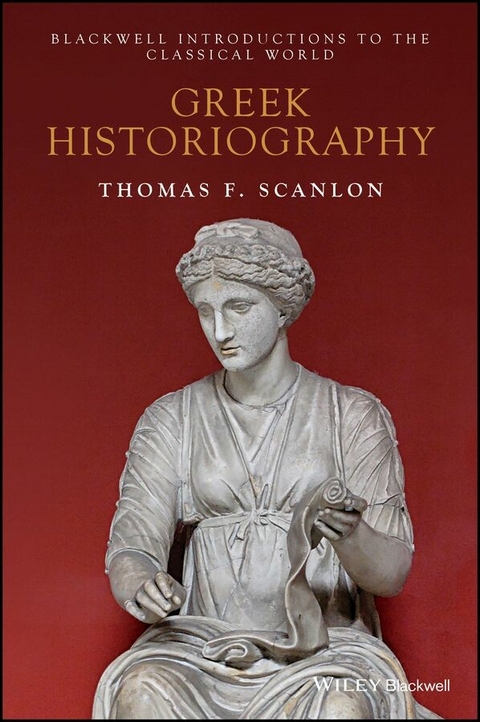
Greek Historiography (eBook)
John Wiley & Sons (Verlag)
978-1-119-08580-5 (ISBN)

Thomas F. Scanlon is Professor of Classics and Chair of the Department of Comparative Literature and Foreign Languages at the University of California, Riverside. He has published several books on Greek and Roman history, including most recently Sport in the Greek and Roman Worlds (2014) and Eros and Greek Athletics (2002).
Preface vi
Abbreviations ix
Chapter 1: Origins and Early Forms of Greek Historiography 1
Chapter 2: Herodotus and the Limits of Happiness: Beyond Epic, Lyric, and Logography 26
Chapter 3: Thucydides on the Ends of Power 69
Chapter 4: Xenophon on Leadership and Moral Authority 126
Chapter 5: History and Rhetoric in Fourth?]Century Historians 160
Chapter 6: Diversity and Innovation in the Hellenistic Era 190
Chapter 7: Polybius on the Supremacy of a Balanced State 202
Chapter 8: Greek Historians in the Roman Era 237
Chapter 9: Concluding Observations on Greek Historical Writing 276
Further Reading 291
Index Locorum 300
Index 317
1
Origins and Early Forms of Greek Historiography
Prologue
Two famous passages from Thucydides’ History, written between the late 430s and the early 390s BC, set out several themes common to the ancient Greek historians.
In the light of the evidence I have cited, however, no one would go wrong in supposing that the early events I have related happened much in that way, if one would not believe that the past was more like what the poets have sung, embellishing with their exaggerations, or the prose chroniclers have composed, in versions more seductive to the ear than true, being unexamined and many because of the lapse of time incredibly winning the status of patriotic legend, but if one would regard my discoveries from the clearest possible evidence as adequate for what concerns antiquity.
(Th. 1.21.1, Lattimore, adapted)
For [Athens] alone of existing cities surpasses her reputation when put to the test … Through great proofs, and by exhibiting power in no way unwitnessed, we will be admired by this and future generations, thus requiring no Homer to sing our praises nor any other whose verses will charm for the moment and whose claims the factual truth will destroy, since we have compelled every sea and land to become open to our daring and populated every region with lasting monuments of our acts of harm and good.
(Th. 2.41.3–4, Lattimore)
The first quotation, a conclusion to Thucydides’ introductory summary of earlier history, evidences direct competition with earlier poetic and prose versions of the Greek past and asserts the superiority of his narrative to those of poets and prose “story writers” (logographoi) (Marincola 1997: Chapter 5, on the topos). It contrasts both poetic exaggeration or adornment and the persuasive power of popular prose stories with Thucydides’ principles of clear evidence (sēmeia). The second passage, from Pericles’ funeral oration, illustrates the monumental product of history through the example of Athens itself. From it we see that fame attested by proofs (sēmeia) and preserved through memory is of paramount importance to Greek culture, that truth witnessed or supported by evidence is superior to poetic fiction, and that demonstrations of power ensure memory in posterity. Power is a central theme: its acquisition and loss and the human attraction to it and admiration for it. How will future generations receive the message of dynamic achievements in the absence of poetic commemoration? Implicitly Pericles’ own speech and the historian’s account, together, ensure that the monuments – literally, “memorials” (mnēmeia) – will not be forgotten. (“We are irresistibly reminded of 1.22.1 with its dismissal of what the poets have sung about; also surely of 1.22.4 with its contrast between Thucydides’ own permanent but superficially unpleasing work … and prize competitions designed for the immediate moment”: Hornblower 1997 ad l.; see also Gomme 1956 ad l. and Lattimore 1998.)
The Western tradition has for centuries shared the foundational elements exemplified in these passages: preservation of the past, inspiration for the present, and a claim to truth. Thucydides’ challenge to earlier tradition is also characteristic of an agonistic impulse among historians who forged the genre before him, most notably Herodotus (480s–420s BC) and, even earlier, Hecataeus (late sixth–early fifth century BC). The challenge was inevitable in the highly dynamic period of the beginnings of historical writing in the fifth century and earlier. Oral and written media in literature, local traditions, and budding empirical studies all coexisted and vied for attention. Genres were far less well defined in fifth-century Greece than in the following centuries. For example, drama, victory odes, new forms of lyric poetry, and philosophy or protoscience in verse and prose were all first evidenced from the mid-sixth to the mid-fifth centuries, prior to Herodotus’ and Thucydides’ compositions. Prose was especially fluid in content and form and was influenced by contemporary verse traditions in this progressive period. The earliest “historical” texts (by today’s definition of empirical studies of people and places over time) depended heavily, but not exclusively, on purely oral sources of myth, folklore, or popular local traditions transmitted in verse or prose. These points will be explored below. Historical writing was a highly innovative enterprise in this first century of its existence, and we now turn to an examination of how it got to the point where Herodotus received it.
Choosing and Using History
Before turning to the complex shapes of pre-Herodotean tradition, we ask an obviously prior question about the meaning(s) of “history” common to the ancients and ourselves. Modern cynical wit sees history as nothing but a fiction, a hypocrisy, a litmus test for repeated human folly, or a tool for political control:
History is a set of lies, agreed upon. (Napoleon)
History is the nightmare from which we are trying to awaken. (James Joyce)
History would be a wonderful thing, if it were only true. (Tolstoy)
We learn from history that we do not learn from history. (Hegel)
Who controls the past controls the future: who controls the present controls the past. (G. Orwell)
The genre’s promise of truth inevitably provokes aphorisms alleging bias. Yet the skeptical impulse is a productive one, with an ancient pedigree reaching at least to Hecataeus in 500 BC. One scholar began his study of the philosophy of history with a bleak observation: “The future is dark, the present burdensome; only the past, dead and finished, bears contemplation” – (Elton 2002: 1) to which he added:, “Like Oedipus we are dissatisfied with stories and seek our true parentage.” The past can best explain our identity in relation to that of others in the present and can help us anticipate or even shape the future. (For a good sourcebook of quotations from modern intellectuals and scholars on select themes, see Morley 1999.)
The meaning of history depends upon its perceived function. Is history written to uncover a universally objective truth? Or is all history a verbal fiction, a “literary artifact,” to use Hayden White’s phrase, inevitably bound to the subjective aims of the author and culture in which it was formulated? (White 1978: 81–100; see Morley 1999: 97–131; on postmodern theory and Roman historians, Batstone 2009). One need not subscribe to any particular postmodern critical theory to make the simple observation that everything is political in the realm of human discourse. Universally shared absolutes of meaning and absolute objectivity are evanescent ideals that are reasonably embraced by groups and individuals, but they are rarely globally agreed upon. So social and cultural meaning arises from the discourse or dialogue among a multiplicity of views. One description of the current orientation to history as framed in literary studies is that of “the historicity of texts and the textuality of history” (Montrose 1998: 781). Otherwise stated, all texts, be they ancient and modern, primary and secondary, are embedded in social and cultural contexts. Our access to a historical past as a lived experience must be mediated by documents, monuments, and other forms of evidence as they happen to be preserved. In short, literature, including historical writing, is both socially produced and socially productive (Montrose 1998). In our review of ancient Greek historical writing, it will be useful to keep in mind this quality of texts being socially embedded and to ask how literary content, together with social context (both ancient and modern), determines the meaning of each text. Connor, for example, shows how Thucydides warned his contemporaries of the breakdown of traditional values and social order in the violent context of war, and how modern scholarship responded to these same themes with a torrent of scholarship in the Cold War and then in the post-Vietnam and postmodernist eras. Now Herodotus has enjoyed a renaissance among classical scholars in recent decades not least because of his constant reinforcement of respect for cultural diversity.
One useful definition of history common to both ancient and modern cultures is “writing about the past, selectively and with a purpose” (proposed by John Crook at a seminar I attended on “Society and the Ancient Historian” at the University of Cambridge, in winter 1977). Selection is of course dictated not only by the body of available evidence selectively preserved or eliminated over time, but by the active choice of the author from among that material. Whether a Greek historian has relied upon written documents, other narrative accounts, oral tradition, or personal observation and interview, that author inevitably must choose to include certain aspects and exclude others. He includes, excludes, and thereby imposes his own principles of valuation of the material with every sentence. In this sense, the historian can be as much a literary artist as a novelist or playwright who chooses a historical topic. Yes, certain fundamental events and participants must be acknowledged, but within those constraints a huge amount of creative description and emphasis is possible.
Our understanding of...
| Erscheint lt. Verlag | 25.6.2015 |
|---|---|
| Reihe/Serie | Blackwell Introductions to the Classical World |
| Blackwell Introductions to the Classical World | Blackwell Introductions to the Classical World |
| Sprache | englisch |
| Themenwelt | Geisteswissenschaften ► Geschichte ► Allgemeines / Lexika |
| Geschichte ► Allgemeine Geschichte ► Vor- und Frühgeschichte | |
| Geisteswissenschaften ► Geschichte ► Regional- / Ländergeschichte | |
| Geisteswissenschaften ► Sprach- / Literaturwissenschaft ► Anglistik / Amerikanistik | |
| Geisteswissenschaften ► Sprach- / Literaturwissenschaft ► Latein / Altgriechisch | |
| Geisteswissenschaften ► Sprach- / Literaturwissenschaft ► Literaturwissenschaft | |
| Sozialwissenschaften ► Soziologie ► Gender Studies | |
| Schlagworte | Ancient & Classical History • ancient civilizations • Ancient Greece • Ancient history • Appian • Arrian • Classical Greek Literature • Classical Studies • classics • Dio Cassius • Diodorus Siculus • Dionysius of Halicarnassus • Ephorus • Fabius Pictor • Geschichte • Geschichte des Altertums u. der klassischen Antike • greek historians • Greek History • Hecataeus • Hellanicus • hellenistic era • Herodotus • Historical Methods & Historiography • Historiographie • History • Humanistische Studien • Josephus • Klassische griechische Literatur • Methoden der Geschichtsforschung u. Geschichtsschreibung • Polybius • Posidonius • Roman History • the Atthidographers • the logographers • Theopompus • the Oxyrhynchus Historian • Thucydides • Timaeus • Xenophon |
| ISBN-10 | 1-119-08580-2 / 1119085802 |
| ISBN-13 | 978-1-119-08580-5 / 9781119085805 |
| Informationen gemäß Produktsicherheitsverordnung (GPSR) | |
| Haben Sie eine Frage zum Produkt? |
 EPUB (Adobe DRM)
Kopierschutz: Adobe-DRM
Adobe-DRM ist ein Kopierschutz, der das eBook vor Mißbrauch schützen soll. Dabei wird das eBook bereits beim Download auf Ihre persönliche Adobe-ID autorisiert. Lesen können Sie das eBook dann nur auf den Geräten, welche ebenfalls auf Ihre Adobe-ID registriert sind.
Details zum Adobe-DRM
Dateiformat: EPUB (Electronic Publication)
EPUB ist ein offener Standard für eBooks und eignet sich besonders zur Darstellung von Belletristik und Sachbüchern. Der Fließtext wird dynamisch an die Display- und Schriftgröße angepasst. Auch für mobile Lesegeräte ist EPUB daher gut geeignet.
Systemvoraussetzungen:
PC/Mac: Mit einem PC oder Mac können Sie dieses eBook lesen. Sie benötigen eine
eReader: Dieses eBook kann mit (fast) allen eBook-Readern gelesen werden. Mit dem amazon-Kindle ist es aber nicht kompatibel.
Smartphone/Tablet: Egal ob Apple oder Android, dieses eBook können Sie lesen. Sie benötigen eine
Geräteliste und zusätzliche Hinweise
Buying eBooks from abroad
For tax law reasons we can sell eBooks just within Germany and Switzerland. Regrettably we cannot fulfill eBook-orders from other countries.
aus dem Bereich