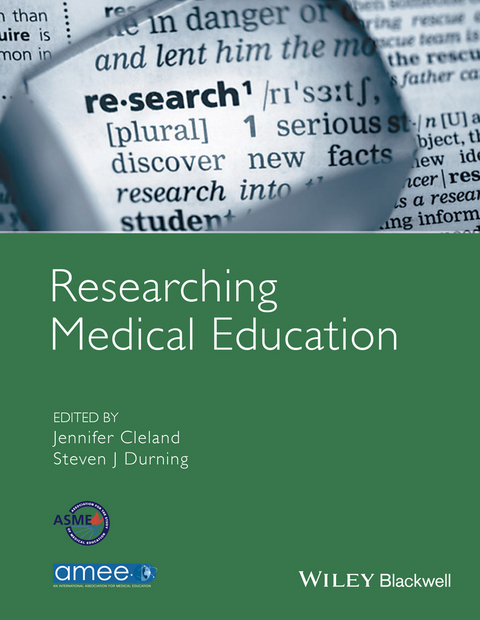
Researching Medical Education (eBook)
John Wiley & Sons (Verlag)
978-1-118-83918-8 (ISBN)
Researching Medical Education is an authoritative guide to excellence in educational research in the health professions. Presented by the Association for the Study of Medical Education and the Association for Medical Education in Europe, Researching Medical Education includes contributions from a team of international clinicians and non-clinical researchers in health education, representing a range of disciplines and backgrounds.
This accessible reference provides readers with the basic building blocks of research, introduces a range of theories and how to use them, illustrates a diversity of methods and their use, and gives guidance on practical researcher development.
By linking theory and design and methods across the health profession education research spectrum, this book supports the improvement of quality, capacity building and knowledge generation. Researching Medical Education is the ideal resource for anyone researching health education, from undergraduate, through postgraduate training, to continuing professional development.
Professor Jennifer Cleland is John Simpson Chair of Medical Education, University of Aberdeen, and Chair, Association for the Study of Medical Education (ASME)
Professor Steven J. Durning is Professor of Medicine and Pathology, Uniformed Services University, Bethesda, and Chair, Association for Medical Education Europe (AMEE) Research Group
Professor Jennifer Cleland is John Simpson Chair of Medical Education, University of Aberdeen, and Chair, Association for the Study of Medical Education (ASME) Professor Steven J. Durning is Professor of Medicine and Pathology, Uniformed Services University, Bethesda, and Chair, Association for Medical Education Europe (AMEE) Research Group
A refreshing scholarly milestone, comprehensively synthesizing the evidence of research in medical education. A true inspiration for innovating our educational practices. (Cees van der Vleuten, Scientific Director of the Graduate School of Health Professions Education, Maastricht University, The Netherlands)
This is a book of immense scope and rich in diverse range of topics written by contemporary thought leaders in medical education. It bridges the theory and practice of medical education research from a global perspective. (Zubair Amin, Associate Professor of Pediatrics and Medical Educator, National University of Singapore)
Balancing the complexities and practicalities of medical education research is a challenging task. Researching Medical Education strikes that balance by providing theoretical frameworks, practical tips and examples of best research practices; essential reading for anyone engaged in rigorous educational research in the health professions. (David M. Irby, Professor of Medicine at University College San Francisco)
Preface
The intent of Researching Medical Education is to provide an authoritative guide to promote excellence in educational research in the healthcare professions (which includes medicine, nursing, dentistry and other fields).
Rigorous and original educational research in healthcare professions is critical to the future of healthcare education and, hence, ultimately, patient care. By encouraging thinking, discovery, evaluation, innovation, teaching, learning and improvement via research, the gaps between best practice and what actually happens in medical (and other healthcare professions) education can be addressed. In this way, knowledge can inform and advance education and practice, while education and practice can, in turn, inform and advance future research.
We have to ask the right questions, and answer them in the right way for a field of research to progress. To do so requires drawing on not just the existing education literature in healthcare professions but also the broader educational, sociological, cognitive and psychological literatures. These open our minds to different ways of thinking and working via different theories and methods, and different perspectives on the fundamental nature of research. To this end, our objectives in Researching Medical Education are to provide readers with the basic building blocks of research, introduce a range of theories and how to use a theory to underpin research, provide examples and illustrations of a diversity of methods and their use and, finally, give guidance on developing your practice as a researcher. By linking theory and design and methods across the context of educational research in healthcare professions, this book supports the improvement of quality, capacity building and knowledge generation within our field. This moves the focus of our work from local evaluation, assessment and audit to considering problems more generally, in terms of how they may contribute to new knowledge about learning, teaching and education.
There are many textbooks available that introduce theories, research designs and methodologies relevant to educational research in healthcare professions. However, most are not written specifically with this field of enquiry in mind and this can limit their impact. In contrast, this textbook is embedded with healthcare profession education and is illustrated throughout with examples from healthcare education and from selection to learning and teaching to professional development, drawn from international settings, using language and metaphors accessible to those working in, and wishing to work in, educational research. Reflecting our own backgrounds and the relationship of this book with the immensely successful Understanding Medical Education, the majority of examples are drawn from medical education. However, the aims and objectives of the book, and its key messages, are generalisable across any healthcare profession, or indeed any other profession, where learning knowledge, skills and attitudes are central to professional development.
Researching Medical Education provides a guide for Masters and PhD students in healthcare profession education and their supervisors; those who are new to the field, those who are generally inexperienced in research, those who are new to the field of educational research but have prior research experience in the clinical or biomedical domains and experienced researchers seeking to explore new ways of thinking and working. With this broad audience in mind, we have designed the book to be of value to degree programme students and faculty; those juggling a portfolio of clinical work, teaching and research; and those few whose sole focus is research. To achieve these objectives, our authors are a blend of clinicians and PhD researchers in healthcare profession education, representing a range of disciplines and backgrounds. Their contributions provide a blueprint of how to pose and address research questions, illustrated by practical examples – from the straightforward to the aspirational. Many examples are to illustrate how medical education and related research are currently progressing knowledge in the field. International examples help ensure that the messages in this textbook are relevant to all healthcare profession educators even though the structures, systems and processes of healthcare delivery and education vary across countries.
Researching Medical Education is presented in three sections. The first is labelled ‘A primer of healthcare education research’. This section systematically introduces the initial steps in the research process. It starts with a broad overview of the two main research philosophies relevant to the educational research in healthcare professions and how these differ in terms of assumptions about the world, about how science should be conducted and about what constitutes legitimate problems, solutions and criteria from Cleland. McMillan then considers the influence of the individual researcher's preferences or ‘worldview’ on the research process, and introduces and explains the critical concepts of ontology, epistemology and reflexivity in research. Wong introduces the next step in the research process, of identifying, then critically examining, the quality, methodological and/or theoretical contribution of the existing literature on a particular topic, and explains the different purposes and approaches to producing a literature review. In the fourth chapter, Bezuidenhout and van Schalkwyk describe how to move from an idea or a problem to formulating a research question, using the analogy of distillation and concrete worked examples to illustrate the steps in this process. Following on from this, Stansfield and Gruppen discuss how to conduct a power analysis to help ensure your quantitative study has an adequate number of participants to find effects such as the impact of an intervention, an educational outcome or the relationship between variables.
The next section of Researching Medical Education introduces theory, of the utmost importance in terms of providing a solid foundation to any research. A good theory (one which is internally consistent and coherent) should describe, explain, enable explanations (not just the what, but the why and the how) and yield testable hypotheses or research questions. The use of theory should generate new routes for research – routes that are conceptually related to and build on prior research. Theories can be described in terms of their scope, with wider scopes reflecting generally higher levels of abstraction in the knowledge hierarchy. Mann and Macleod open this section with an introduction to a ‘grand theory’ (a very general theory that provides a framework for the nature and goals of a discipline), that of social constructivism. They promote alignment of worldview, theoretical frameworks and research approaches (methods) in relation to constructivism and its philosophical underpinnings.
This section then introduces a number of specific theories that are intended to guide empirical inquiry, action or practice. We first focus on theories that emphasise the collective, or social, where relationships between context, environment, people and things matter. Fenwick and Nimmo provide an overview of some main ideas shared across different sociomaterial theories and methods, those which foreground materials – bodies, objects, substances, settings, technologies, and so on – to examine how they act with and on the human activity and thought. Bleakley and Cleland focus on complexity theory as an overarching framework to inform and guide how healthcare profession researchers can meaningfully engage with highly complex contexts, such as clinical teams or educational systems, and where the outcomes of interactions are not always predictable. Johnson and Dornan then introduce activity theory, a socio-cultural perspective, which places a person's social and cultural surroundings, and history, as central to what they do. This system-level focus can be used to analyse situations and enable change beyond the individual. We continue with a chapter by Torre and Durning who discuss social cognitive theories, those that consider learning and performance as inherently social and where the uniqueness that each situation brings (in terms of environment, participants, interactions) can often lead to different learning and performance experiences and outcomes. We finish this section with Sweet and Billett who introduce the concept of participatory practices – what opportunities for learning are provided in healthcare workplace settings and how individuals elect to engage in and learn through those practices – for understanding, supporting and developing workplace-based learning.
The next chapters introduce rich families of theories where a number of different theories offer a particular perspective on the same phenomena. This is itself not unusual, but what is of interest is that each topic area encompasses theories that range from those that focus on the individual level (beliefs, processes and/or performance) to theories that offer a social or environmental lens through which to look at the same phenomena. Monrouxe and Rees consider the issues of professional identity and present a range of identity theories, from those that acknowledge that personal identities develop in a social world to individualist approaches that conceptualise identities as personal attributes. Cilliers and colleagues outline a number of different health behaviour theories and illustrate how these can be used as a means of illuminating, explaining and changing behaviour in teaching-learning settings, whether campus-based or...
| Erscheint lt. Verlag | 18.6.2015 |
|---|---|
| Sprache | englisch |
| Themenwelt | Medizin / Pharmazie ► Allgemeines / Lexika |
| Medizin / Pharmazie ► Medizinische Fachgebiete | |
| Medizin / Pharmazie ► Studium | |
| Sozialwissenschaften ► Pädagogik | |
| Schlagworte | Bildungswesen • Education • Educational Research & Statistics • medical education • Medical Professional Development • Medical Science • Medizin • Medizinstudium • Pädagogik • Pädagogik / wissenschaftliche Studien u. Statistik • Pädagogik • Pädagogik / wissenschaftliche Studien u. Statistik • Perspektiven in medizinischen Berufen • researching medical education educational health profession professional association study education theory design methods quality capacity building knowledge generation undergraduate postgraduate development |
| ISBN-10 | 1-118-83918-8 / 1118839188 |
| ISBN-13 | 978-1-118-83918-8 / 9781118839188 |
| Informationen gemäß Produktsicherheitsverordnung (GPSR) | |
| Haben Sie eine Frage zum Produkt? |
 EPUB (Adobe DRM)
Kopierschutz: Adobe-DRM
Adobe-DRM ist ein Kopierschutz, der das eBook vor Mißbrauch schützen soll. Dabei wird das eBook bereits beim Download auf Ihre persönliche Adobe-ID autorisiert. Lesen können Sie das eBook dann nur auf den Geräten, welche ebenfalls auf Ihre Adobe-ID registriert sind.
Details zum Adobe-DRM
Dateiformat: EPUB (Electronic Publication)
EPUB ist ein offener Standard für eBooks und eignet sich besonders zur Darstellung von Belletristik und Sachbüchern. Der Fließtext wird dynamisch an die Display- und Schriftgröße angepasst. Auch für mobile Lesegeräte ist EPUB daher gut geeignet.
Systemvoraussetzungen:
PC/Mac: Mit einem PC oder Mac können Sie dieses eBook lesen. Sie benötigen eine
eReader: Dieses eBook kann mit (fast) allen eBook-Readern gelesen werden. Mit dem amazon-Kindle ist es aber nicht kompatibel.
Smartphone/Tablet: Egal ob Apple oder Android, dieses eBook können Sie lesen. Sie benötigen eine
Geräteliste und zusätzliche Hinweise
Buying eBooks from abroad
For tax law reasons we can sell eBooks just within Germany and Switzerland. Regrettably we cannot fulfill eBook-orders from other countries.
aus dem Bereich