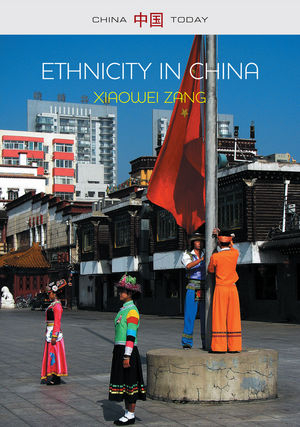
Ethnicity in China: A Critical Introduction (eBook)
John Wiley & Sons (Verlag)
978-0-7456-9045-2 (ISBN)
Xiaowei Zang is Chair Professor of Social Sciences at the City University of Hong Kong
On the global stage, China is often seen to be a homogenous nation when, in fact, it is a diverse multi-ethnic society, with 55 minority nationality groups recognized by the government. Scattered across the vast landmass, ethnic minorities in China occupy a precarious place in the state, where the Confucian concept of cultural community plays down ethnicity and encourages integration of minority nationalities into the majority Han-Chinese society. This insightful book reveals the ethnic diversity underlying the People s Republic of China and examines how ethnicity intersects with social and political issues through key themes such as ethnic inequality, the preservation and contribution of the rich traditions and customs of minority cultures, and the autonomy of regions such as Tibet and Xinjiang. The author investigates the important role of the state and Beijing s assimilation stance to show how its nationality policy, driven by Confucian assimilation ideology, has dictated China s own minority rights regime and influenced its foreign policy towards international minority rights. This book by a distinguished scholar of ethnicity in China will be essential reading for students and scholars of race and ethnic relations, nationalism and Chinese culture and society.
Xiaowei Zang is Chair Professor of Social Sciences at the City University of Hong Kong
Map
Chronology
Preface Acknowledgements
List of Acronyms
1. The People's Republic of China as a Multi-National
Country
2. Ethnic Inequality
3. Minority Cultures
4. Regional Autonomy
5. Intra- and Inter-Group Differences
6. Tibet and Xinjiang
7. China's Nationality Policy and International Minority
Rights
Bibliography
This is an exceptional book on ethnic minorities in the People's Republic of China. Zang is an outstanding authority on the topic, having already written widely on the societies of the Muslim and other minorities. He has an extraordinarily firm grasp both of the primary and secondary literature and has carried out extensive field work on the minorities. We are very fortunate that he has now produced a book with more general coverage of issues concerning the overall picture of China's ethnic minorities. This is a major contribution to the literature on an important topic. I recommend it strongly both for specialists and the general reader.
Colin Mackerras, Griffith University, Queensland, Australia
I am a long-time admirer of Dr. Zang's work. He is a fine theorist and researcher with a knack for spotting important problems and utilizing creative methodologies. His writing is clear and crisp, and students will appreciate his latest treatment of a complex and highly significant topic.
William Jankowiak, University of Nevada
"Xiaowei Zang's book breaks down China's ethnicities' policy and takes the discussion beyond routine 'White Papers' and statistics on the subject. [...]The discussions in chapter five on assimilation, acculturation and differential treatment as regards different ethnic groups, depending on their proximity to the Han culture, is interesting and is also an important aspect of the book. The comparative discussion on Tibet and Xinjiang is useful, as well as intelligently and sensitively done."
Asian Affairs
Preface
Nationality is arguably a product of state building in the West. No such concept existed in pre-modern China, and it was not until the late nineteenth century that it was introduced to China from Japan. It is often translated as minzu (民族) in Chinese, which means ‘a people’ or ‘an ethnic group’. In Chinese, ‘minority nationality’ is called ‘shaoshu minzu’ (少数民族). According to the Chinese government, there are altogether 56 ethnic groups in China. This book is about ethnic minorities in China and their relations to the Chinese state in the context of social and political change since 1949, with the emphasis on the post-1978 era, as market reforms have fundamentally changed the institutional arrangements for ethnic relations in the People's Republic of China (PRC). This book insists that the most important aspect of ethnic relations in China is the relations between the PRC state and the ethnic minorities rather than those between Han Chinese, the ethnic majority group, and the ethnic minority groups. The PRC state created the ethnic divide between Han Chinese and non-Han groups, classifying non-Han groups into different nationality groups and maintaining the ethnic identity of each PRC citizen through the state household registration system and personal identity card (Gladney 1996). There would not be 56 nationality groups in China without the PRC nationality policy. Accordingly, this book focuses on the PRC's nationality policy and its impacts on the ethnic minorities to elucidate ethnic relations in China.
Good knowledge of the ethnic relations is a lens through which one can better understand the political system and patterns of government behaviour in China and how the state defines and represents Chinese nationalism, the ethnic identities of Han Chinese, and the ethnic minority groups (Barabantseva 2008; Gladney 1994). Chinese nationalism, together with economic growth, has become a main pillar of political legitimacy for the Chinese Communist Party (CCP) in the post-1978 era. There are other reasons why the study of ethnic relations in China is important. Firstly, given recent ethnic unrest in some minority regions in China, the Chinese state's capacity for governance has been called into question. The ethnic minority groups were previously seen as vulnerable and subject to dominance or even acculturation by Han culture; today they represent one of the most powerful challenges to the Chinese government (Gladney 1996). Secondly, ethnic relations are no longer an issue solely related to domestic politics in China. Concerns over religious freedom and minority rights in China are presently receiving attention from the international community. This not only raises the profile of such issues within the PRC, but also between and among China and other countries on her borders and with which she does business. For example, China's handling of Uyghurs in Xinjiang has had significant implications for her relations with Muslim majority countries in Asia and the Middle East. Thirdly, China has become an economic superpower and is playing an increasingly important role in international affairs, and there is little doubt that its foreign policy towards minority rights has affected how ethnic conflicts in other parts of the world are resolved.
Thus, how the PRC manages ethnic relations has attracted widespread interest in the West. So far, opinions about ethnic relations in China have varied greatly. It is quite popular among some scholars, commentators and politicians in the West to condemn China's nationality policy and to accuse the PRC of suppressing minority rights and persecuting ‘the ethnic and democratic consciousness of minority nationalities’. Others have asserted that Beijing has paid lip service to minority group rights (Sautman 1999, pp. 283–4). The US Congressional-Executive Commission on China (2005b, p. 2) states that ‘The Chinese Government systematically denies some minorities their legal rights and arbitrarily arrests their members for exercising legally protected freedoms.’ Unsurprisingly, Beijing has categorically rejected these accusations and has tirelessly publicized its efforts to reverse the traditional pattern of marginalization and subordination of ethnic minority groups in China. Former senior Chinese leader Deng Xiaoping claimed with confidence that ‘there has never been any ethnic discrimination’ in China. So did other top Chinese leaders. To them, major ethnic frictions should not exist in China as its nationality policy is benevolent, and if bad things happen, they must be caused by ‘foreign instigation’ or ‘a handful of splittists’ (Sautman 1997, p. 3).
To help readers find a balanced portrait of ethnic relations in China, a series of questions are asked and answered in the course of this book: What is the guiding ideology for Beijing's nationality policy? What has Beijing done to protect minority cultures and languages and how has it done this? Has the PRC earnestly promoted multiculturalism or actively pursued the assimilation of its ethnic minority groups? Economically, have the minority nationality groups become better off or worse off after 1978? Are equal opportunity programmes effective in reducing ethnic gaps in schooling, employment and income? Is ethnic inequality growing or declining in the post-1978 era? What does regional autonomy mean to the ethnic minority groups in the PRC? How much executive, legislative and judiciary power do ethnic minority groups have in minority areas under the jurisdiction of regional autonomy? Why have ethnic tensions in Tibet and Xinjiang been growing in the post-1978 era? What has the PRC done to reduce ethnic tensions, and are these measures sufficient and effective? What does the PRC think of minority rights when it engages with the outside world? Why is there a gap between Beijing's nationality policy and the international minority rights regime? Will the PRC modify or change its nationality policy and move closer to global norms on minority rights?
In this book, I address these questions using insights from both historical and cultural perspectives on ethnic relations in China, particularly the impact of Confucian assimilative legacies on the PRC nationality policy. I find it productive to conceptualize pre-modern China as a cultural sphere when discussing ethnic relations. Drawing on the hierarchal relations between Han civilization and those of non-Han peoples, and the age-old distinction between cooked (i.e., acculturated) barbarians and raw or uncooked (i.e., unacculturated) barbarians in the pre-1949 era, I emphasize continuity in the evolution of the sinocentric relations between Han Chinese and non-Han groups, from Confucius to Dr Sun Yat-sen and all the way to Mao Zedong, Deng Xiaoping and current Chinese leaders. A central theme that links China's past with current PRC nationality policy in this book is the Confucian ideology of ronghe, which promotes and celebrates minority acculturation and eventual assimilation into Han society (see chapter 1).
Chapter 1 examines the basic facts about ethnic demographics in the PRC before discussing the political origin of the ethnic labels which ethnic minority groups are given by the state. Next, it offers an account of the Ethnic Classification Project conducted in 1953–4 and explains that although the PRC government followed the USSR in initiating this project, it relied on the Chinese scholarship on ethnicity rather than Stalin's nationality criterion. The Ethnic Classification Project took place mainly to address Beijing's need to form a multi-ethnic National People's Congress in an attempt to show off its political legitimacy and mandate to govern China. The PRC's political considerations dictated the process of the classification project, and the input from ethnic minority groups in their identification was minimal. Some existing minority groups were officially recognized, some different minority groups were combined under a single group name through administrative fiat despite vast inter-group differences in language, customs, etc., and some groups were arbitrarily denied the status of minority ethnicity. The ethnic labels that were created in the early 1950s are still used by the PRC state to determine the ethnic identities of the people in China, demonstrating the power of the state over ethnic relations in China.
Chapter 1 also discusses the central theme in Beijing's nationality policy – acculturation and assimilation of the minority nationality groups into Han culture and society despite its effort to promote the image of China as a multicultural country to the outside world. It discusses how the notion of nationality was developed in China at the end of the nineteenth century, how the CCP dealt with the nationality question before 1949, why the CCP regarded the nationality question as an issue of class struggle before 1978, and why the official rhetoric and nationality policy worked in the pre-1978 era. The chapter then outlines drastic changes in China's nationality policy in the post-1978 era and the major efforts the Chinese government has made to reduce inter-group inequality as the means of improving ethnic relations. Finally, it draws attention to the impact of Beijing's assimilation stance on ethnic inequality, the protection of minority cultures, and regional autonomy in the PRC.
Chapter 2 evaluates Beijing's efforts to reduce...
| Erscheint lt. Verlag | 5.6.2015 |
|---|---|
| Reihe/Serie | China Today |
| China Today | China Today |
| Sprache | englisch |
| Themenwelt | Sozialwissenschaften ► Ethnologie ► Völkerkunde (Naturvölker) |
| Sozialwissenschaften ► Politik / Verwaltung | |
| Sozialwissenschaften ► Soziologie | |
| Schlagworte | Asian/Asian-American Studies • Asien-/Asioamerika-Forschung • China • Cultural Studies • Ethnie • Kulturwissenschaften • nationalism, nationality, diversity, race, ethnic relations, inequality, Tibet, Xinjiang, Han, assimilation • Political Sociology • Politische Soziologie • Race & Ethnicity Studies • Rassen- u. Ethnienforschung • Sociology • Soziologie |
| ISBN-10 | 0-7456-9045-9 / 0745690459 |
| ISBN-13 | 978-0-7456-9045-2 / 9780745690452 |
| Informationen gemäß Produktsicherheitsverordnung (GPSR) | |
| Haben Sie eine Frage zum Produkt? |
 EPUB (Adobe DRM)
Kopierschutz: Adobe-DRM
Adobe-DRM ist ein Kopierschutz, der das eBook vor Mißbrauch schützen soll. Dabei wird das eBook bereits beim Download auf Ihre persönliche Adobe-ID autorisiert. Lesen können Sie das eBook dann nur auf den Geräten, welche ebenfalls auf Ihre Adobe-ID registriert sind.
Details zum Adobe-DRM
Dateiformat: EPUB (Electronic Publication)
EPUB ist ein offener Standard für eBooks und eignet sich besonders zur Darstellung von Belletristik und Sachbüchern. Der Fließtext wird dynamisch an die Display- und Schriftgröße angepasst. Auch für mobile Lesegeräte ist EPUB daher gut geeignet.
Systemvoraussetzungen:
PC/Mac: Mit einem PC oder Mac können Sie dieses eBook lesen. Sie benötigen eine
eReader: Dieses eBook kann mit (fast) allen eBook-Readern gelesen werden. Mit dem amazon-Kindle ist es aber nicht kompatibel.
Smartphone/Tablet: Egal ob Apple oder Android, dieses eBook können Sie lesen. Sie benötigen eine
Geräteliste und zusätzliche Hinweise
Buying eBooks from abroad
For tax law reasons we can sell eBooks just within Germany and Switzerland. Regrettably we cannot fulfill eBook-orders from other countries.
aus dem Bereich