


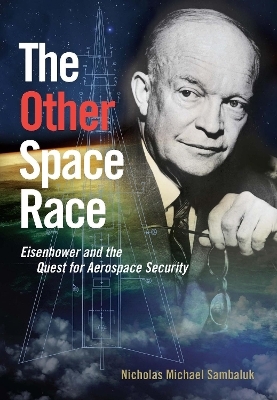
The Other Space Race
Eisenhower and the Quest for Aerospace Security
Seiten
2016
Naval Institute Press (Verlag)
978-1-61251-886-2 (ISBN)
Naval Institute Press (Verlag)
978-1-61251-886-2 (ISBN)
- Titel z.Zt. nicht lieferbar
- Versandkostenfrei
- Auch auf Rechnung
- Artikel merken
Presents a unique look at the early US space programme and how it both shaped and was shaped by politics during the Cold War. This well-argued, well-researched book gives much needed perspective on the Cold War's influence on space travel and it's relation to the formation of public policy.
The Other Space Race is a unique look at the early U.S. space program and how it both shaped and was shaped by politics during the Cold War. Eisenhower's ""New Look"" expanded the role of the Air Force in national security, and ultimately allowed ambitious aerospace projects, namely the ""Dyna-Soar,"" a bomber equipped with nuclear weapons that would operate in space. Eisenhower's space policy was purely practical, creating a strong deterrent against the use of nuclear arms against the United States.
With the Soviet launch of Sputnik in 1957, the political climate changed, and space travel became part of the United States' national discourse. Sambaluk explores what followed, including the scuttling of the ""Dyna-Soar"" program and the transition from Eisenhower's space policy to John Kennedy's. This well-argued, well-researched book gives much needed perspective on the Cold War's influence on space travel and it's relation to the formation of public policy.
The Other Space Race is a unique look at the early U.S. space program and how it both shaped and was shaped by politics during the Cold War. Eisenhower's ""New Look"" expanded the role of the Air Force in national security, and ultimately allowed ambitious aerospace projects, namely the ""Dyna-Soar,"" a bomber equipped with nuclear weapons that would operate in space. Eisenhower's space policy was purely practical, creating a strong deterrent against the use of nuclear arms against the United States.
With the Soviet launch of Sputnik in 1957, the political climate changed, and space travel became part of the United States' national discourse. Sambaluk explores what followed, including the scuttling of the ""Dyna-Soar"" program and the transition from Eisenhower's space policy to John Kennedy's. This well-argued, well-researched book gives much needed perspective on the Cold War's influence on space travel and it's relation to the formation of public policy.
Nicholas Michael Sambaluk is an assistant professor of practice in military science and technology for Purdue University, USA and a research fellow for the Army Cyber Institute at West Point. He earned his PhD in U.S., military, and international relations history from the University of Kansas in May 2012.
| Erscheint lt. Verlag | 28.1.2016 |
|---|---|
| Zusatzinfo | 75 images |
| Verlagsort | Annopolis |
| Sprache | englisch |
| Maße | 152 x 228 mm |
| Gewicht | 339 g |
| Themenwelt | Sachbuch/Ratgeber ► Geschichte / Politik ► Allgemeines / Lexika |
| Geisteswissenschaften ► Geschichte ► Regional- / Ländergeschichte | |
| Sozialwissenschaften ► Politik / Verwaltung | |
| Technik ► Fahrzeugbau / Schiffbau | |
| Technik ► Luft- / Raumfahrttechnik | |
| ISBN-10 | 1-61251-886-9 / 1612518869 |
| ISBN-13 | 978-1-61251-886-2 / 9781612518862 |
| Zustand | Neuware |
| Informationen gemäß Produktsicherheitsverordnung (GPSR) | |
| Haben Sie eine Frage zum Produkt? |
Mehr entdecken
aus dem Bereich



aus dem Bereich
Handbuch zum Lesen des Himmels
Buch | Hardcover (2025)
Harpercollins (Verlag)
CHF 30,80
historische Porträts von George Washington bis Donald Trump
Buch | Softcover (2025)
C.H.Beck (Verlag)
CHF 33,55


