


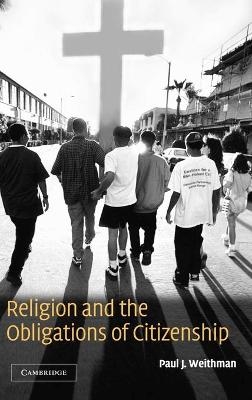
Religion and the Obligations of Citizenship
Seiten
2002
Cambridge University Press (Verlag)
978-0-521-80857-6 (ISBN)
Cambridge University Press (Verlag)
978-0-521-80857-6 (ISBN)
In this book Paul J. Weithman asks whether citizens in a liberal democracy may base their votes and their public political arguments on their religious beliefs, and challenges the standard view that they must appeal to non-religious reasons for their positions.
In Religion and the Obligations of Citizenship Paul J. Weithman asks whether citizens in a liberal democracy may base their votes and their public political arguments on their religious beliefs. Drawing on empirical studies of how religion actually functions in politics, he challenges the standard view that citizens who rely on religious reasons must be prepared to make good their arguments by appealing to reasons that are 'accessible' to others. He contends that churches contribute to democracy by enriching political debate and by facilitating political participation, especially among the poor and minorities, and as a consequence, citizens acquire religiously based political views and diverse views of their own citizenship. He concludes that the philosophical view which most defensibly accommodates this diversity is one that allows ordinary citizens to draw on the views their churches have formed when voting and offering public arguments for their political positions.
In Religion and the Obligations of Citizenship Paul J. Weithman asks whether citizens in a liberal democracy may base their votes and their public political arguments on their religious beliefs. Drawing on empirical studies of how religion actually functions in politics, he challenges the standard view that citizens who rely on religious reasons must be prepared to make good their arguments by appealing to reasons that are 'accessible' to others. He contends that churches contribute to democracy by enriching political debate and by facilitating political participation, especially among the poor and minorities, and as a consequence, citizens acquire religiously based political views and diverse views of their own citizenship. He concludes that the philosophical view which most defensibly accommodates this diversity is one that allows ordinary citizens to draw on the views their churches have formed when voting and offering public arguments for their political positions.
PAUL J. WEITHMAN is Associate Professor of Philosophy at the University of Notre Dame. He is editor of Religion and Contemporary Liberalism (1997) and co-editor of the five-volume Philosophy of Rawls (with Henry Richardson, 1999).
Preface and acknowledgement; 1. Introduction; 2. Participation, full participation and realized citizenship; 3. Religion's role in promoting democracy; 4. Public argument; 5. The principles; 6. Robert Audi on secular reasons; 7. John Rawls on public reasons; Conclusion; Select bibliography.
| Erscheint lt. Verlag | 15.8.2002 |
|---|---|
| Verlagsort | Cambridge |
| Sprache | englisch |
| Maße | 160 x 237 mm |
| Gewicht | 523 g |
| Themenwelt | Geisteswissenschaften ► Philosophie |
| Geisteswissenschaften ► Religion / Theologie | |
| Sozialwissenschaften ► Politik / Verwaltung | |
| ISBN-10 | 0-521-80857-X / 052180857X |
| ISBN-13 | 978-0-521-80857-6 / 9780521808576 |
| Zustand | Neuware |
| Informationen gemäß Produktsicherheitsverordnung (GPSR) | |
| Haben Sie eine Frage zum Produkt? |
Mehr entdecken
aus dem Bereich


aus dem Bereich
wie Tiere den Tod verstehen
Buch | Hardcover (2025)
Insel Verlag
CHF 42,90
Band 8: Ästhetik (1961/62)
Buch | Hardcover (2025)
Suhrkamp (Verlag)
CHF 109,15
eine Ethik des Verzichts
Buch | Softcover (2025)
Reclam (Verlag)
CHF 9,80


