
Breaking the Book (eBook)
John Wiley & Sons (Verlag)
978-1-118-27444-6 (ISBN)
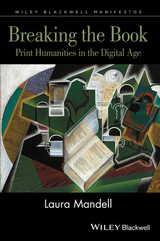
Breaking the Book is a manifesto on the cognitive consequences and emotional effects of human interactions with physical books that reveals why the traditional humanities disciplines are resistant to 'digital' humanities.
- Explores the reasons why the traditional humanities disciplines are resistant to 'digital humanities'
- Reveals facets of book history, offering it as an example of how different media shape our modes of thinking and feeling
- Gathers together the most important book history and literary criticism concerning the hundred years leading up to the early 19th-century emergence of mass print culture
- Predicts effects of the digital revolution on disciplinarity, expertise, and the institutional restructuring of the humanities
Laura Mandell is Professor of English Literature and Director of the Initiative for Digital Humanities, Media, and Culture at Texas A & M University. Her publications include Misogynous Economies: The Business of Literature in Eighteenth-Century Britain (1999) and a Longman Cultural Edition of The Castle of Otranto and Man of Feeling. Dr. Mandell is also Director of 18thConnect.org and General Editor of the Poetess Archive.
Breaking the Book is a manifesto on the cognitive consequences and emotional effects of human interactions with physical books that reveals why the traditional humanities disciplines are resistant to 'digital' humanities. Explores the reasons why the traditional humanities disciplines are resistant to 'digital humanities' Reveals facets of book history, offering it as an example of how different media shape our modes of thinking and feeling Gathers together the most important book history and literary criticism concerning the hundred years leading up to the early 19th-century emergence of mass print culture Predicts effects of the digital revolution on disciplinarity, expertise, and the institutional restructuring of the humanities
Laura Mandell is Professor of English Literature and Director of the Initiative for Digital Humanities, Media, and Culture at Texas A & M University. Her publications include Misogynous Economies: The Business of Literature in Eighteenth-Century Britain (1999) and a Longman Cultural Edition of The Castle of Otranto and Man of Feeling. Dr. Mandell is also Director of 18thConnect.org and General Editor of the Poetess Archive.
Acknowledgments vii
Advertisement ix
Part I Pre-Bound 1
1 Language by the Book 3
Part II Bound 69
2 Print Subjectivity, or the Case History 71
3 Distributed Reading, or the Critic Filter 103
Part III Unbound 147
Conclusion 149
Works Cited 187
Index 205
2
Print Subjectivity, or the Case History
Was what we know as “the unconscious mind” invented during the eighteenth-century, and if so, in response to print culture? One reason I ask is that so many of the early eighteenth-century writers look insane to me, suggesting that there is something I’m repressing which they are not. Moreover, the writers of the 1720s are conscious, maybe even hyperconscious, of the structuring of mind articulated by Sigmund Freud, the main codifier if not inventor of the modern unconscious. In Tale of a Tub, Jonathan Swift argues that some of our highest ideals are distinguished from what we find most abject by only minimal differences:
And whereas the mind of Man, when he gives the spur and bridle to his thoughts, doth never stop, but naturally sallies out into both extremes of high and low, of good and evil; his first flight of fancy commonly transports him to ideas of what is most perfect, finished, and exalted; till having soared out of his own reach and sight, not well perceiving how near the frontiers of height and depth border upon each other; with the same course and wing, he falls down plumb into the lowest bottom of things, like one who travels the east into the west, or like a straight line drawn by its own length into a circle. (Swift 1704b: 324–5)
According to Freud, writing over two centuries later, the mechanism that creates an absolute out of a minimal distinction is repression. From his discussion of repression as a mechanism, Freud says,
we can understand how it is that the objects to which men give most preference, their ideals, proceed from the same perceptions and experiences as the objects which they most abhor, and that they were originally distinguished from one another through slight modifications.
Through distinguishing the abhorrent from the ideal, repression differentiates the conscious from the unconscious mind. Jokes according to Freud offer a temporary lifting of such repression (Freud 1953–74: 14.150, 148, 151), and so the comedy Caddyshack (1980) amply illustrates Swift and Freud’s point: swimmers screech and flee from a country-club swimming pool as a bowel movement appears in the water. The pool is drained, at which point Bill Murray picks up the offending creature from the drain and takes a bite out of it. Here an ideal, a Baby Ruth bar, differs minimally from our most abject wastes.
Early-modern bathers would not have laughed. Norbert Elias’s History of Manners quotes a conduct manual that suggests a much different structure of repressions. In telling people what not to do, it presumes that they will openly admit to a desire that we repress. Of course the people whom this conduct manual addressed were walking through city streets in which human and animal excrement freely flowed:
[I]t is not a refined habit, when coming across something disgusting in the street, as sometimes happens, to turn at once to one’s companion and point it out to him. It is far less proper to hold out the stinking thing for the other to smell, as some are wont, who even urge the other to do so, lifting the foul-smelling thing to his nostrils and saying, “I should like to know how much that stinks,” when it would be better to say, “Because it stinks do not smell it.”1
The desire expressed by Bill Murray’s joke, to pick up, play with, and even closely smell human excrement, is repressed from twentieth- and twenty-first century consciousness, but expressed through the love of an ideal: chocolate bars. That there is such a repressed desire is indicated by the laughter at the Caddyshack joke, laughter indicating a temporary lifting of repression. Would an eighteenth-century audience laugh, given that Mme. du Deffand writes a letter about using a lovely chamber pot in order to serve peas and gravy?2
Elias marks the eighteenth century as the civilizing moment, and one can see what he means in a story recounted by psychoanalyst Hans Loewald in his book about the civilizing process of sublimation. The title of Freud’s Civilization and Its Discontents was once given the title (in German) of its ground—translatable as Uncivilized Contentment—a text that would recount the pleasures, Loewald says, of screaming, physically fighting, and farting. I present these scatological images of unconscious construction to emphasize how physical a reality “it” [id] actually is, in accounts stretching from Swift in the early eighteenth century to Loewald writing in the late twentieth. We have all noticed that neurotics are highly literate readers of books, disciplined to sit still, book in hand, body obfuscated or even repressed.
In this chapter, I investigate the ways in which the unconscious became during the eighteenth-century structured by the bodily practices involved in manipulating printed texts, just as the unconscious might be structured by stopping in the street to pick up waste—or not. In particular, I wish to look at modes of sympathetic identification that are later best expressed by “the case history” that first emerged as a genre around 1800. Georges Gusdorf successfully argues that the physical page’s capacity to create an “inside space” makes autobiography an instrument for creating, living out, and recognizing psychological depth. Until the advent of autobiography, a form unique to Western literature and literatures of those colonized by the West, the subjects of biography were “great personages,” “heroes, princes.” Suddenly, via this “new spiritual revolution” within the history of humanity, an individual begins
to conceive of him or herself as a great person, as worthy of being remembered by people … [and,] despite his or mediocrity in the theater of the world, as worthy of being offered as an example. Interest was transferred from public to private history: next to great men who acted out the public history of humanity, there are obscure men who waged war in the heart of spiritual life, leading silent battles of which the means and ways, the triumphs and losses, also deserve to be impressed upon universal memory… . If the space of outside, the theater of the world, is a clear space, where the behavior, motives, and types are grasped well enough upon first sight, inner space is essentially shadowy. (1956: 107–8, my translation)3
The authors who write Puritan experience narratives (autobiographical confessions by any other name) as well as their readers feel their spirits spatialized, but only with the emergence of a specific bibliographic practice: silent reading. This “dialogue between the spirit and God in which each gesture, each willed thought or action, can be put into question” (Gusdorf 1956: 107–8). If the eyes are the window of the soul, and the codex page, printed or handwritten, mirrors that soul, then the page gives to the soul multiple, sequentially ordered surfaces. I apply that argument here, adding to it a focus on how physical activities surrounding printed books—their covers and heft, for instance—inflect psychic reality. To put the argument in its strongest form, I would say that those activities foster a distinctively modern mode of internalization. It’s only because of the printed book, I would argue, and especially the form of that book as produced by mass print culture, that identification comes to be seen as a means for communication. When that happens, the unconscious mind becomes structured by the desire to be recognized through sympathetic identifications made by others, by imagining oneself the star or author of a printed novel, poem, newspaper, or periodical essay: the repressed is to some extent what cannot be printed in publishable form. To overcome that repression, one must write about oneself getting at the particular in a way that makes it publishable or universal, identifiable. Writing, publishing, and reading the case history, then, in which humans are portrayed as particular instances that contribute to general theories of psychic functioning precisely through their variances, becomes a mode of cure. Unlike coterie print autobiographies, the mass-printed case history offers everyone down at least to the literate classes the opportunity to be agents in history, to be recognized abroad and at home. Here I wish to examine how the emergence of the case history is tied to the very physical form of the book as it is lived (lived with and lived in), the more that books abound.
The Case History
The term “case” is, as James Chandler points out, connected etymologically to casuistry (1998: 198–9), and for that reason is applied to legal battles.4 How does the term extend to the medical realm? John Woodward wrote in the 1720s, “it was by the Method of transmitting Cases and Cures, that Physick first began to be formed into a Science” (Woodward 1757: 338). The historical argument made by Woodward, a member of the Royal Society who was one of the virtuosi roundly ridiculed by the Scriblerians, is that medicine moves from being recipes to becoming knowledge via the technology of the case, an emergent form in the Philosophical Transactions. That is, this Royal Society journal transmits accounts of cases; it does not (yet) contain what would properly count as published case histories, though the case-lecture begins as a medial, generic form several years before Woodward dies. By the...
| Erscheint lt. Verlag | 14.5.2015 |
|---|---|
| Reihe/Serie | Blackwell Manifestos |
| Blackwell Manifestos | Wiley-Blackwell Manifestos |
| Sprache | englisch |
| Themenwelt | Geschichte ► Teilgebiete der Geschichte ► Kulturgeschichte |
| Geisteswissenschaften ► Sprach- / Literaturwissenschaft ► Anglistik / Amerikanistik | |
| Geisteswissenschaften ► Sprach- / Literaturwissenschaft ► Literaturwissenschaft | |
| Sozialwissenschaften ► Kommunikation / Medien ► Medienwissenschaft | |
| Schlagworte | and Culture • Cultural Studies • digital books • Digital Culture & the Information Age • Digitale Kultur • Digitale Kultur im Informationszeitalter • digital humanities • Digital Media • Digital Revolution • digital text • future of the humanities • history of the book • human interactions • Humanities • institutional restructuring of the humanities • Journal of the Initiative for Digital Humanities • Kulturwissenschaften • Literary criticism • Literary Criticism & History • Literary Culture • Literature • Literaturkritik • Literaturkritik u. -geschichte • Literaturwissenschaft • mass communications • mass print • media • New Media • PAJ • physical books • Poetess Archive Journal • print cultures • printed book • the book |
| ISBN-10 | 1-118-27444-X / 111827444X |
| ISBN-13 | 978-1-118-27444-6 / 9781118274446 |
| Informationen gemäß Produktsicherheitsverordnung (GPSR) | |
| Haben Sie eine Frage zum Produkt? |
 EPUB (Adobe DRM)
Kopierschutz: Adobe-DRM
Adobe-DRM ist ein Kopierschutz, der das eBook vor Mißbrauch schützen soll. Dabei wird das eBook bereits beim Download auf Ihre persönliche Adobe-ID autorisiert. Lesen können Sie das eBook dann nur auf den Geräten, welche ebenfalls auf Ihre Adobe-ID registriert sind.
Details zum Adobe-DRM
Dateiformat: EPUB (Electronic Publication)
EPUB ist ein offener Standard für eBooks und eignet sich besonders zur Darstellung von Belletristik und Sachbüchern. Der Fließtext wird dynamisch an die Display- und Schriftgröße angepasst. Auch für mobile Lesegeräte ist EPUB daher gut geeignet.
Systemvoraussetzungen:
PC/Mac: Mit einem PC oder Mac können Sie dieses eBook lesen. Sie benötigen eine
eReader: Dieses eBook kann mit (fast) allen eBook-Readern gelesen werden. Mit dem amazon-Kindle ist es aber nicht kompatibel.
Smartphone/Tablet: Egal ob Apple oder Android, dieses eBook können Sie lesen. Sie benötigen eine
Geräteliste und zusätzliche Hinweise
Buying eBooks from abroad
For tax law reasons we can sell eBooks just within Germany and Switzerland. Regrettably we cannot fulfill eBook-orders from other countries.
aus dem Bereich