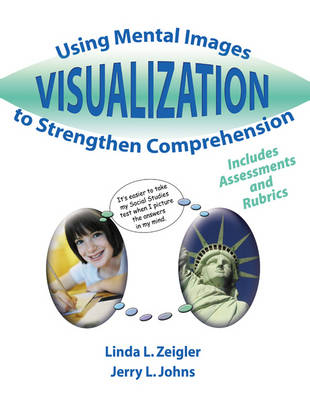
Visualization
Kendall/Hunt Publishing Co ,U.S. (Verlag)
978-0-7575-0935-3 (ISBN)
- Titel z.Zt. nicht lieferbar
- Versandkostenfrei
- Auch auf Rechnung
- Artikel merken
Visualization, by Linda L. Zeigler and Jerry L. Johns, is intended to help classroom teachers, reading specialists, and other professionals who are involved in creating and delivering high-quality reading instruction to students. The book can be used for staff development programs and as a supplemental in a wide variety of reading courses at colleges and universities.
Preface
About the Authors
Acknowledgments
Visualization Overview
STAGE 1 REALIZING
Overview
Goal 1: To help students realize that they use visualization to remember images or experiences from their lives.
Lessons 1: It's Your Life
2: What's in the Box?
3: Picture This
4: Own the Object
Reinforcing Goal 1
Linking Literature
Using Questions and Cues
Assessment for Goal 1
Rubric to Score the Assessment for Goal 1
Samples of Student Assessment Results
Goal 2: To help students realize that mental images are created by imagination and prior knowledge.
Lessons 1: Stimulating the Imagination
2: Bubble Experiences
3: Let's Pretend
4: You Can Imagine
Reinforcing Goal 2
Linking Literature
Using Questions and Cues
Assessment for Goal 2
Rubric to Score the Assessment for Goal 2
Samples of Student Assessment Results
Goal 3: To help students realize that mental images can be created while listening or reading.
Lessons 1: Picture Power
2: Who Said That?
3: See the Setting
4: Hear It, See It
Reinforcing Goal 3
Linking Literature
Using Questions and Cues
Assessment for Goal 3
Rubric to Score the Assessment for Goal 3
Samples of Student Assessment Results
STAGE 2 UNDERSTANDING
Overview
Goal 4: To help students understand that images move and change during reading.
Lessons 1: Change It Up
2: Past/Present/Future
3: Act It Out
4: Setting Changes
5: Divide and Conquer
6: Stop and Draw
Reinforcing Goal 4
Linking Literature
Using Questions and Cues
Assessment for Goal 4
Rubric to Score the Assessment for Goal 4
Samples of Student Assessment Results
Goal 5: To help students form mental images in greater detail.
Lessons 1: In the Beginning
2: Look and Touch
3: Rock On
4: Similar Details
5: See the Sentence
Reinforcing Goal 5
Linking Literature
Using Questions and Cues
Assessment for Goal 5
Rubric to Score the Assessment for Goal 5
Samples of Student Assessment Results
Goal 6: To help students use all five senses to create images.
Lessons 1: Discover the Senses
2: Connecting the Senses to Text
3: Sense Cards
4: Sense Cards and Inference
Reinforcing Goal 6
Linking Literature
Using Questions and Cues
Assessment for Goal 6
Rubric to Score the Assessment for Goal 6
Samples of Student Assessment Results
Goal 7: To help students identify and use eight basic emotions to remember
images.
Lessons 1: Guess the Emotions
2: Find the Feeling
3: Emotion Continuums
4: Spot the Feeling Words
5: Remember When
Reinforcing Goal 7
Linking Literature
Using Questions and Cues
Assessment for Goal 7
Rubric to Score the Assessment for Goal 7
Samples of Student Assessment Results
Goal 8: To help students understand that images must be created to match the text, rather than over-relying on their prior knowledge.
Lessons 1: It Must Match
2: Confusion
3: What You Know May Not Go
Reinforcing Goal 8
Linking Literature
Using Questions and Cues
Assessment for Goal 8
Rubric to Score the Assessment for Goal 8
Samples of Student Assessment Results
Goal 9: To help students understand that imaging varies for narrative, informational, and other text structures.
Lessons 1: Understanding the Parts of a Narrative
2: Connecting the Parts of a Narrative
3: Movie Time
4: Parts of Informational Text
5: Documentary Time
6: Parts of Technical Text
7: Parts of Persuasive Text
Reinforcing Goal 9
Linking Literature
Using Questions and Cues
Assessment for Goal 9
Rubric to Score the Assessment for Goal 9
SAMPLES OF STUDENT ASSESSMENT RESULTS
STAGE 3 APPLYING
Overview
Goal 10: To help students use visual images as a foundation to help them predict, draw conclusions, infer, and evaluate text.
Lessons 1: Put the Clues Together
2: What Do You Think?
3: Why Laugh?
4: Predict Differently
5: Questions and Answers
Reinforcing Goal 10
Linking Literature
Using Questions and Cues
Goal 11: To help students use visualization as a strategy to enhance learning throughout the curriculum.
Lessons 1: Visualize for Writing
2: Visualize for Art
3: Visualize for Social Studies
4: Visualize for Math
5: Visualize for Science
Reinforcing Goal 11
Linking Literature
Using Questions and Cues
Goal 12: To help students use visual imagery with figurative language and analogies to better understand a process or a new concept.
Lessons 1: Making Heads or Tails Out of Idioms
2: Personification Intrigues the Imagination
3: Similes and Metaphors Are Images
4: Analogies Promote Higher-Level Thinking
5: A Sandwich?
Reinforcing Goal 12
Linking Literature
Using Questions and Cues
Goal 13: To help students use visualization to envision, dream, or imagine new thoughts and ideas.
Lessons 1: Invention through Imagination
2: Reflect to Connect
3: Visual Freedom and Creativity
Reinforcing Goal 13
Linking Literature
Using Questions and Cues
Assessment for the Application Stage
Rubric to Score the Application Stage
Samples of Student Assessment Results
References
Index
| Erscheint lt. Verlag | 30.6.2004 |
|---|---|
| Verlagsort | Iowa |
| Sprache | englisch |
| Themenwelt | Sozialwissenschaften ► Pädagogik ► Berufspädagogik |
| Sozialwissenschaften ► Pädagogik ► Sonder-, Heil- und Förderpädagogik | |
| ISBN-10 | 0-7575-0935-5 / 0757509355 |
| ISBN-13 | 978-0-7575-0935-3 / 9780757509353 |
| Zustand | Neuware |
| Informationen gemäß Produktsicherheitsverordnung (GPSR) | |
| Haben Sie eine Frage zum Produkt? |
aus dem Bereich