


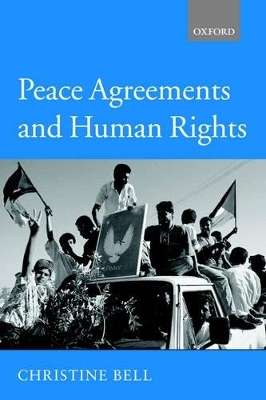
Peace Agreements and Human Rights
Seiten
2000
Oxford University Press (Verlag)
978-0-19-829889-2 (ISBN)
Oxford University Press (Verlag)
978-0-19-829889-2 (ISBN)
This is an examination of the place of human rights in peace agreements against the backdrop of international legal provision. The introductory analysis draws on many peace agreements, while the text focuses on the peace agreements in South Africa, Israel/Palestine, Northern Ireland, and Bosnia.
Peace Agreements and Human Rights examines the place of human rights in peace agreements against the backdrop of international legal provision. The introductory analysis draws on a review of many peace agreements, while the body of the book focuses, in particular, on the peace agreements in four peace processes: South Africa, Israel/Palestine, Northern Ireland, and Bosnia. It addresses the phenomenon of the post-Cold War peace process, the types of agreement that are typically produced, and the typical role of human rights in those agreements. This includes discussion of the legal status of peace agreements, and their relationships to international law.
The purpose of the study is to illuminate thinking at three levels. First, to provide some clear analysis of peace agreements, peace processes, and human rights, and the assumptions that lead to human rights being included in agreements. Secondly, to inform consideration of the relationship between international law and protracted social conflict involving ethnic division (`ethnic conflict'). Finally, to provide a context from which to consider the relationship between justice and peace more generally, and draw some conclusions about international law's capacity to provide a positive context for conflict transformation.
The author identifies three main elements of the human rights component of peace agreements in agreements: provision dealing with self-determination and minority rights; provision for institutions to protect human rights; and provision dealing with past human rights violations. The central chapters of the book begin with a discussion of relevant international legal provision, and then focuses on a comparison of how the four sets of peace agreements addressed the issue. The conclusions returns to the possible relationship between justice and peace, and how this accounts for where human rights ends up in peace agreements, together with observations as to good and bad practice, and possible future directions for international law and actors in conflict situations.
Peace Agreements and Human Rights examines the place of human rights in peace agreements against the backdrop of international legal provision. The introductory analysis draws on a review of many peace agreements, while the body of the book focuses, in particular, on the peace agreements in four peace processes: South Africa, Israel/Palestine, Northern Ireland, and Bosnia. It addresses the phenomenon of the post-Cold War peace process, the types of agreement that are typically produced, and the typical role of human rights in those agreements. This includes discussion of the legal status of peace agreements, and their relationships to international law.
The purpose of the study is to illuminate thinking at three levels. First, to provide some clear analysis of peace agreements, peace processes, and human rights, and the assumptions that lead to human rights being included in agreements. Secondly, to inform consideration of the relationship between international law and protracted social conflict involving ethnic division (`ethnic conflict'). Finally, to provide a context from which to consider the relationship between justice and peace more generally, and draw some conclusions about international law's capacity to provide a positive context for conflict transformation.
The author identifies three main elements of the human rights component of peace agreements in agreements: provision dealing with self-determination and minority rights; provision for institutions to protect human rights; and provision dealing with past human rights violations. The central chapters of the book begin with a discussion of relevant international legal provision, and then focuses on a comparison of how the four sets of peace agreements addressed the issue. The conclusions returns to the possible relationship between justice and peace, and how this accounts for where human rights ends up in peace agreements, together with observations as to good and bad practice, and possible future directions for international law and actors in conflict situations.
Christine Bell is Professor of Law at the University of Ulster
1. Introduction ; 2. Peace processes, Peace Agreements, and Human Rights: What are They? ; 3. From Conflict to Peace? South Africa and Northern Ireland ; 4. From Conflict to Peace: Israel/Palestine and Bosnia-Herzegovina ; 5. Getting to Yes? negotiating Self-Determination ; 6. But What was the Question? Evaluating the Deal ; 7. Building for the Future: Human Rights Institutions ; 8. Undoing the Past: Refugees, Land, and Possession ; 9. Dealing with the Past: Prisoners, Accountability, and 'Truth' ; 10. 'Back to the Future': Human Rights and Peace Agreements ; Appendix: A Decade of Peace Agreements ; References ; Index
| Erscheint lt. Verlag | 14.12.2000 |
|---|---|
| Verlagsort | Oxford |
| Sprache | englisch |
| Maße | 163 x 243 mm |
| Gewicht | 740 g |
| Themenwelt | Recht / Steuern ► EU / Internationales Recht |
| Recht / Steuern ► Öffentliches Recht ► Völkerrecht | |
| Sozialwissenschaften ► Politik / Verwaltung ► Europäische / Internationale Politik | |
| ISBN-10 | 0-19-829889-7 / 0198298897 |
| ISBN-13 | 978-0-19-829889-2 / 9780198298892 |
| Zustand | Neuware |
| Informationen gemäß Produktsicherheitsverordnung (GPSR) | |
| Haben Sie eine Frage zum Produkt? |
Mehr entdecken
aus dem Bereich
aus dem Bereich
Die Rechtsprechung des Gerichtshofs der Europäischen Union, deutscher …
Buch | Softcover (2025)
Nomos (Verlag)
CHF 53,50


