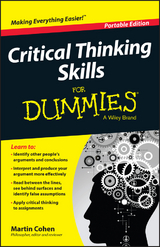
Critical Thinking Skills For Dummies (eBook)
John Wiley & Sons (Verlag)
978-1-118-92473-0 (ISBN)
Martin Cohen is a philosopher, editor and reviewer. His first book, 101 Philosophy Problems, has been published in a dozen languages and is now in its fourth edition.
Introduction 1
Part I: Getting Started with Critical Thinking Skills 7
Chapter 1: Entering the Exciting World of Critical Thinking 9
Chapter 2: Peering into the Mind: How People Think 21
Chapter 3: Planting Ideas in Your Head: The Sociology of Thinking 41
Chapter 4: Assessing Your Thinking Skills 65
Part II: Developing Your Critical Thinking Skills 91
Chapter 5: Critical Thinking Is Like Solving Puzzles: Reasoning by Analogy 93
Chapter 6: Thinking in Circles: The Power of Recursion 113
Chapter 7: Drawing on Graphical (and Other) Tools for Thinking 133
Chapter 8: Constructing Knowledge: Information Hierarchies 159
Part III: Applying Critical Thinking in Practice 175
Chapter 9: Getting to the Heart of the (Reading) Matter 177
Chapter 10: Cultivating Your Critical Writing Skills 199
Chapter 11: Speaking and Listening Critically: Effective Learning 217
Part IV: Reason and Argument 235
Chapter 12: Unlocking the Logic of Real Arguments 237
Chapter 13: Behaving Like a Rational Animal 259
Chapter 14: Using Words to Persuade: The Art of Rhetoric 275
Chapter 15: Presenting Evidence and Justifying Opinions 293
Part V: The Part of Tens 317
Chapter 16: Ten Logical Pitfalls and How to Avoid Them 319
Chapter 17: Ten Arguments that Changed the World 327
Index 339
Introduction
Critical Thinking! Now that sounds like a good idea. Because it's a kind of souped-up, laser-sharp powerful thinking, just waiting to zap rotten arguments and churn out some pretty brilliant insights instead. And don't worry if people tell you that it is a rather high-level kind of thinking, and that only a few can do it, mainly tweedy professors who tell jokes in Latin (dimidium facti qui coepit habet — ‘he who has begun, has the work half done’), because Critical Thinking certainly isn't like that. Critical Thinking is not just for the tweedy few — but for the curious, the imaginative, the creative many. In fact the only thing that is really deeply mysterious about Critical Thinking is why everyone's not doing it. But I've got a theory about that, and it is to do with education and the kind of ways of working that people are corralled into, like so many sheep — supposedly as a preparation for life outside. But life outside is rarely just a business of unreflectively following set procedures and instructions — but rather something where you need constantly to reflect on what you are doing, and why — and act not as a machine, but as a person. So the first skill a Critical Thinker needs to learn is how to think ‘the unthinkable’, to think outside the box, to ‘free their mind’ no less.
Sounds idealistic? A bit 60s and hippies wearing flowers? Well, yes, there's a bit of idealism in Critical Thinking, just as there is in all the best things. But there's also a lot of structure, and solid research backing it too. This book will give you what you need of both — plus plenty of opportunities to develop and test your own skills. I've done both my bit of being taught and of teaching over the years, and another rather mysterious thing is why so many people seem to imagine that thinking, let alone Critical Thinking, is something that can be learned by rote: that is, by writing down and memorizing a collection of facts (a body of knowledge) with right and wrong answers. Critical Thinking guides that create obscure distinctions and list technical terms for you to learn are promoting passive, not active, thinking. Rote learning is fine if all you ever intend to do is deal with past problems, but won't get you many new insights or ideas. And, in fact, it is the opposite of what Critical Thinking is all about. Critical Thinking is really a set of transferable skills — learned for one thing, equally useful for another — that cuts across the whole swathe of academic disciplines and is applicable in all spheres of human activity. This is why you will find Critical Thinking useful as part of learning design skills, nursing studies, economics, and even playing good football: it is really a toolbox for making the most of life.
About This Book
In this book you can find both the conventional material on Critical Thinking Skills, which is broadly about avoiding logical fallacies and following the rules of good essay structure, and a lot more besides. Most other books focus on these bits of Critical Thinking because they are easy to talk about, but rather harder to actually get anyone to do. In fact, like philosophy itself (and Critical Thinking is traditionally a branch of philosophy), properly understood the only way to learn the method is to use the skills in practice. So what I try to offer here is a kind of map or guide book that will come in handy as you actively start using Critical Thinking in whatever areas you want to. I include enough of the background to the academic debates for you to see the ‘why’ as well as the ‘what’, plenty of hands-on tips and advice so that you have the ‘how’, and I certainly include some opportunities to try things out in practical exercises.
Foolish Assumptions
One of the key skills in Critical Thinking that too often gets overlooked is ‘knowing your audience’ — and indeed empathising with them. In this case, that means understanding what motivates them. So as I write this book, just as when you write an essay or prepare a report, the crucial thing is to know what the interests and needs of the likely reader are. I assume that you:
- Are interested in ideas, and in how to communicate them.
- Already know there is a difference between Critical Thinking and just criticising without thinking.
- Want to be able to see through a bad argument.
- Know how to construct a persuasive argument — although I don't make any assumptions about what you will be arguing about or the context that you are studying or working within.
Whether you're young or old, male or female, an engineer or a philosopher, makes no difference to me — the book is zero jargon and open access.
You could be a CEO or the prime minister, but you won't get special sections for that reason. However, I do anticipate that you might be a student, perhaps starting your studies or perhaps having progressed to the point where you are being asked to produce longer dissertations. Because, believe it or not, Critical Thinking is a skill that even PhD students often fall short in. This ‘thinking gap’ is behind a lot of dodgy research and public policy all over the world. So really, I also assume that the likely reader has a moral purpose too. You want to think better and more clearly: to get things right, not just know enough to pass the exam.
On the other hand, if you are sort of a reluctant Critical Thinker, heck, let me have a go at converting you. Because I know there is an awful lot of boring stuff out there on informal logic and structuring essays, and I certainly don't intend to add to it here. So if you are starting off by wanting ‘just the minimum to pass’, you've still come to the right place. If Critical Thinking is sometimes a diet of thoroughly stodgy skills, here you should find plenty of flavouring has been added to the stew that makes it all much more tasty.
Icons Used in This Book
I use this icon to point you towards more detailed explanations of important ideas or theories that shed light on Critical Thinking techniques and skills.
There's a lot of jargon used in some Critical Thinking circles. I attach this icon near the plain English explanation of a term.
I use this icon to highlight key facts and ideas that — literally — you may want to remember. If you know it already, sometimes it will come across more as a reminder.
This flags up a simple idea that can be used to achieve both academic Critical Thinking aims (how to dissect an argument, for example) and also broader CT skills such as how to give space to other people to develop their ideas, rather than switch off at the first point of disagreement.
And last, but definitely not least, this one flags up an opportunity for you to try your skills out!
I reserve this scary icon to indicate both practical ‘pitfalls’, and theories that have downsides.
Beyond the Book
In addition to the material in the print or e-book you're reading right now, this product also comes with some access-anywhere goodies on the Web. Check out the free Cheat Sheet at www.dummies.com/cheatsheet/criticalthinking for some helpful tips and hints.
You can also access some fun critical thinking exercises at www.dummies.com/extras/criticalthinking .
Where to Go from Here
You can read this book any way you want — I don't mind if you just try a few bits that seem particularly relevant, or if you plough through the whole thing in one evening (take it to bed with you), or if you skim read it while eating chips and watching TV.
In fact, I'd recommend that you don't treat it as a textbook, with lesson one leading to lesson two, because the smart reader knows — and the Critical Thinker is a smart reader — that information is best digested when it connects to something you have a current, real need to know. Only you can say what it is at the moment you're looking at, or thinking about, or interested in. So use the index, the contents page or that valuable method known as ‘flicking through’ to find bits that seem relevant to you, and take it from there. (Because I assume many readers will only dip into or out of this book, so I have tried to group material into clearly labeled sections, each with its own 30-second intro, so that you can quickly check out particular aspects as and when you need to.)
However, if you want my advice about where to start, and why not, I wrote the book so I ought to know a bit about it, I'd say some good places to go are:
- Chapter 1 : Because that is where I ‘Welcome you to the Arguments Clinic’ and say a bit about what Critical Thinking is.
- Chapter 4 : Which is on ‘Assessing Your Thinking Skills’, because it contains a pretty cool test of the kind that evil employers may give you, and is quite fun too. But don't read if for that reason, because all of the book is fun.
- Chapter 9 : ‘Getting to the Heart of the (Reading) Matter’: another possible jumping in point.
It sounds a bit serious, but it's also a good place to start as it is through reading that most people get...
| Erscheint lt. Verlag | 18.3.2015 |
|---|---|
| Sprache | englisch |
| Themenwelt | Geisteswissenschaften ► Psychologie ► Allgemeine Psychologie |
| Sozialwissenschaften ► Pädagogik ► Allgemeines / Lexika | |
| Schlagworte | Academic Success • apply critical thinking to your work • be more critical in your assignments • Bildung • Bildungswesen • construct effective arguments • Critical analysis • critical thinking • Critical thinking skills • Critical Thinking Skills For Dummies • developing strong critical thinking skills • develop reflective thinking skills • Education • effective arguments • how to identify other people's arguments • how to identify other people's arguments and conclusions • improve your grades • martin cohen • produce your arguments more effectively • reflective thinking skills • strong critical thinking • strong critical thinking skills • use critical thinking • use critical thinking in your assignments |
| ISBN-10 | 1-118-92473-8 / 1118924738 |
| ISBN-13 | 978-1-118-92473-0 / 9781118924730 |
| Informationen gemäß Produktsicherheitsverordnung (GPSR) | |
| Haben Sie eine Frage zum Produkt? |
 EPUB (Adobe DRM)
Kopierschutz: Adobe-DRM
Adobe-DRM ist ein Kopierschutz, der das eBook vor Mißbrauch schützen soll. Dabei wird das eBook bereits beim Download auf Ihre persönliche Adobe-ID autorisiert. Lesen können Sie das eBook dann nur auf den Geräten, welche ebenfalls auf Ihre Adobe-ID registriert sind.
Details zum Adobe-DRM
Dateiformat: EPUB (Electronic Publication)
EPUB ist ein offener Standard für eBooks und eignet sich besonders zur Darstellung von Belletristik und Sachbüchern. Der Fließtext wird dynamisch an die Display- und Schriftgröße angepasst. Auch für mobile Lesegeräte ist EPUB daher gut geeignet.
Systemvoraussetzungen:
PC/Mac: Mit einem PC oder Mac können Sie dieses eBook lesen. Sie benötigen eine
eReader: Dieses eBook kann mit (fast) allen eBook-Readern gelesen werden. Mit dem amazon-Kindle ist es aber nicht kompatibel.
Smartphone/Tablet: Egal ob Apple oder Android, dieses eBook können Sie lesen. Sie benötigen eine
Geräteliste und zusätzliche Hinweise
Buying eBooks from abroad
For tax law reasons we can sell eBooks just within Germany and Switzerland. Regrettably we cannot fulfill eBook-orders from other countries.
aus dem Bereich