


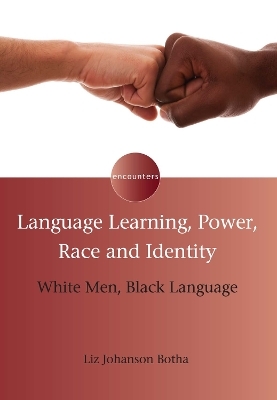
Language Learning, Power, Race and Identity
White Men, Black Language
Seiten
2015
Multilingual Matters (Verlag)
978-1-78309-385-4 (ISBN)
Multilingual Matters (Verlag)
978-1-78309-385-4 (ISBN)
This book investigates the strategies and identities of colonials who have learned the languages of colonised people. Using the stories of white South Africans who acquired isiXhosa during the apartheid years, this book offers insights into relationships between language, power, race, identity and change.
This book investigates the strategies and identities of colonials who have learned the languages of colonised people, using the context of isiXhosa in South Africa. While power in language learning research has traditionally focused on the powerful native speaker and the relatively disempowered learner, this book studies the inverse, where elites are the language learners. The author analyses the life histories of four white South Africans who acquired isiXhosa during the apartheid years. The book offers insights into relationships between language, power, race, identity and change in their stories and in the broader context of apartheid and post-apartheid South Africa, with its conflicted history and disparities. This book should appeal to researchers interested in studies of language acquisition, narrative and identity, as well as those more broadly interested in South African history, multilingualism and race studies.
This book investigates the strategies and identities of colonials who have learned the languages of colonised people, using the context of isiXhosa in South Africa. While power in language learning research has traditionally focused on the powerful native speaker and the relatively disempowered learner, this book studies the inverse, where elites are the language learners. The author analyses the life histories of four white South Africans who acquired isiXhosa during the apartheid years. The book offers insights into relationships between language, power, race, identity and change in their stories and in the broader context of apartheid and post-apartheid South Africa, with its conflicted history and disparities. This book should appeal to researchers interested in studies of language acquisition, narrative and identity, as well as those more broadly interested in South African history, multilingualism and race studies.
Liz Johanson Botha has taught languages since 1968 and held a faculty post at the University of Fort Hare, South Africa from 1998 to 2012. More recently, she has worked as a Research Associate to the Faculty of Education at Rhodes University, South Africa. Her interests include language learning, identity and teacher education.
Acknowledgements
Preface
Introduction
Chapter 1: The Eastern Cape, Then and Now
Chapter 2: Life History, Identity and Language Acquisition
Chapter 3: Childhood: Intimacy and Separation
Chapter 4: Rites of Passage: Paths Diverge
Chapter 5: Adult Life and Work: Language and Power
Chapter 6: Identity across Spaces: White Discourse and Hybrid Space
Chapter 7: Conclusion
Appendices
| Erscheint lt. Verlag | 2.7.2015 |
|---|---|
| Reihe/Serie | Encounters |
| Verlagsort | Bristol |
| Sprache | englisch |
| Maße | 148 x 210 mm |
| Gewicht | 484 g |
| Themenwelt | Geisteswissenschaften ► Sprach- / Literaturwissenschaft ► Sprachwissenschaft |
| Sozialwissenschaften ► Ethnologie | |
| Sozialwissenschaften ► Soziologie | |
| ISBN-10 | 1-78309-385-4 / 1783093854 |
| ISBN-13 | 978-1-78309-385-4 / 9781783093854 |
| Zustand | Neuware |
| Informationen gemäß Produktsicherheitsverordnung (GPSR) | |
| Haben Sie eine Frage zum Produkt? |
Mehr entdecken
aus dem Bereich


aus dem Bereich
Eine Wiederentdeckung
Buch | Softcover (2025)
Piper (Verlag)
CHF 19,55
Das umfassende Standardwerk auf der Grundlage der aktuellen amtlichen …
Buch | Hardcover (2024)
Duden (Cornelsen Verlag)
CHF 48,95


