


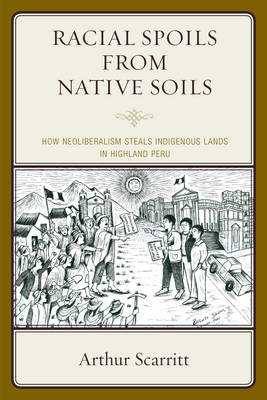
Racial Spoils from Native Soils
How Neoliberalism Steals Indigenous Lands in Highland Peru
Seiten
2015
Lexington Books (Verlag)
978-0-7391-9137-8 (ISBN)
Lexington Books (Verlag)
978-0-7391-9137-8 (ISBN)
This book proposes a racialization theory that explains the continued impoverishment and dependency of indigenous peoples. Through the case study of an Andean village, the book shows how the normal workings of society push for indigenous subordination and eventually the loss of their lands under neoliberalism.
This book explains how one man swindled his Andean village twice. The first time he extorted everyone’s wealth and disappeared, leaving the village in shambles. The village slowly recovered through the unlikely means of converting to Evangelical religions, and therein reestablished trust and the ability to work together. The new religion also kept villagers from exacting violent revenge when this man returned six years later. While hated and mistrusted, this same man again succeeded in cheating the villagers. Only this time it was for their lands, the core resource on which they depended for their existence.
This is not a story about hapless isolation or cruel individuals. Rather, this is a story about racism, about the normal operation of society that continuously results in indigenous peoples’ impoverishment and dependency. This book explains how the institutions created for the purpose of exploiting Indians during colonialism have been continuously revitalized over the centuries despite innovative indigenous resistance and epochal changes, such as the end of the colonial era itself. The ethnographic case of the Andean village first shows how this institutional set up works through—rather than despite—the inflow of development monies. It then details how the turn to advanced capitalism—neoliberalism—intensifies this racialized system, thereby enabling the seizure of native lands.
This book explains how one man swindled his Andean village twice. The first time he extorted everyone’s wealth and disappeared, leaving the village in shambles. The village slowly recovered through the unlikely means of converting to Evangelical religions, and therein reestablished trust and the ability to work together. The new religion also kept villagers from exacting violent revenge when this man returned six years later. While hated and mistrusted, this same man again succeeded in cheating the villagers. Only this time it was for their lands, the core resource on which they depended for their existence.
This is not a story about hapless isolation or cruel individuals. Rather, this is a story about racism, about the normal operation of society that continuously results in indigenous peoples’ impoverishment and dependency. This book explains how the institutions created for the purpose of exploiting Indians during colonialism have been continuously revitalized over the centuries despite innovative indigenous resistance and epochal changes, such as the end of the colonial era itself. The ethnographic case of the Andean village first shows how this institutional set up works through—rather than despite—the inflow of development monies. It then details how the turn to advanced capitalism—neoliberalism—intensifies this racialized system, thereby enabling the seizure of native lands.
Arthur Scarritt is associate professor in the Department of Sociology at Boise State University.
1. Introduction: How Does Racism Impoverish Indigenous People?
2. Historical Arc: Centuries/Sentries of Contested Racism
3. Exploiting through the Guise of Helping
4. Evangelical Ethnic Revitalization
5. Racially Reinventing Privatization
6. The Privatization Battle
7. The Localities and Globalities of Racism
| Zusatzinfo | 1 BW Illustration, 10 Color Photos |
|---|---|
| Sprache | englisch |
| Maße | 161 x 233 mm |
| Gewicht | 372 g |
| Themenwelt | Sozialwissenschaften ► Ethnologie |
| Sozialwissenschaften ► Politik / Verwaltung | |
| Sozialwissenschaften ► Soziologie | |
| ISBN-10 | 0-7391-9137-3 / 0739191373 |
| ISBN-13 | 978-0-7391-9137-8 / 9780739191378 |
| Zustand | Neuware |
| Informationen gemäß Produktsicherheitsverordnung (GPSR) | |
| Haben Sie eine Frage zum Produkt? |
Mehr entdecken
aus dem Bereich

aus dem Bereich
Prolegomena zu einer Geschichte der Magie
Buch | Hardcover (2025)
Matthes & Seitz Berlin (Verlag)
CHF 53,20
ethnographische Texte
Buch | Hardcover (2025)
Konstanz University Press (Verlag)
CHF 36,40
Buch | Softcover (2024)
Königshausen u. Neumann (Verlag)
CHF 39,20


