


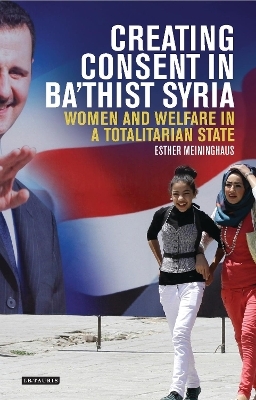
Creating Consent in Ba‘thist Syria
Women and Welfare in a Totalitarian State
Seiten
2016
I.B. Tauris (Verlag)
978-1-78453-115-7 (ISBN)
I.B. Tauris (Verlag)
978-1-78453-115-7 (ISBN)
An examination of the attempts authoritarian Syria has made to create consent for its rule.
The challenge of maintaining dictatorial regimes through control, co-option and coercion while upholding a facade of legitimacy is something that has concerned leaders throughout the Middle East and beyond. Nowhere is this more evident than in the Syria ruled by the Asads, both Hafiz and his son Bashar. Drawing on the example of the General Union of Syrian Women (founded in 1967), Esther Meininghaus offers new insights into how the Syrian Ba'thist regimes attempted to move beyond mere satisfaction with the compliance of the citizenry and to consolidate their rule amongst the local population. Meininghaus argues that this was partially achieved through providing welfare services delivered by the Union as one of the state-led mass organisations. In this way, she suggests, these regimes did not only aim to undermine opposition and to create the illusion of consent, but they factually catered to local needs and depended on consent. Based on archival material, interviews and statistics, Creating Consent in Ba'thist Syria will shed new light on mass organisations as a crucial institution of Ba'thist state building and, more broadly, the construction of the Asad regimes.
The challenge of maintaining dictatorial regimes through control, co-option and coercion while upholding a facade of legitimacy is something that has concerned leaders throughout the Middle East and beyond. Nowhere is this more evident than in the Syria ruled by the Asads, both Hafiz and his son Bashar. Drawing on the example of the General Union of Syrian Women (founded in 1967), Esther Meininghaus offers new insights into how the Syrian Ba'thist regimes attempted to move beyond mere satisfaction with the compliance of the citizenry and to consolidate their rule amongst the local population. Meininghaus argues that this was partially achieved through providing welfare services delivered by the Union as one of the state-led mass organisations. In this way, she suggests, these regimes did not only aim to undermine opposition and to create the illusion of consent, but they factually catered to local needs and depended on consent. Based on archival material, interviews and statistics, Creating Consent in Ba'thist Syria will shed new light on mass organisations as a crucial institution of Ba'thist state building and, more broadly, the construction of the Asad regimes.
Esther Meininghaus teaches Sociology at the University of Manchester. She holds a PhD in Middle Eastern Studies from the University of Manchester.
Chapter 1: Introduction
Chapter 2: The Roots of Women’s Educational, Social and Political Engagement in Syria
Chapter 3: Mass Organisation in Ba'thist State Building and the Establishment of the Union
Chapter 4: Union Membership and Mobilisation (1967-2008)
Chapter 5: Reaching Out to Every Woman
Chapter 6: Administration of Union Membership and Activities
Chapter 7: Conclusion
| Zusatzinfo | 20 bw integrated, 2 maps, 49 figures |
|---|---|
| Sprache | englisch |
| Maße | 138 x 216 mm |
| Gewicht | 623 g |
| Themenwelt | Geisteswissenschaften ► Geschichte ► Regional- / Ländergeschichte |
| Geschichte ► Teilgebiete der Geschichte ► Kulturgeschichte | |
| Sozialwissenschaften ► Pädagogik ► Sozialpädagogik | |
| Sozialwissenschaften ► Soziologie ► Gender Studies | |
| ISBN-10 | 1-78453-115-4 / 1784531154 |
| ISBN-13 | 978-1-78453-115-7 / 9781784531157 |
| Zustand | Neuware |
| Informationen gemäß Produktsicherheitsverordnung (GPSR) | |
| Haben Sie eine Frage zum Produkt? |
Mehr entdecken
aus dem Bereich



aus dem Bereich
Die Revolution des Gemeinen Mannes
Buch | Softcover (2024)
C.H.Beck (Verlag)
CHF 16,80
Eine Geschichte des Geschmacks
Buch | Hardcover (2025)
C.H.Beck (Verlag)
CHF 49,95
vom Mittelalter bis zur Gegenwart
Buch | Softcover (2024)
C.H.Beck (Verlag)
CHF 16,80


