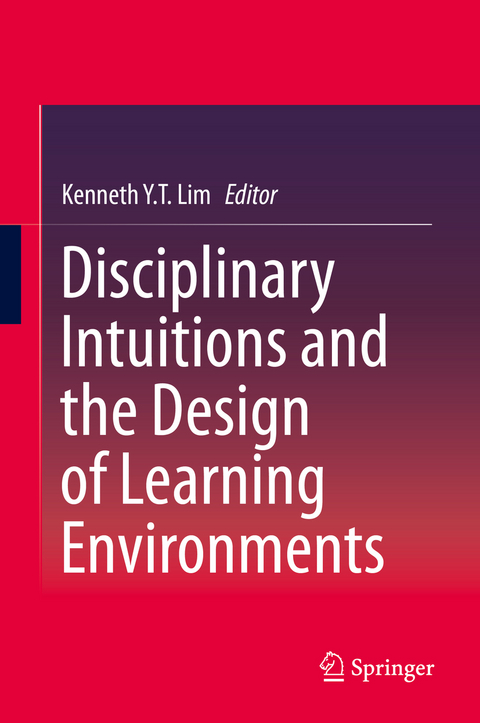
Disciplinary Intuitions and the Design of Learning Environments (eBook)
XXIII, 201 Seiten
Springer Singapore (Verlag)
978-981-287-182-4 (ISBN)
Many of the chapters within draw frequent and explicit linkages to curriculum design, from the premise of the need to go beyond addressing the conceptions of learners, to seeking to understand the substrate upon which these conceptions are founded. The argument is made that this substrate comprises the particular set of lived experiences of each learner, and how - because these lived experiences are as tacit as they are diverse - designing curriculum around misconceptions and preconceptions alone would not lead to enduring understanding from first principles. From this perspective, Disciplinary Intuitions constitute an exciting field at the nexus of learning theories and curriculum design.
Kenneth Y. T. Lim is a Research Scientist at the National Institute of Education, Nanyang Technological University, Singapore. Prior to his appointment, he taught geography and social studies in several schools and junior colleges in Singapore, as well as served as a Curriculum Designer in the Ministry of Education. He received his Masters in Technology-in-Education from Harvard and built on this during his doctoral research on adolescent spatial cognition. Kenneth's present research interests lie in maker movements and the affordances for learning of fictive worlds and virtual environments, for which he has developed the Six Learnings curriculum framework. As a theory of learning, Disciplinary Intuitions undergirds his work in maker movements and in immersive environments.
As children, we would have spilt glasses of milk, dropped things, and broken things. As children, therefore, we would have developed intuitions about how the world 'works', but we would not necessarily have been able to explain these 'workings'. It would only have been till we entered formal schooling that we would have learned codifications of canon within each respective discipline, and consequently how to articulate the canon to explain the intuition.The preceding example was from the natural sciences, but one could just have easily taken an example from, say, the environmental sciences or from the social sciences. Indeed, much of this book does just that, as it seeks to chart the territory of a new theory of learning around Disciplinary Intuitions.Many of the chapters within draw frequent and explicit linkages to curriculum design, from the premise of the need to go beyond addressing the conceptions of learners, to seeking to understand the substrate upon which these conceptions are founded. The argument is made that this substrate comprises the particular set of lived experiences of each learner, and how - because these lived experiences are as tacit as they are diverse - designing curriculum around misconceptions and preconceptions alone would not lead to enduring understanding from first principles. From this perspective, Disciplinary Intuitions constitute an exciting field at the nexus of learning theories and curriculum design.
Kenneth Y. T. Lim is a Research Scientist at the National Institute of Education, Nanyang Technological University, Singapore. Prior to his appointment, he taught geography and social studies in several schools and junior colleges in Singapore, as well as served as a Curriculum Designer in the Ministry of Education. He received his Masters in Technology-in-Education from Harvard and built on this during his doctoral research on adolescent spatial cognition. Kenneth’s present research interests lie in maker movements and the affordances for learning of fictive worlds and virtual environments, for which he has developed the Six Learnings curriculum framework. As a theory of learning, Disciplinary Intuitions undergirds his work in maker movements and in immersive environments.
PART ONE Theoretical and historical foundationsChapter 1 Intuitions all around usChapter 2 On the nature of Disciplinary IntuitionsChapter 3 Learning through intuition in early ChinaChapter 4 Applying Disciplinary Intuitions to classroom contexts: a constructivist perspective PART TWO Delving into DisciplinesChapter 5 Developing Disciplinary Intuitions in the Natural SciencesChapter 6 The nature of Intuition in DesignChapter 7 From seasons to cisterns - the nature of Geographical IntuitionChapter 8 Second Language Intuition: native language and linguistic universalsChapter 9 Manifestations of intuitions in the English LanguageChapter 10 Disciplinary Intuitions in the English Language classroom: implications for practiceChapter 11 Surfacing Intuitions through visual novelsChapter 12 Mathematical Intuition and storytelling for meaningful learningPART THREE CodaChapter 13 Disciplinary Intuitions as Praxis: the role of Intuition in Social EducationChapter 14 Misconceptions, Intuitions and Elementary Physics: harnessing everyday understanding in learning environment design
| Erscheint lt. Verlag | 19.10.2014 |
|---|---|
| Zusatzinfo | XXIII, 201 p. 31 illus. |
| Verlagsort | Singapore |
| Sprache | englisch |
| Themenwelt | Geisteswissenschaften ► Psychologie ► Pädagogische Psychologie |
| Sozialwissenschaften ► Pädagogik ► Schulpädagogik / Grundschule | |
| Schlagworte | Curriculum Design • disciplinary intuitions • intuitions and learning • Learning and Instruction • Non-formal learning • Prior knowledge • Tacit Knowledge |
| ISBN-10 | 981-287-182-9 / 9812871829 |
| ISBN-13 | 978-981-287-182-4 / 9789812871824 |
| Informationen gemäß Produktsicherheitsverordnung (GPSR) | |
| Haben Sie eine Frage zum Produkt? |
 PDF (Wasserzeichen)
DRM: Digitales Wasserzeichen
Dieses eBook enthält ein digitales Wasserzeichen und ist damit für Sie personalisiert. Bei einer missbräuchlichen Weitergabe des eBooks an Dritte ist eine Rückverfolgung an die Quelle möglich.
Dateiformat: PDF (Portable Document Format)
Mit einem festen Seitenlayout eignet sich die PDF besonders für Fachbücher mit Spalten, Tabellen und Abbildungen. Eine PDF kann auf fast allen Geräten angezeigt werden, ist aber für kleine Displays (Smartphone, eReader) nur eingeschränkt geeignet.
Systemvoraussetzungen:
PC/Mac: Mit einem PC oder Mac können Sie dieses eBook lesen. Sie benötigen dafür einen PDF-Viewer - z.B. den Adobe Reader oder Adobe Digital Editions.
eReader: Dieses eBook kann mit (fast) allen eBook-Readern gelesen werden. Mit dem amazon-Kindle ist es aber nicht kompatibel.
Smartphone/Tablet: Egal ob Apple oder Android, dieses eBook können Sie lesen. Sie benötigen dafür einen PDF-Viewer - z.B. die kostenlose Adobe Digital Editions-App.
Buying eBooks from abroad
For tax law reasons we can sell eBooks just within Germany and Switzerland. Regrettably we cannot fulfill eBook-orders from other countries.
aus dem Bereich