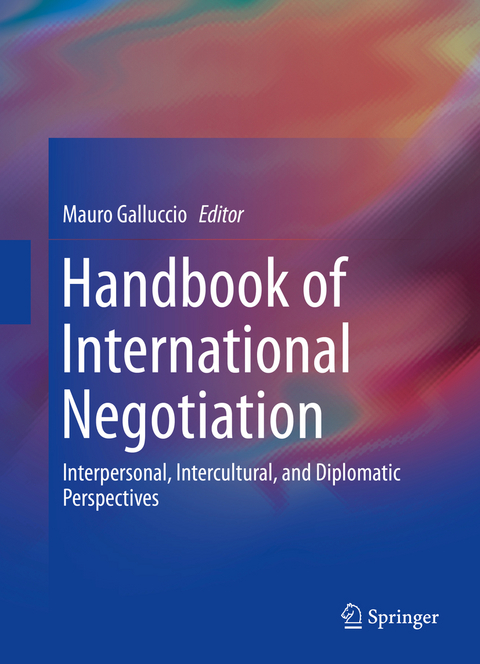
Handbook of International Negotiation (eBook)
XLIX, 438 Seiten
Springer International Publishing (Verlag)
978-3-319-10687-8 (ISBN)
Mauro Galluccio received his PhD in Political Science from the Free University of Brussels, Belgium. He is the President of the European Association for Negotiation and Mediation (EANAM), based in Brussels. Dr. Galluccio studied for a long time in Italy and has a degree in both political sciences and psychological sciences and techniques for the persons and the community. He has given many speeches, presented numerous papers and symposia at international conferences and congresses on the subject of International Relations, with a particular interest in the application of cognitive-behavioral psychotherapy principles to the field of political sciences. As lecturer on behalf of the Directorate-General Communication of the European Commission he gives conferences to many International Universities, enterprises, and national administrations from different Countries. Dr. Galluccio has worked within the European institutional framework as political analyst and adviser. He was political coordinator at the Directorate-General of the European Commission for Development and Relations with African, Caribbean and Pacific States. Previously he was Spokesman to the President of COPA and coordinator of the Crisis Management Unit at the COPA-COGECA. Among Dr. Galluccio's research interests are those on applied cognitive psychology and psychotherapy; interpersonal negotiations; specific training for negotiators and politicians; preventive diplomacy and conflict resolution; Common Foreign and Security Policy for the European Union; the European Union internal negotiation processes and institutional external communication. He is coauthor of Psychological processes in international negotiations: theoretical and practical perspectives (with F. Aquilar, New York, 2008).
Mauro Galluccio received his PhD in Political Science from the Free University of Brussels, Belgium. He is the President of the European Association for Negotiation and Mediation (EANAM), based in Brussels. Dr. Galluccio studied for a long time in Italy and has a degree in both political sciences and psychological sciences and techniques for the persons and the community. He has given many speeches, presented numerous papers and symposia at international conferences and congresses on the subject of International Relations, with a particular interest in the application of cognitive-behavioral psychotherapy principles to the field of political sciences. As lecturer on behalf of the Directorate-General Communication of the European Commission he gives conferences to many International Universities, enterprises, and national administrations from different Countries. Dr. Galluccio has worked within the European institutional framework as political analyst and adviser. He was political coordinator at the Directorate-General of the European Commission for Development and Relations with African, Caribbean and Pacific States. Previously he was Spokesman to the President of COPA and coordinator of the Crisis Management Unit at the COPA-COGECA. Among Dr. Galluccio’s research interests are those on applied cognitive psychology and psychotherapy; interpersonal negotiations; specific training for negotiators and politicians; preventive diplomacy and conflict resolution; Common Foreign and Security Policy for the European Union; the European Union internal negotiation processes and institutional external communication. He is coauthor of Psychological processes in international negotiations: theoretical and practical perspectives (with F. Aquilar, New York, 2008).
Section I Decision Making Approaches to Negotiation.- 1.Representative Decision Making: Challenges to Democratic Peace Theory.- 2.Tacit knowledge awareness and its role in Improving the Decisions-making process in international negotiations.- 3.A Psychotherapeutic View of Decision Making: Implications for Peaceful Negotiations.- 4.Moral disengagement in “War fever.” How Can We Resist?.- Section II Re-framing Approaches to Negotiation.- 5.The Biology of Cooperative decision-making: Neurobiology to International Relations.- 6.Psychological Dynamics of Insight: Relevance to International Negotiation.- 7.Why is it so Difficult to Resolve Intractable Conflicts Peacefully? A Socio-Psychological Explanation.- 8.Dignity in Negotiation: Its Transforming Power.- Section III Conflict Management and International Negotiation.- 9.Negotiating Conflict Transformations.- 10.The Evolution of Readiness Theory.- 11.Why is Mediation So Hard? The Case of Syria.- 12.Underpinning Conflict Prevention by International Cooperation.- Section IV Emotions Regulation in Negotiation.- 13.Improving Negotiation Effectiveness with Skills of Emotional Competence.- 14.International Negotiation and Emotional Intelligence.- 15.From Conflict to Peace through Emotional Regulation and Co-operation.- 16.Mindfulness Based Training for Negotiators: Fostering Resilience in the Face of Stress.- Section V Cognitive and Behavioural Approach to Negotiation.- 17.A Cognitive Insight on Cooperation and Conflict.- 18.Impediments and Strategies in Negotiating: A Cognitive Therapy Model.- 19.Negotiating in the world of mixed beliefs and values systems: A compassion focused model.- 20.Cognitive Behavioral Therapy inspiring values in the planning and management of Lebanon National Conflict Resolution: A Brief Essay.- Section VI The Intercultural Dimension of International Negotiation.- 21.Reflections on The Cultural Contexts of Conflict Resolution Via Truth and Reconciliation Processes.- 22.On Instinctive Human Peace versus War.- 23.Beyond Impasse: Addressing Sacred Values in International Political Negotiations.- 24.Developing a Global Community: A Social Psychological Perspective.- Section VII Diplomacy and International Negotiation.- 25.An inquiry on war and peace.- 26.Negotiating Partners: Friends or Foes?.- 27.Environment and Science: Finding Common Ground through International Agreements. An Insider’s View of Negotiation Processes.- 28.Micro-negotiation in the Security Sector Advising Context: A Case Study from Afghanistan.- 29.International Cooperation and Negotiation in Practice.- 30.Diplomacy meets Science: Negotiating Responsible and Inclusive Growth.
| Erscheint lt. Verlag | 4.12.2014 |
|---|---|
| Zusatzinfo | XLIX, 438 p. 7 illus., 3 illus. in color. |
| Verlagsort | Cham |
| Sprache | englisch |
| Themenwelt | Geisteswissenschaften ► Psychologie ► Klinische Psychologie |
| Sozialwissenschaften ► Politik / Verwaltung | |
| Schlagworte | cognitive resources • Conflict Management • Conflict Resolution • diplomatic perspectives • emotional competence • Emotional Intelligence • emotional resources • European Union • global conflict resolution • human conflict • Human Rights • Intercultural perspectives • International Negotiation • interpersonal alliances • interpersonal perspectives • negotiation process • negotiations in underdeveloped countries • North Korea • peaceful negotiation |
| ISBN-10 | 3-319-10687-2 / 3319106872 |
| ISBN-13 | 978-3-319-10687-8 / 9783319106878 |
| Informationen gemäß Produktsicherheitsverordnung (GPSR) | |
| Haben Sie eine Frage zum Produkt? |
 PDF (Wasserzeichen)
DRM: Digitales Wasserzeichen
Dieses eBook enthält ein digitales Wasserzeichen und ist damit für Sie personalisiert. Bei einer missbräuchlichen Weitergabe des eBooks an Dritte ist eine Rückverfolgung an die Quelle möglich.
Dateiformat: PDF (Portable Document Format)
Mit einem festen Seitenlayout eignet sich die PDF besonders für Fachbücher mit Spalten, Tabellen und Abbildungen. Eine PDF kann auf fast allen Geräten angezeigt werden, ist aber für kleine Displays (Smartphone, eReader) nur eingeschränkt geeignet.
Systemvoraussetzungen:
PC/Mac: Mit einem PC oder Mac können Sie dieses eBook lesen. Sie benötigen dafür einen PDF-Viewer - z.B. den Adobe Reader oder Adobe Digital Editions.
eReader: Dieses eBook kann mit (fast) allen eBook-Readern gelesen werden. Mit dem amazon-Kindle ist es aber nicht kompatibel.
Smartphone/Tablet: Egal ob Apple oder Android, dieses eBook können Sie lesen. Sie benötigen dafür einen PDF-Viewer - z.B. die kostenlose Adobe Digital Editions-App.
Buying eBooks from abroad
For tax law reasons we can sell eBooks just within Germany and Switzerland. Regrettably we cannot fulfill eBook-orders from other countries.
aus dem Bereich