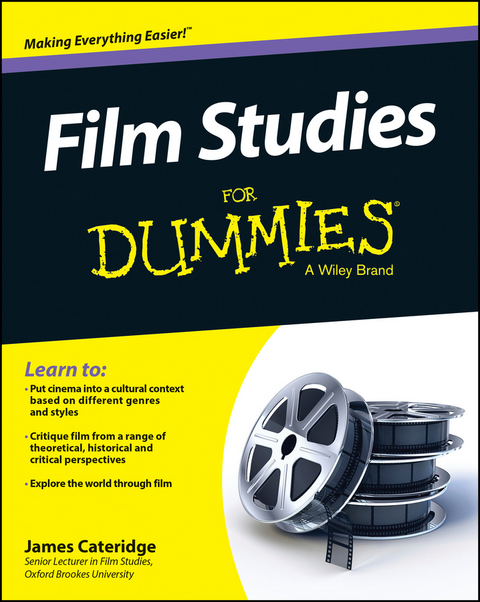
Film Studies For Dummies (eBook)
John Wiley & Sons (Verlag)
978-1-118-88656-4 (ISBN)
Want to pull back the curtain on film? This hands-on, friendly guide unravels the complexities of film and helps you put cinema into a cultural context, You'll get an easy-to-follow introduction to different film genres and styles, learn about the history of cinema, get to know who makes up a filmmaking team, explore global cinema from Hollywood to Bollywood and much more,
Film Studies For Dummies will open your mind to how the film industry works and help you to discover the impact of film on popular culture, You'll get easy-to-read information on analyzing and critiquing film from a range of theoretical, historical and critical perspectives, and learn how people communicate ideas in film, You'll also be able to shine a light on how stories are developed in movies, understand how a storyline is related to broader issues in society and become a well-versed and insightful film student,
- Covers the narrative, artistic, cultural, economic and political implications of cinema
- Provides conceptual frameworks for understanding a film's relationship to reality
- Explores how people tell stories and communicate ideas in film
- Helps you excel as a student of film
Whether you're planning to study film, a humanities student with a forthcoming module on film or a film enthusiast wondering if this might be the future for you, Film Studies For Dummies has you covered,
James Cateridge is Senior Lecturer in Film Studies at Oxford Brookes University, He researches and teaches British cinema, film policy and the international film industry, James has also worked with the Arts Council of England and as a film journalist for the London Film Festival,
Film Studies From Hollywood to Bollywood, explore the fantastic world of film Whether you re preparing to study film at university or you simply have a passion for cinema, you re bound to enjoy this book. Here s where you ll learn how people communicate ideas in films, how the industry works and who s on the team, the impact of film on popular culture, the different genres and styles, film theory, the joys of animation and so much more. Explore far-reaching effects examine the narrative, artistic, cultural, economic and political implications of cinema Compare and contrast film and reality explore conceptual frameworks for a film s relationship to reality Find out just how they do it discover how stories are developed in movies and how a storyline is related to broader issues in society Work out what it s all about get to grips with avant-garde cinema and find out what such films really offer Take the incredible world tour sample the unique styles of cinema in Europe, Japan, India and other countries Go larger than life learn about greats in the industry, venture into film analysis and look at the transitions into 21st century cinema Open the book and find: How people tell stories in film Ways film is used to explore current issues and attitudes Responsibilities of cinema tographers and producers The mysteries of mise-en-scene All about digital-age animation Auteurs from the 1930s to today What poststructuralism and postmodernism really mean Ten must-watch movies
James Cateridge is Senior Lecturer in Film Studies at Oxford Brookes University. He researches and teaches British cinema, film policy and the international film industry. James has also worked with the Arts Council of England and as a film journalist for the London Film Festival.
Introduction 1
Part I: Getting Started with Film Studies 5
Chapter 1: Becoming a Fantastic Film Student 7
Chapter 2: Putting Words and Pictures into Motion: The Film-Making Team 25
Chapter 3: Watching the Stars Come Out: Film Stars, and Why We Love Them 47
Chapter 4: Building Movie Stories 67
Part II: Taking All Types: Genres, Modes and Style 89
Chapter 5: Distinguishing Films by Type: Genres and Style 91
Chapter 6: Getting Animated about Animation 123
Chapter 7: Leading from the Front: Avant-Garde Film 141
Chapter 8: Getting Real: The Truth about Documentary 157
Part III: Travelling a World of Wonders: Global Cinema 177
Chapter 9: Bringing Hollywood into Focus 179
Chapter 10: Enjoying the British Invasion: From Brit-Grit to Frock Flicks 201
Chapter 11: Admiring European Films: Culture and Commerce 221
Chapter 12: Mixing Monsters, Musicals and Melodrama: World Cinema 241
Part IV: Bringing In the Big Ideas: Theories and Beyond 261
Chapter 13: Theorising about Film: How Movies Work 263
Chapter 14: Praising Great Directors: Auteur Theory 283
Chapter 15: Exploring New Approaches to Film Theory - and Beyond 307
Chapter 16: Outliving Celluloid: Cinema in the 21st Century 325
Part V: The Part of Tens 343
Chapter 17: Ten Film Writers You Need to Read 345
Chapter 18: Ten Must-Watch Movies 353
Chapter 19: Ten Film-Makers You Need to Know Better 363
Chapter 20: Ten Tips for Becoming a Film Student 371
Index 379
Chapter 1
Becoming a Fantastic Film Student
In This Chapter
Starting your film studies journey
Analysing the building blocks of film
Appreciating the importance of films to the world
Film studies is about appreciating, understanding and explaining the greatest art form of the 20th century, which despite repeated predictions to the contrary is still going strong. The discipline involves research into and analysis of films, first and foremost, but also film-makers, film cultures, the film industry and film audiences.
To fulfil its aims, film studies borrows the best methods and theories from other academic areas, notably literary (or other cultural) studies and philosophy, as well as political science, sociology and psychology. In addition, analysing films uses similar tools to analysing paintings and photographs, but with the essential addition of movement.
If you already love film and want to become a film student, you’ve come to the right place. In this chapter, I take you through the basics of studying film: from learning how to watch films critically, to understanding the different types of film writing that you can use for research, to justifying the meaning and importance of cinema for the wider world. Everyone knows that film is important, but as a film student you need to develop ways to say why and how it matters.
Upping Your Cinematic Game
To study films, you have to do more than simply watch them; you have to try to understand them, which doesn’t just happen – studying films requires time and effort. And put on your leggings, like the kids from Fame (1980), cos right here’s where you start paying. In sweat.
Going beyond merely watching films
Luckily, many (if not most) people love watching films. But many people decide that simply enjoying movies is enough for them, or even worry that studying films may destroy the pleasure they take from them.
You needn’t worry about ruining the fun of watching films as you step into the world of film studies. Studying films not only helps you to understand why everyone needs a bit of escapism, but also offers entirely new ways to enjoy cinema:
- Understanding cinematic narrative structures can make even the dumbest action movie seem quite profound (check out Chapters 4 and 5).
- Knowing about film history can make a 100-year-old silent film as fresh and exciting as the day it was first screened (see Chapter 2 to read about early cinema).
- Appreciating the many techniques, skills and creative decisions that go into creating a successful picture can keep you interested even when the story sags.
- Viewing a wider range of films builds up your reference points and helps you understand how the classics influence contemporary cinema.
- Reading and appreciating film criticism means that you always have an opinion about what you just saw. Prepare yourself to start winning pub debates with ease.
Film studies is fun, yes, but that doesn’t necessarily mean that it’s easy. You’ve been watching films in your own particular way for most of your life, and making the effort to step back and analyse something so instinctive and pleasurable can be quite difficult. Like trying to explain why you love ice cream – or sausages!
To start doing this kind of analysis, I recommend starting with your favourite film of all time. I don’t mean the film you use as your favourite to impress people (step forward, Citizen Kane). I mean your genuine favourite, the one you watch while you’re ill in bed or after getting back from a late night out.
Ask yourself what you enjoy about this film: the familiar storyline or the rewarding pay-off when the protagonists complete their journeys? Do you relate to one particular character or does the film showcase your favourite star (the person you want to be like or be with)? Or does the music – or the gorgeous images – keep you coming back?
Whatever your main reason (and be honest), focus on that and watch your film again, by yourself with no interruptions. This time, take notes. Doing so is really important. Write down every thought that occurs to you about how the film works and why you find it enjoyable. Even draw pictures if you want to. Stick men shooting each other can be a surprisingly effective way to capture and recall what is happening on screen.
If you can manage to view and take notes successfully with your favourite film, congratulations, you’ve broken free from the chains of habitual watching and are now analysing, assessing and being critical. That’s where you need to start.
Connecting film studies to other stuff you can study
Film studies is inherently interdisciplinary, which means that it steals the best theories and research methods from other fields of study and applies them to films. This aspect of film studies is useful, because even if you’ve never studied films before you may well have encountered a few film studies methods already.
I hope that the following experiences and related methods come flooding back to you as you read this book.
Studying stories
Analysing storytelling is a process that’s very similar regardless of whether you find the story in a book, on the stage or on the silver screen. So if you spent any time grappling with literary classics at school, you have a basic understanding of concepts such as characterisation and narrative point of view, which you can apply to films.
Look a little deeper and you soon realise that some of the theories you use to understand books and those you use in film studies are strikingly similar. For example, you may be familiar with the notion that you can boil down all stories to seven (or even just three) basic universal plots, which have entertained humans throughout history.
This notion of universal stories or myths comes from a branch of literary theory called structuralism, which also happens to be useful when studying films. Even Hollywood producers use a type of shorthand all the time when describing movies:
- Boy meets girl. Boy hates girl. Boy falls for girl. Boy loses girl. Boy fights to get girl back. Girl gives in.
- Girl versus shark. Shark wins. Boy versus shark. Boy loses first round due to personality flaw. Boy tackles personality flaw. Boy beats shark.
- Cowboy rides into border town. Cowboy shoots bad people. Cowboy rides off into the sunset.
Breaking films down into basic plot elements – and implying that the same stories are repeated over and over with only minor changes – is pure structuralism. So you see, Hollywood isn’t as stupid as it often seems. (For much more on structuralism, flip to Chapter 13.)
Studying people and places
Watching films is an enormously popular activity across the world, and like any large-scale human activity, you can use methods from the social sciences to analyse and explain the phenomenon. When you take a sociological approach to studying film, you’re less interested in the films themselves and more interested in the people who consume or produce them.
Audience research is an important branch of film studies, which gathers data from its human subjects in many different ways. You can achieve broad surveys by using simple questionnaires, or gain more detailed and nuanced analysis through individual interviews or focus groups. The data provided can be quantitative, such as percentages or charts, or qualitative, like explanations of behaviour or emotional responses.
Cinema is a global phenomenon, and so analysing films in relation to places can be helpful. The long-standing and continued interest in studies of national cinemas is the most obvious spatial concern of film studies, as Part III of this book attests. But the national character of film has also been tested by film scholars driven by the concept of transnationalism. For example, studying the films of a population who are displaced or dispersed across many countries or even continents provides a transnational perspective on so-called migrant or diasporic cinema.
Studying the past
To understand how cinema works in a particular place, you also need to think about how it developed over time. Therefore another important area of film studies draws from historical theories and methods. Historical research relies on traces of evidence to help illuminate the past, and so archives of material (including film archives) are vital.
Of course films themselves are a kind of historical evidence, particularly the actuality films (short scenes taken from real life) that were popular in the early days of cinema (see Chapter 2). Just take a look at a few of the Lumière brothers’ films or those of Mitchell and Kenyon in Britain (I delve into British cinema of all sorts in Chapter 10). You soon realise just how much you can discover from looking into the eyes of factory workers as they left to go home at the end of a regular working day, over a century ago.
Focusing on creativity, industry and technology
Film is such a rich, varied and important object of study because it exists at the intersection of...
| Erscheint lt. Verlag | 23.1.2015 |
|---|---|
| Sprache | englisch |
| Themenwelt | Kunst / Musik / Theater ► Film / TV |
| Kunst / Musik / Theater ► Fotokunst | |
| Sachbuch/Ratgeber ► Freizeit / Hobby ► Fotografieren / Filmen | |
| Sozialwissenschaften ► Kommunikation / Medien ► Medienwissenschaft | |
| Schlagworte | Cultural Studies • Film • Filmforschung • Film Studies • Kino • Kulturwissenschaften |
| ISBN-10 | 1-118-88656-9 / 1118886569 |
| ISBN-13 | 978-1-118-88656-4 / 9781118886564 |
| Informationen gemäß Produktsicherheitsverordnung (GPSR) | |
| Haben Sie eine Frage zum Produkt? |
 EPUB (Adobe DRM)
Kopierschutz: Adobe-DRM
Adobe-DRM ist ein Kopierschutz, der das eBook vor Mißbrauch schützen soll. Dabei wird das eBook bereits beim Download auf Ihre persönliche Adobe-ID autorisiert. Lesen können Sie das eBook dann nur auf den Geräten, welche ebenfalls auf Ihre Adobe-ID registriert sind.
Details zum Adobe-DRM
Dateiformat: EPUB (Electronic Publication)
EPUB ist ein offener Standard für eBooks und eignet sich besonders zur Darstellung von Belletristik und Sachbüchern. Der Fließtext wird dynamisch an die Display- und Schriftgröße angepasst. Auch für mobile Lesegeräte ist EPUB daher gut geeignet.
Systemvoraussetzungen:
PC/Mac: Mit einem PC oder Mac können Sie dieses eBook lesen. Sie benötigen eine
eReader: Dieses eBook kann mit (fast) allen eBook-Readern gelesen werden. Mit dem amazon-Kindle ist es aber nicht kompatibel.
Smartphone/Tablet: Egal ob Apple oder Android, dieses eBook können Sie lesen. Sie benötigen eine
Geräteliste und zusätzliche Hinweise
Buying eBooks from abroad
For tax law reasons we can sell eBooks just within Germany and Switzerland. Regrettably we cannot fulfill eBook-orders from other countries.
aus dem Bereich