


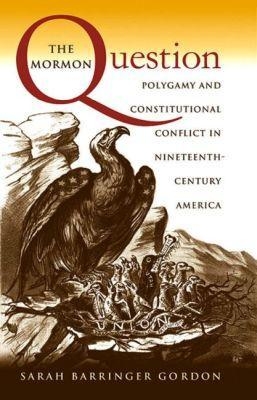
The Mormon Question
Polygamy and Constitutional Conflict in Nineteenth-Century America
Seiten
2002
|
New edition
The University of North Carolina Press (Verlag)
978-0-8078-4987-3 (ISBN)
The University of North Carolina Press (Verlag)
978-0-8078-4987-3 (ISBN)
From 1852, until the Mormon Church's decision to abandon the practice in 1890, the battle over polygamy redefined religious liberty in America. This book discusses the ""Mormon question"" and its legacy in constitutional law and political theory.
How the battle over polygamy redefined religious liberty in America; From the Mormon Church's public announcement of its sanction of polygamy in 1852 until its formal decision to abandon the practice in 1890, people on both sides of the ""Mormon question"" debated central questions of constitutional law. Did principles of religious freedom and local self-government protect Mormons' claim to a distinct, religiously based legal order? Or was polygamy, as its opponents claimed, a new form of slavery - this time for white women in Utah? And did constitutional principles dictate that democracy and true liberty were founded on separation of church and state? As Sarah Barringer Gordon shows, the answers to these questions finally yielded an apparent victory for antipolygamists in the late nineteenth century, but only after decades of argument, litigation, and open conflict. Victory came at a price; as attention and national resources poured into Utah in the late 1870s and 1880s, antipolygamists turned more and more to coercion and punishment in the name of freedom. They also left a legacy in constitutional law and political theory that still governs our treatment of religious life: Americans are free to believe, but they may well not be free to act on their beliefs.
How the battle over polygamy redefined religious liberty in America; From the Mormon Church's public announcement of its sanction of polygamy in 1852 until its formal decision to abandon the practice in 1890, people on both sides of the ""Mormon question"" debated central questions of constitutional law. Did principles of religious freedom and local self-government protect Mormons' claim to a distinct, religiously based legal order? Or was polygamy, as its opponents claimed, a new form of slavery - this time for white women in Utah? And did constitutional principles dictate that democracy and true liberty were founded on separation of church and state? As Sarah Barringer Gordon shows, the answers to these questions finally yielded an apparent victory for antipolygamists in the late nineteenth century, but only after decades of argument, litigation, and open conflict. Victory came at a price; as attention and national resources poured into Utah in the late 1870s and 1880s, antipolygamists turned more and more to coercion and punishment in the name of freedom. They also left a legacy in constitutional law and political theory that still governs our treatment of religious life: Americans are free to believe, but they may well not be free to act on their beliefs.
Sarah Barringer Gordon holds degrees in religion, law, and history. She teaches in the Law School and the History Department at the University of Pennsylvania.
| Erscheint lt. Verlag | 31.1.2002 |
|---|---|
| Reihe/Serie | Studies in Legal History |
| Verlagsort | Chapel Hill |
| Sprache | englisch |
| Maße | 146 x 233 mm |
| Gewicht | 520 g |
| Themenwelt | Religion / Theologie ► Christentum ► Kirchengeschichte |
| Recht / Steuern ► EU / Internationales Recht | |
| Recht / Steuern ► Öffentliches Recht | |
| Sozialwissenschaften ► Soziologie ► Allgemeines / Lexika | |
| ISBN-10 | 0-8078-4987-1 / 0807849871 |
| ISBN-13 | 978-0-8078-4987-3 / 9780807849873 |
| Zustand | Neuware |
| Informationen gemäß Produktsicherheitsverordnung (GPSR) | |
| Haben Sie eine Frage zum Produkt? |
Mehr entdecken
aus dem Bereich


aus dem Bereich
eine andere Geschichte der Papststadt
Buch | Softcover (2024)
C.H.Beck (Verlag)
CHF 25,20


