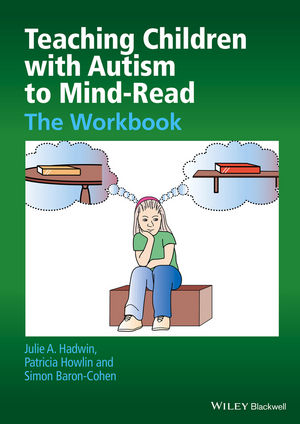
Teaching Children with Autism to Mind-Read (eBook)
John Wiley & Sons (Verlag)
978-1-118-31486-9 (ISBN)
- Complements the best-selling Teaching Children with Autism to Mind-Read: A Practical Guide for use in practical settings
- Answers the need for more training of professionals in early interventions for children assessed with ASD called for by the National Plan for Autism
- Written by a team of experts in the field
- Covers issues such as how to interpret facial expressions; how to recognize feelings of anger, sadness, fear and happiness; how to perceive how feelings are affected by what happens and what is expected to happen; how to see things from another person?s perspective; and how to understand another person?s knowledge and beliefs
Julie Hadwin is Lecturer in Developmental Psychology at Southampton University, UK.
Patricia Howlin is Professor of Clinical Child Psychology at the Institue of Psychiatry, King’s College, London. She is the author of numerous books and articles on intervention in autism, including Children with Autism and Asperger Syndrome (1998).
Simon Baron-Cohen is Professor of Developmental Psychopathology and Director of the Autism Research Centre at Cambridge University, UK, and one of the co-discoverers of the 'theory of mind' deficit in autism. His books include Mindblindness (1995), The Essential Difference (2003) and Autism and Asperger Syndrome: The Facts (2009).
This workbook expands upon the authors? Teaching Children with Autism to Mind-Read: A Practical Guide to present the most effective approaches, strategies, and practical guidelines to help alleviate social and communication problems in individuals with Autism Spectrum Disorders (ASD). Complements the best-selling Teaching Children with Autism to Mind-Read: A Practical Guide for use in practical settings Answers the need for more training of professionals in early interventions for children assessed with ASD called for by the National Plan for Autism Written by a team of experts in the field Covers issues such as how to interpret facial expressions; how to recognize feelings of anger, sadness, fear and happiness; how to perceive how feelings are affected by what happens and what is expected to happen; how to see things from another person?s perspective; and how to understand another person?s knowledge and beliefs
Julie Hadwin is Lecturer in Developmental Psychology at Southampton University, UK. Patricia Howlin is Professor of Clinical Child Psychology at the Institue of Psychiatry, King's College, London. She is the author of numerous books and articles on intervention in autism, including Children with Autism and Asperger Syndrome (1998). Simon Baron-Cohen is Professor of Developmental Psychopathology and Director of the Autism Research Centre at Cambridge University, UK, and one of the co-discoverers of the 'theory of mind' deficit in autism. His books include Mindblindness (1995), The Essential Difference (2003) and Autism and Asperger Syndrome: The Facts (2009).
1 Introduction 1
Julie A. Hadwin, Hanna Kovshoff, Simon Baron-Cohen and Patricia Howlin
2 Visual Perspective Taking 9
Level 1: Simple Perspective Taking 10
Level 2: Complex Perspective Taking 14
3 Conceptual Perspective Taking 17
Level 3: Seeing Leads to Knowing 21
Level 4: True Belief 44
Level 5: False Belief 65
Level 6: Embedded Beliefs 106
Appendix 128
Bibliography 137
Postscript 140
Index 145
'Without being aware of it we all continuously attribute mental states, such as desires and beliefs, to other people, and in this way we predict what they are going to do next. This is what children and adults with autism cannot do spontaneously. But, years of painstaking research has shown that they can be taught to do it. Clearly, this does not turn them into spontaneous mentalisers, but it does benefit their understanding of the otherwise unpredictable social world.
'In their scholarly introduction to the book the authors review an impressive number of training studies using different types of teaching aids. Informed by scientific evidence, and without any hype, they offer the best of these in The Workbook. It contains teaching aids in picture and story form that are bound to inspire teachers. The general approach is to build up a sequence of skills in line with the sequence observed in typical development; from joint attention, to pretend play, to perspective taking, to understanding emotions, desire and more complex informational mental states such as knowledge and ignorance, and finally complex second order beliefs (eg: "he thinks that she believes he is telling the truth"). It is with these complex mental states that the new workbook has expanded most over the previous one.
'This manual provides an invaluable source of ideas and techniques on how to teach children and adults with autism about mental states, and it never loses sight of the need to link this teaching to their social skills in everyday life.'
--Professor Uta Frith, University College London, UK
"The Workbook joins the authors' seminal Teaching Children with Autism to Mind-Read: A Practical Guide for Teachers and Parents in providing research-based protocols for developing and advancing mentalizing skills and social cognition in children with autism spectrum conditions. It extends the program provided in the book, offering scientifically validated, though clear and simple-to-use, principles for the understanding of informational states, as well as illuminating stories, examples and activities, promoting the generalization of the principles acquired.
"The Workbook is highly recommended for parents, teachers, and clinicians wishing to base their work on rigorous scientific knowledge of how the understanding of others' minds works, and how this can be improved in children on the autistic spectrum."
--Dr Ofer Golan, Head of the Child Clinical Program, Bar-Ilan University, Israel
| Erscheint lt. Verlag | 17.12.2014 |
|---|---|
| Sprache | englisch |
| Themenwelt | Geisteswissenschaften ► Psychologie |
| Sozialwissenschaften ► Pädagogik ► Sonder-, Heil- und Förderpädagogik | |
| Schlagworte | Autism • Autismus • Bildungswesen • children • Communication • Development • Education • Educational & School Psychology • Erziehungs- u. Schulpsychologie • Learning Disabilities • Lernstörungen, Lernschwächen • Lernstörungen, Lernschwächen • Pädagogik • Pädagogik • Psychologie • Psychology • Social • Theory of Mind • Workbook |
| ISBN-10 | 1-118-31486-7 / 1118314867 |
| ISBN-13 | 978-1-118-31486-9 / 9781118314869 |
| Informationen gemäß Produktsicherheitsverordnung (GPSR) | |
| Haben Sie eine Frage zum Produkt? |
 EPUB (Adobe DRM)
Kopierschutz: Adobe-DRM
Adobe-DRM ist ein Kopierschutz, der das eBook vor Mißbrauch schützen soll. Dabei wird das eBook bereits beim Download auf Ihre persönliche Adobe-ID autorisiert. Lesen können Sie das eBook dann nur auf den Geräten, welche ebenfalls auf Ihre Adobe-ID registriert sind.
Details zum Adobe-DRM
Dateiformat: EPUB (Electronic Publication)
EPUB ist ein offener Standard für eBooks und eignet sich besonders zur Darstellung von Belletristik und Sachbüchern. Der Fließtext wird dynamisch an die Display- und Schriftgröße angepasst. Auch für mobile Lesegeräte ist EPUB daher gut geeignet.
Systemvoraussetzungen:
PC/Mac: Mit einem PC oder Mac können Sie dieses eBook lesen. Sie benötigen eine
eReader: Dieses eBook kann mit (fast) allen eBook-Readern gelesen werden. Mit dem amazon-Kindle ist es aber nicht kompatibel.
Smartphone/Tablet: Egal ob Apple oder Android, dieses eBook können Sie lesen. Sie benötigen eine
Geräteliste und zusätzliche Hinweise
Buying eBooks from abroad
For tax law reasons we can sell eBooks just within Germany and Switzerland. Regrettably we cannot fulfill eBook-orders from other countries.
aus dem Bereich