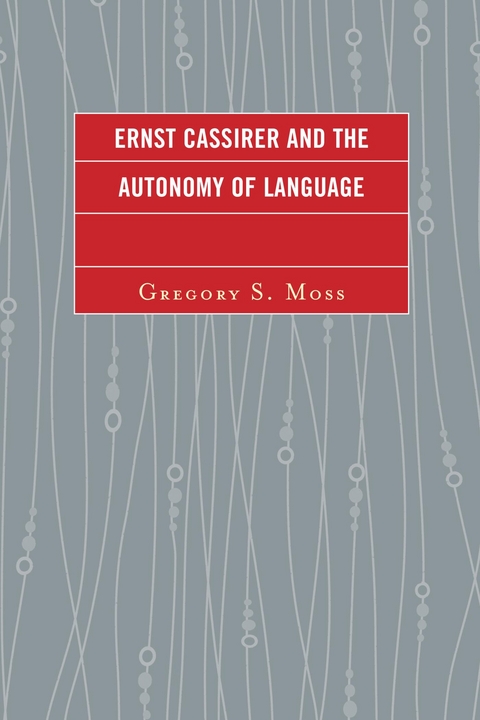
Ernst Cassirer and the Autonomy of Language (eBook)
276 Seiten
Lexington Books (Verlag)
978-0-7391-8623-7 (ISBN)
Ernst Cassirer and the Autonomy of Language examines the central arguments in Cassirer's first volume of the Philosophy of Symbolic Forms. Gregory Moss demonstrates both how Cassirer defends language as an autonomous cultural form and how he borrows the concept of the "e;concrete universal"e; from G. W. F. Hegel in order to develop a concept of cultural autonomy. While Cassirer rejected elements of Hegel's methodology in order to preserve the autonomy of language, he also found it necessary to incorporate elements of Hegel's method to save the Kantian paradigm from the pitfalls of skepticism. Moss advocates for the continuing relevanceof Cassirer's work on language by situating it within in the context of contemporary linguistics and contemporary philosophy. This book provides a new program for investigating Cassirer's work on the other forms of cultural symbolism in his Philosophy of Symbolic Forms, by showing how the autonomy of culture is one of the leading questions motivating Cassirer's philosophy of culture. With a thorough comparison of Cassirer's theory of symbolism to other dominant theories from the twentieth century, including Heidegger and Wittgenstein, this book provides valuable insight for studies in philosophy of language, semiotics, epistemology, pyscholinguistics, continental philosophy, Neo-Kantian philosophy, and German idealism.
Gregory Moss received his PhD in philosophy from the University of Georgia in 2014.
1. Hegelian Psycholinguistics 2. The Copy Theory of Language 3. Kant’s Transcendental Turn 4. Humboldt’s Philosophy of Language 5. Towards the Schematism: Hegel’s Concrete Universal 6. The Concrete Universal: Symbolic Form 7. Mystical Alternatives: Heidegger and Wittgenstein 8. On the Way to Cultural Symbolism 9. Non-Human Communication 10. The A priori Synthetic Imagination 11. Symbolic Prägnanz 12. The Grammar of the Symbolic Function 13. The Logical Function of Language 14. Form as Movement: Language as Concrete Universal 15. Beyond Language: The Serial Form of Scientific Law 16. Language: the Vehicle of Self-Knowledge
| Erscheint lt. Verlag | 12.11.2014 |
|---|---|
| Sprache | englisch |
| Themenwelt | Geisteswissenschaften ► Philosophie ► Allgemeines / Lexika |
| Geisteswissenschaften ► Philosophie ► Erkenntnistheorie / Wissenschaftstheorie | |
| Geisteswissenschaften ► Philosophie ► Philosophie der Neuzeit | |
| Geisteswissenschaften ► Philosophie ► Sprachphilosophie | |
| Geisteswissenschaften ► Sprach- / Literaturwissenschaft ► Sprachwissenschaft | |
| Sozialwissenschaften | |
| Schlagworte | Continental Philosophy • Cultural Studies • German Idealism • Hegel • Heidegger • History of Philosophy • Neo-Kantianism • Philosophy of Symbolic Forms • Semiotics • Wittgenstein |
| ISBN-10 | 0-7391-8623-X / 073918623X |
| ISBN-13 | 978-0-7391-8623-7 / 9780739186237 |
| Informationen gemäß Produktsicherheitsverordnung (GPSR) | |
| Haben Sie eine Frage zum Produkt? |
 EPUB (Adobe DRM)
Kopierschutz: Adobe-DRM
Adobe-DRM ist ein Kopierschutz, der das eBook vor Mißbrauch schützen soll. Dabei wird das eBook bereits beim Download auf Ihre persönliche Adobe-ID autorisiert. Lesen können Sie das eBook dann nur auf den Geräten, welche ebenfalls auf Ihre Adobe-ID registriert sind.
Details zum Adobe-DRM
Dateiformat: EPUB (Electronic Publication)
EPUB ist ein offener Standard für eBooks und eignet sich besonders zur Darstellung von Belletristik und Sachbüchern. Der Fließtext wird dynamisch an die Display- und Schriftgröße angepasst. Auch für mobile Lesegeräte ist EPUB daher gut geeignet.
Systemvoraussetzungen:
PC/Mac: Mit einem PC oder Mac können Sie dieses eBook lesen. Sie benötigen eine
eReader: Dieses eBook kann mit (fast) allen eBook-Readern gelesen werden. Mit dem amazon-Kindle ist es aber nicht kompatibel.
Smartphone/Tablet: Egal ob Apple oder Android, dieses eBook können Sie lesen. Sie benötigen eine
Geräteliste und zusätzliche Hinweise
Buying eBooks from abroad
For tax law reasons we can sell eBooks just within Germany and Switzerland. Regrettably we cannot fulfill eBook-orders from other countries.
aus dem Bereich