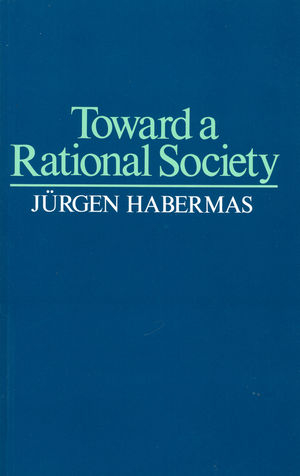
Toward a Rational Society (eBook)
John Wiley & Sons (Verlag)
978-0-7456-9455-9 (ISBN)
Jürgen Habermas is a German philosopher and sociologist in the tradition of critical theory and pragmatism. He is perhaps best known for his theories on communicative rationality and the public sphere. In 2014, Prospect readers chose Habermas as one of their favourites among the "world's leading thinkers". Jeremy J. Shapiro, is an American academic, a professor at Fielding Graduate University who works in the area of critical social theory with emphasis on the social and cultural effects of information technology and systems, social change, and the aesthetics of music.
Translator's Preface vii
Chapter One: The University in a Democracy--Democratization of the University 1
Chapter Two: Student Protest in the Federal Republic of Germany 13
Chapter Three: The Movement in Germany: A Critical Analysis 31
Three Intentions
First Justification: The Theory of Imperialism
Second Justification: Neoanarchism
Third Justification: Cultural Revolution
The Actual Results
The Source of the Protest Potential
What Is to Be Done?
Chapter Four: Technical Progress and the Social Life-World 50
Chapter Five: The Scientization of Politics and Public Opinion 62
Chapter Six: Technology and Science as "Ideology" 81
Notes 123
Index 129
CHAPTER TWO
Student Protest in the Federal Republic of Germany*
Until recently we were convinced that students do not play a political role in developed industrialized societies. They played a revolutionary role in nineteenth-century Russia, in China in the twenties and thirties, and in Cuba in the fifties. In 1956, the revolts in Budapest and Warsaw were set off by student protests. Students are of great political significance especially in the developing areas of Southeast Asia, Latin America, and Africa. Governments in Bolivia, Venezuela, Indonesia, and South Vietnam have been overthrown by students. In countries in which revolutionary nationalist groups, usually army officers, have come to power, students exercise a permanent political pressure. In these cases, three conditions for the politicization of student consciousness are generally present:
None of these conditions is present in advanced industrial societies. In Europe and the United States the university has narrowly circumscribed functions, namely preparation for qualified career positions, the production of technically exploitable knowledge, and the transmission of a culture which for centuries science and technology have been rooted in rather than uprooting. Moreover, there is no opposition in principle between parental orientations and the norms and values of modern achievement-oriented society that prevail at the university. Sociological considerations of this sort have led to the prediction that students in our countries cannot attain political significance.1 Seymour Martin Lipset still holds to this thesis:
A brief comparative look at the situation of the university and educated youth in the emerging and industrially developed societies suggests that student activism cannot take on major proportions in the latter.2
Nevertheless, for two or three years we have been witnessing student protests at our universities that definitely surpass in scope and method the proportions that have been customary since the end of the war. How are we to explain this? I should like to investigate this question, taking West Germany as an example.
I shall concentrate on events in Berlin, for, as is well known, the Free University is the Berkeley of West Germany. Yet the activism of the students of Berlin is echoed at the other West German universities. This has become clear since June 2 of this year. The outrage over the death of Benno Ohnesorg, a politically rather undistinguished student, who was shot by a plainclothesman at a demonstration against the Shah of Iran at the Berlin opera, touched every university in West Germany. Nowhere, to be sure, did these conflicts attain the extent and constancy of the student protests in Berlin, which have been going on since the spring of 1965 and whose end is not yet in sight.
An active, generally highly qualified minority of students, predominantly in the social sciences and humanities, is leading the struggle against the majority of professors, of which the conservative elements are particularly concentrated in the faculties of law and medicine. Since in Germany the universities are state institutions vested with the power of self-government, there are no independent administrations against which students could organize. The faculty is the born opponent. In the intrauniversity conflicts, three points are at issue. Disregarding specific differences, they correspond to the issues designated here by the phrases “free speech,” “knowledge factory,” and “student power.”3
First the question of free speech. The so-called political mandate of the local student government has been disputed since the late forties. The student governments and their umbrella organization, the Verband Deutscher Studentenschaften (Association of German Student Bodies), are compulsory associations based on the automatic membership of all registered students. Hence, the argument that these organizations cannot take a position in the name of student bodies on current political issues is formally correct. On the other hand, the students have pointed out that university problems cannot be neatly separated from those of society as a whole.4 Given the existing authority structures and the actual division of power at the university, the position of strict legality would be an automatic guarantee of failure. Thus, the political mandate has always been practiced and tacitly accepted. But there remained the legal possibility of restricting the liberties actually taken. In the spring of 1965 the Senate Commissioner of Political Education was censured by the Rector for abuse of office because of an invitation to Karl Jaspers to speak on the twentieth anniversary of the German capitulation and liberation from the Nazi regime. Jaspers declined, and the student parliament invited Erich Kuby, the writer and journalist, to speak in his place. Several years before, Kuby had expressed doubt about the state of freedom at the Free University. The Rector used this as an occasion for prohibiting the speech at the Free University, and it had to be given at the Institute of Technology. This was the beginning of a series of causes célébres. The academic authorities saw themselves called upon to repeatedly restrict the scope of the students’ political activity. A few examples: despite his formal apology, an instructor’s contract was not renewed because of vague public statements discrediting the Rector. An exhibition about Vietnam was prevented on grounds of violation of housing ordinances. For a while, the use of lecture halls for political events of a not strictly academic character was absolutely denied. Finally, the academic senate attempted to make an “undesirable” political group ineligible for scholarships.
Now to the second point: the knowledge factory. The universities of West Germany have been expanded hesitantly, without structural change, and have since the late fifties, on recommendation of the Government Council on Education and Culture, been externally adapted to the rapidly growing number of students by a linear expansion of the faculty. In institutes and clinics, laboratories and libraries, the mass university affords conditions that discourage many students. The traditionally rigidified courses of study are often unclearly defined and examinations are in many cases burdened with requirements that are antiquated and oriented to the mere reproduction of facts. Only after the recommendations for a reorganization of studies put forth by the Council on Education and Culture in 1966 did the faculties subject the organization of instruction to certain cosmetic operations in order to prevent further interventions. But within a fixed budget and an untouched hierarchical order, these efforts had the immediate effect only of creating more regulation of teaching and study as well as an administratively forced curtailment of attendance at the university. Two of the Berlin faculties hurried to introduce a time limit to immatriculation, that is, to forcibly limit the amount of time that could be spent at the university. There is no doubt that the high dropout rate and the extended duration of study are the result not of bad work attitudes or a poor selection of students, but primarily of catastrophic study conditions and an inadequate organization of university instruction. The students were thus rightly outraged. In the summer of 1966 they demonstratively took action against the restrictive application of the recommendations of the Council. This confrontation resulted in the first major sit-in, in which about three thousand students participated, and led to the establishment of joint commissions on the reform of university study, whose efficacy, nevertheless, remained limited.
This leads us to the third point: student power. Despite an extensive rhetoric of reform, the only comprehensive conceptions for universities in a democratically constituted industrial society have been worked out by students. In the early sixties the Verband Deutscher Studentenschaften, and the Sozialistische Deutsche Studentenbund (German Socialist Student Union, SDS) compiled programs for university reform. Both aimed at the...
| Erscheint lt. Verlag | 8.12.2014 |
|---|---|
| Übersetzer | Jeremy J. Shapiro |
| Sprache | englisch |
| Themenwelt | Geisteswissenschaften |
| Sozialwissenschaften ► Politik / Verwaltung | |
| Sozialwissenschaften ► Soziologie ► Allgemeine Soziologie | |
| Schlagworte | Continental Philosophy • democracydemocratization • Federal • Four • Gesellschaftstheorie • Kontinentalphilosophie • Philosophie • Philosophy • Political Philosophy & Theory • Political Science • Politics • Politikwissenschaft • Politische Philosophie u. Politiktheorie • Progress • Public • SIX • Social • Social Theory • Sociology • Soziologie • technical • Technology • Translators • two student protest • University • VII |
| ISBN-10 | 0-7456-9455-1 / 0745694551 |
| ISBN-13 | 978-0-7456-9455-9 / 9780745694559 |
| Informationen gemäß Produktsicherheitsverordnung (GPSR) | |
| Haben Sie eine Frage zum Produkt? |
 EPUB (Adobe DRM)
Kopierschutz: Adobe-DRM
Adobe-DRM ist ein Kopierschutz, der das eBook vor Mißbrauch schützen soll. Dabei wird das eBook bereits beim Download auf Ihre persönliche Adobe-ID autorisiert. Lesen können Sie das eBook dann nur auf den Geräten, welche ebenfalls auf Ihre Adobe-ID registriert sind.
Details zum Adobe-DRM
Dateiformat: EPUB (Electronic Publication)
EPUB ist ein offener Standard für eBooks und eignet sich besonders zur Darstellung von Belletristik und Sachbüchern. Der Fließtext wird dynamisch an die Display- und Schriftgröße angepasst. Auch für mobile Lesegeräte ist EPUB daher gut geeignet.
Systemvoraussetzungen:
PC/Mac: Mit einem PC oder Mac können Sie dieses eBook lesen. Sie benötigen eine
eReader: Dieses eBook kann mit (fast) allen eBook-Readern gelesen werden. Mit dem amazon-Kindle ist es aber nicht kompatibel.
Smartphone/Tablet: Egal ob Apple oder Android, dieses eBook können Sie lesen. Sie benötigen eine
Geräteliste und zusätzliche Hinweise
Buying eBooks from abroad
For tax law reasons we can sell eBooks just within Germany and Switzerland. Regrettably we cannot fulfill eBook-orders from other countries.
aus dem Bereich