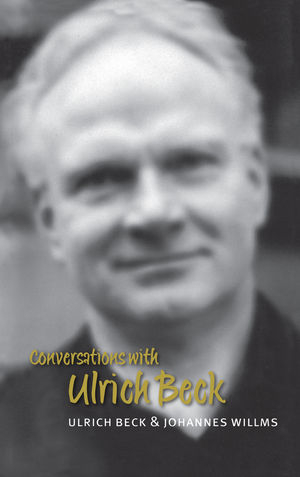
- Ulrich Beck, one of the most important and influential contemporary social thinkers, reveals and expands his work in a series of conversations with journalist Johannes Willms.
- These conversations shed new light onto the major themes in Beck’s work and provide an insight into some of the commitments and beliefs that they rest upon.
- Includes new thinking on the risk society and on globalisation, themes that have put him at the forefront of contemporary debates.
- Witten in a clear and lucid way and thus ideal for anyone seeking to come to grips with Beck’s work.
In this new book, Ulrich Beck and the journalist Johannes Willms engage in a series of accessible conversations that reveal and explore the key elements in Beck s thought. Ulrich Beck, one of the most important and influential contemporary social thinkers, reveals and expands his work in a series of conversations with journalist Johannes Willms. These conversations shed new light onto the major themes in Beck s work and provide an insight into some of the commitments and beliefs that they rest upon. Includes new thinking on the risk society and on globalisation, themes that have put him at the forefront of contemporary debates. Witten in a clear and lucid way and thus ideal for anyone seeking to come to grips with Beck s work.
Ulrich Beck is Professor of Sociology at the Ludwig-Maximilian University in Munich. Johannes Willms is a journalist and writer.
Introduction: Thinking Society Anew (John Urry).
1. Post modernity or the second modernity.
2. Individualisation.
3. Global risk society.
4. Labour society and regime of risk.
5. Cosmopolitan society and its enemies.
6. The prospects for a second enlightenment.
Recommended literature for further reading.
Selected Works by Authors Cited in the Text.
Books by the Authors in English.
About the Authors.
Index.
Introduction: Thinking Society Anew
John Urry
Department of Sociology, Lancaster University
Every now and then a new way of thinking about the social world appears. And once that happens it is difficult to imagine how sociology had managed without that new way of thinking. It simply seems so obvious. Further, it is often difficult to see why it had taken so long to get to that novel way of thinking; once “discovered” it is hard to imagine what all the fuss was about. The new theory or concept or method rapidly becomes part of the academic furniture, one prop that supports or holds up sociological thinking. The distinctiveness of the innovation may thus be hard to see even just a few years later. It is normalized, making possible some understanding of the extraordinarily opaque and hard to fathom social world.
Teaching students can be difficult since some of the time one is trying to explain just why a particular theory or concept or method was such an innovation although it has now become part of the furniture. The teacher has to recre-ate the disciplinary world before that new way of thinking and this is something that contemporary, cool students may find hard to see the point of. I was struck by this issue while reading obituaries of Robert K. Merton who recently died aged 92 and who was responsible for probably more enduring innovations than any other sociologist during the second half of the twentieth century. But explaining the nature of Merton's contribution to those young people who at least as teenagers will soon only know the twenty-first century will not be easy.
It is also not easy to convey the sheer difficulties involved in generating really productive new ways of thinking. They are not simple to achieve. Indeed most innovations have a very short shelf life; they never survive more than a few outings within various books, articles, and papers. Like new start-up companies new ways of thinking die rather rapidly and the author's innovation remains at best a small footnote in the history of the discipline. Not that small footnotes are unimportant since building on the “small footnotes” of others is how all disciplines make even faltering progress. Merton incidentally emphasized the importance of developing intellectual work that builds “on the shoulders of giants.”
Intermittently, however, something more than a small footnote does occur and the new way of thinking becomes part of the furniture. Indeed to become part of the furniture is the best measure of success and scholarly achievement. Within sociology there are relatively few such bits of furniture. This is in part because the social world is so opaque, social systems are incredibly open, and there are extraordinarily diverse processes affecting human practices moving through time and across space.
Ulrich Beck's concept of risk society is one such innovation that has become part of the furniture of modern sociology, an innovation nicely simple to grasp but which conveys a profoundly illuminating argument that deals with how the results of social activities powerfully and unpredictably move through time and space.
Beck argues that there is an epochal shift from industrial to risk societies. The former were based upon industry and social class, upon welfare states and upon the distribution of various goods organized and distributed through the state, especially of good health, extensive education, and equitable forms of social welfare. There were organized societies, there was a national community of fate, and there were large-scale political movements especially based upon industrial class divisions that fought over the distribution of these various “goods.” In the post-war period in western Europe there was a welfare state settlement in such industrial societies based upon achieving a fairer distribution of such goods.
By contrast the concept of risk society is based on the importance of bads. Risk societies involve the distribution of bads that flow within and across various territories and are not confined within the borders of a single society. Nuclear radiation is the key example of this, something few sociologists had ever examined. The risks of nuclear radiation are “deterritorialized.” They cannot be confined into any specific space nor into any current sector of time. Such risks thus cannot be insured against. They are uncontrolled and the consequences incalculable. The unpredictable consequences of radiation stemming from nuclear energy will last into the unimaginable future.
These risks have largely resulted from the actions of people – of state officials, scientists, technologists, and corporations – treating the world as a laboratory. These risks are thus not simply physical effects although they have profound physical consequences. Such risks are difficult to see or even more broadly to sense and yet they can enter and transform the body from within; they are not external to humans.
This concept of the risk society of Beck was a kind of revelation. It provided for sociology a way of speaking of the physical world and of its risks that brought in a striking array of new topics. In effect it enabled people to speak of things, indeed in a way to “see” things, that they had been trying to speak of and to see, but where the concepts had been chronically lacking.
First, then, the notion of risk society puts onto the sociological agenda the very nature of the physical world and of the need to create a sociology of-and-with the environment. No longer is it possible to believe that there is a pure sociology confined and limited to exploring the social in-and-of itself. The distinction of society and nature dissolves. The thesis of risk society brings out that most important phenomena within the world are social-and-physical, such as global warming, extreme weather events, global health risks such as AIDS, biological warfare, BSE, nuclear terrorism, worldwide automobility, nuclear accidents, and so on. None of these is purely social but nor are they simply physical either.
Risk society brings out how important aspects of people's lives are structured not through social processes alone such as the distribution of goods in a welfare state society. Rather major aspects of human welfare stem from the movement and potential impact of these “person-made” risks. So people's lives, we have come to understand, are affected by the global spread of AIDS, by global warming, by the ubiquitous spreading of the motorcar, by acid rain, and so on. Welfare is a matter of bads as well as of goods.
Second, the risk society brings out the importance of human bodies within sociological analysis. In going about their lives humans sensuously encounter other people and physical realities. There are different senses – and indeed sensescapes – that organize how social arrangements are structured and persist. Moreover, some such realities can in effect get inside the body. In the case of nuclear radiation generated by the 1985 explosion at the Chernobyl nuclear power plant (in what is now the Ukraine) people right across northern Europe had their lives transformed by something that could not be directly sensed (in the UK sheep farmers in Wales and Cumbria, for example).
Only experts with specialized recording equipment could monitor such direct exposure, while some effects of Chernobyl are still being generated decades later as children are being born with multiple deformities resulting from the explosion nearly twenty years ago. The naked senses are insufficient – so humans have to depend upon experts and systems of expertise to monitor whether they are subject to risks that may get “inside” their bodies. So bodies are subject to expert intrusions, as with the monitoring of HIV/AIDS, as risks pass in and through humans. And this in turn generates complex relationships between expert knowledge and lay forms of knowledge and especially with how the latter in a “risk-expert” society are often treated as inferior, subordinate, and replaceable by expertise.
Third, these risks know no boundaries. Rich and poor people, rich and poor countries are all subject to the nuclear radiation that emanated from Chernobyl. Such radiation does not stop at national borders nor at the homes of the rich, although there are big inequalities in the distribution of expert resources to remedy the unintended consequences of such risks.
This risk society results from the changing nature of science. Once upon a time science was confined to the laboratory – a spatially and temporally confined site of “science.” Although there are examples of science escaping – most famously in Mary Shelley's story of the monster created by Frankenstein – generally this does not happen. But nuclear energy and weapons change this equation. Suddenly the whole earth is the laboratory – the monster has escaped and risks now flow in, through, over, and under national and indeed other borders. The mobility of GM (genetically modified) crops is a more recent example that shows the difficulties of trying to limit the location and impact of testing GM crops within a confined area (in so-called field trials). Modern science according to Beck increasingly treats the whole world as its laboratory and this spreads risks across the globe. In recent formulations Beck emphasizes the global nature of risks; that there is not so much a risk society as a global risk culture.
This argument about the “borderlessness” of the risk society has, together with the writings of many others, developed...
| Erscheint lt. Verlag | 15.10.2014 |
|---|---|
| Reihe/Serie | Conversations |
| PCVS-Polity Conversations Series | PCVS-Polity Conversations Series |
| Übersetzer | Michael Pollack |
| Sprache | englisch |
| Themenwelt | Sozialwissenschaften ► Politik / Verwaltung |
| Sozialwissenschaften ► Soziologie ► Allgemeines / Lexika | |
| Sozialwissenschaften ► Soziologie ► Allgemeine Soziologie | |
| Schlagworte | accessible • Book • Conversations • Forefront • Gesellschaftstheorie • Globalization • important • individualization • influential • insight • Johannes • Journalist • Key • light • New • recognized • Risk • series • Social • Social Theory • Society • Sociology • Sociology Special Topics • Soziologie • Spezialthemen Soziologie • Thinkers • Ulrich • willms engage • Work • Writings |
| ISBN-13 | 9780745694481 / 9780745694481 |
| Informationen gemäß Produktsicherheitsverordnung (GPSR) | |
| Haben Sie eine Frage zum Produkt? |
 EPUB (Adobe DRM)
Kopierschutz: Adobe-DRM
Adobe-DRM ist ein Kopierschutz, der das eBook vor Mißbrauch schützen soll. Dabei wird das eBook bereits beim Download auf Ihre persönliche Adobe-ID autorisiert. Lesen können Sie das eBook dann nur auf den Geräten, welche ebenfalls auf Ihre Adobe-ID registriert sind.
Details zum Adobe-DRM
Dateiformat: EPUB (Electronic Publication)
EPUB ist ein offener Standard für eBooks und eignet sich besonders zur Darstellung von Belletristik und Sachbüchern. Der Fließtext wird dynamisch an die Display- und Schriftgröße angepasst. Auch für mobile Lesegeräte ist EPUB daher gut geeignet.
Systemvoraussetzungen:
PC/Mac: Mit einem PC oder Mac können Sie dieses eBook lesen. Sie benötigen eine
eReader: Dieses eBook kann mit (fast) allen eBook-Readern gelesen werden. Mit dem amazon-Kindle ist es aber nicht kompatibel.
Smartphone/Tablet: Egal ob Apple oder Android, dieses eBook können Sie lesen. Sie benötigen eine
Geräteliste und zusätzliche Hinweise
Buying eBooks from abroad
For tax law reasons we can sell eBooks just within Germany and Switzerland. Regrettably we cannot fulfill eBook-orders from other countries.
aus dem Bereich