


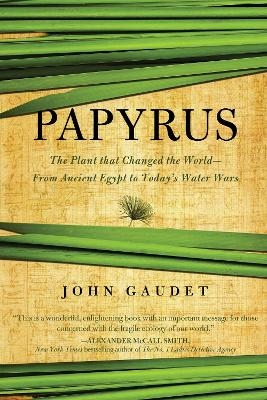
Papyrus
Seiten
2015
Pegasus Books (Verlag)
978-1-60598-828-3 (ISBN)
Pegasus Books (Verlag)
978-1-60598-828-3 (ISBN)
At the center of the most vital human-plant relationship in history, Papyrus evokes the mysteries of the ancient world while holding the key to the world’s wetlands and atmospheric stability.
From ancient Pharaohs to 21st Century water wars, papyrus is a unique plant that is now the fastest growing plant species on earth. It produces its own “soil”—a peaty, matrix that floats on water—and inspired the fluted columns of the ancient Greeks. In ancient Egypt, the papyrus bounty from the Nile delta provided not just paper for record keeping—instrumental to the development of civilization—but food, fuel and boats. Disastrous weather in the 6th Century caused famines and plagues that almost to wipe out civilization in the west, but it was papyrus to the rescue. Today, it is not just a curious relic of our ancient past, but a rescuing force for modern ecological and societal blight. In an ironic twist, Egypt is faced with enormous pollution loads that forces them to import food supplies, and yet papyrus is one of the most effective and efficient natural pollution filters known to man. Papyrus was the key in stemming the devastation to the Sea of Galilee and Jordan River from raging peat fires (that last for years), and the papyrus laden shores of Lake Victoria—which provides water to more than 30 million people—will be crucial as the global drying of the climate continues.
From ancient Pharaohs to 21st Century water wars, papyrus is a unique plant that is now the fastest growing plant species on earth. It produces its own “soil”—a peaty, matrix that floats on water—and inspired the fluted columns of the ancient Greeks. In ancient Egypt, the papyrus bounty from the Nile delta provided not just paper for record keeping—instrumental to the development of civilization—but food, fuel and boats. Disastrous weather in the 6th Century caused famines and plagues that almost to wipe out civilization in the west, but it was papyrus to the rescue. Today, it is not just a curious relic of our ancient past, but a rescuing force for modern ecological and societal blight. In an ironic twist, Egypt is faced with enormous pollution loads that forces them to import food supplies, and yet papyrus is one of the most effective and efficient natural pollution filters known to man. Papyrus was the key in stemming the devastation to the Sea of Galilee and Jordan River from raging peat fires (that last for years), and the papyrus laden shores of Lake Victoria—which provides water to more than 30 million people—will be crucial as the global drying of the climate continues.
John Gaudet, a professional ecologist has worked with the U.S. government and carried out research under grants from the National Geographic Society. As an ecologist and primary environmental advisor he is now a writer and consultant. His work has appeared in the Washington Post and he remains active in African, agricultural, and conservation/environmental agencies. John lives in northern Virginia. Visit his website at http://www.fieldofreeds.com. Review
| Erscheint lt. Verlag | 2.6.2015 |
|---|---|
| Verlagsort | New York |
| Sprache | englisch |
| Maße | 152 x 229 mm |
| Gewicht | 340 g |
| Themenwelt | Sachbuch/Ratgeber ► Natur / Technik ► Natur / Ökologie |
| Geschichte ► Allgemeine Geschichte ► Vor- und Frühgeschichte | |
| Naturwissenschaften ► Biologie ► Botanik | |
| Naturwissenschaften ► Biologie ► Ökologie / Naturschutz | |
| Naturwissenschaften ► Geowissenschaften ► Geografie / Kartografie | |
| Sozialwissenschaften | |
| ISBN-10 | 1-60598-828-6 / 1605988286 |
| ISBN-13 | 978-1-60598-828-3 / 9781605988283 |
| Zustand | Neuware |
| Informationen gemäß Produktsicherheitsverordnung (GPSR) | |
| Haben Sie eine Frage zum Produkt? |
Mehr entdecken
aus dem Bereich

aus dem Bereich
Konzepte – Methoden – Theorien
Buch | Softcover (2024)
UTB (Verlag)
CHF 55,85
auf den Spuren der frühen Zivilisationen
Buch | Hardcover (2023)
C.H.Beck (Verlag)
CHF 27,95


