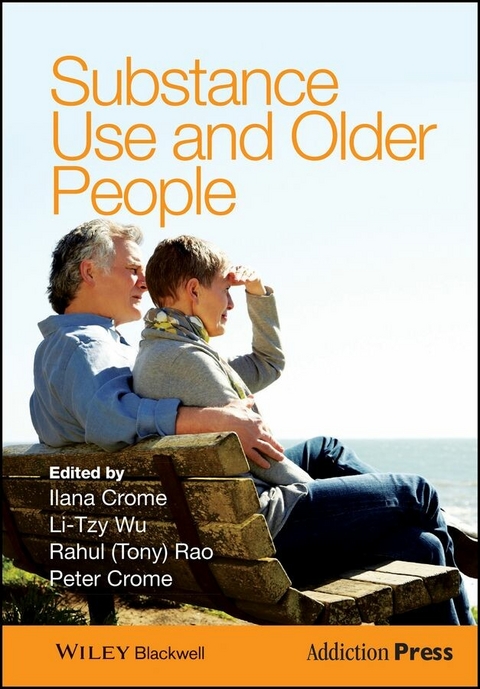
Substance Use and Older People (eBook)
John Wiley & Sons (Verlag)
978-1-118-43097-2 (ISBN)
Substance use and addiction is an increasing problem amongst older people. The identification of this problem is often more difficult in older patients and is frequently missed, particularly in the primary care context and in emergency departments, but also in a range of medical and psychiatric specialties.
Substance Use and Older People shows how to recognise and treat substance problems in older patients. However, it goes well beyond assessment and diagnosis by incorporating up-to-date evidence on the management of those older people who are presenting with chronic complex disorders, which result from the problematic use of alcohol, inappropriate prescribed or over the counter medications, tobacco, or other drugs. It also examines a variety of biological and psychosocial approaches to the understanding of these issues in the older population and offers recommendations for policy.
Substance Use and Older People is a valuable resource for geriatricians, old age psychiatrists, addiction psychiatrists, primary care physicians, and gerontologists as well as policy makers, researchers, and educators. It is also relevant for residents and fellows training in geriatrics or geri-psychiatry, general practitioners and nursing home physicians.
Ilana Crome, Emeritus Professor of Addiction Psychiatry, Keele University, Keele, UK; Honorary Consultant Psychiatrist, South Staffordshire and Shropshire Healthcare NHS Foundation Trust, Stafford, UK; Honorary Professor, Queen Mary University of London, London, UK; Senior Research Fellow, Imperial College, London, UK
Li-Tzy Wu, Professor of Psychiatry, Department of Psychiatry and Behavioral Sciences, School of Medicine, Duke University Medical Center, Durham, NC, USA
Rahul (Tony) Rao, Visiting Researcher, Department of Old Age Psychiatry, Institute of Psychiatry, London, UK and Lead for Dual Diagnosis, Mental Health of Older Adults and Dementia Clinical Academic Group, South London and Maudsley NHS Foundation Trust, UK
Peter Crome, Honorary Professor, Department of Primary Care and Population Health, University College London, London, UK; Emeritus Professor of Geriatric Medicine, Keele University, Keele, UK
Ilana Crome, Emeritus Professor of Addiction Psychiatry, Keele University, Keele, UK; Honorary Consultant Psychiatrist, South Staffordshire and Shropshire Healthcare NHS Foundation Trust, Stafford, UK; Honorary Professor, Queen Mary University of London, London, UK; Senior Research Fellow, Imperial College, London, UK Li-Tzy Wu, Professor of Psychiatry, Department of Psychiatry and Behavioral Sciences, School of Medicine, Duke University Medical Center, Durham, NC, USA Rahul (Tony) Rao, Visiting Researcher, Department of Old Age Psychiatry, Institute of Psychiatry, London, UK and Lead for Dual Diagnosis, Mental Health of Older Adults and Dementia Clinical Academic Group, South London and Maudsley NHS Foundation Trust, UK Peter Crome, Honorary Professor, Department of Primary Care and Population Health, University College London, London, UK; Emeritus Professor of Geriatric Medicine, Keele University, Keele, UK
Chapter 1
NEGOTIATING CAPACITY AND CONSENT IN SUBSTANCE MISUSE
Kritika Samsi
Social Care Workforce Research Unit, King's College London, UK
Introduction
Mental capacity is an individual's ability to make autonomous decisions for themselves, the significance of which has increased with greater recognition of the involvement of the individual as a ‘self-governing welfare subject' [1] with greater emphasis on personal choice and self-determination of his or her own health and social care decisions [2].
The complexity of problems associated with substance use in older people means that there are particular risks around capacity or ‘competency', through impairment in cognition, judgement and function [3]. There could be co-morbid mental health problems that may further contribute to their impairment [4]. Decision making capacity is vital not only for individuals to be able to express their preferences for long-term care but also in the case of immediate in-patient care, when practitioners may face complex decision making issues. Some of these issues include: (i) timing of capacity assessment; (ii) conflict between presence of capacity, alongside evidence of self-neglect and need for medical care; and (iii) the role of the practitioner in encouraging the older person to give up addictions that are harmful to them [3].
Substance abuse and capacity
There had been diagnostic limitations in the Diagnostic and Statistical Manual of Mental Disorders iv (DSM-iv) in how substance abuse and dependence were classified, resulting in what some believed were deceptively low rates of identification of older individuals with substance abuse and dependencies [5]. Some of the criteria used – such as giving up activities and the inability to fulfil major role obligation at work – were also criticized for being irrelevant to an older population [5].
The physiological impact of acute alcohol intoxication is more severe in the elderly, with an increase in the risk of delirium [5]. In the brain, alongside an acute confusional state, cerebral atrophy can result in global cognitive impairment [5]. Mental capacity, judgment and ability to consent can also be affected. Most types of dementia are more prevalent in older people with alcoholism [6].
Impaired decision making capacity characterizes substance misuse. The diagnostic criteria according to the Diagnostic and Statistical Manual of Mental Disorders 5 (DSM-5) acknowledge this, as substance dependence is described as persistent use despite knowing the negative physical and psychological effects of the substance [7]. The self-destructive choices and decisions made by substance abusers have been termed ‘myopia', which are deficits in emotional signalling that produce poor short-term decisions for immediate gains despite potential for higher losses in the future [8].
Mental capacity legislation
Several western countries have existing legislation that addresses and protects autonomy, capacity, dignity and decision making for vulnerable people. None of this legislation codifies ‘age' as a specific vulnerability in itself, and safeguarding incapacity or deteriorating capacity more wholistically is prioritized instead. By handing over decision making powers to a trusted relative or nominated consultee, an individual can choose who makes decisions on their behalf and, thereby, assert their choices and preferences through them.
The Guardianship and Administration Act was introduced in 1993 in South Australia and in 2000 in Queensland, two of Australia's largest states. The Substitute Decisions Act and the Health Care Consent Act were introduced in Ontario, Canada, in 1992 and 1996, respectively. Most of these Acts incorporate the same principles, with variations in the way capacity assessments are carried out, and how care priorities are determined. Presuming an individual has capacity, unless proven otherwise, is the guiding principle in all of these Acts.
Scotland, England and Wales introduced legislation around capacity more recently. Scotland introduced the Adults with Incapacity Act in 2000, and the Mental Capacity Act 2005 was introduced in 2007 in England and Wales; both are applicable to those over the age of 16 years.
Using the Mental Capacity Act 2005 as a case example in England and Wales, the rest of this chapter illustrates some of the principles embedded in current legislation in the area of capacity and consent, focusing specifically on its applicability to those with a history of substance abuse.
Mental Capacity Act 2005
The Mental Capacity Act 2005 (MCA), implemented in England and Wales in 2007, introduced a variety of provisions to safeguard and enhance the rights of vulnerable people with compromised capacity [9]. Prior to the Act, it was sometimes challenging to ascertain ‘mental capacity' to make decisions and different approaches were described under mental capacity legislation and mental health legislation [1].
A central principle of the MCA is the presumption that all adults have the capacity to make decisions for themselves, unless proven otherwise. Provisions for surrogate decision making should only be resorted to after it has been proved that an individual lacks capacity. The other four central principles of the Act include:
- A person must be given all practicable help before anyone treats them as not being able to make their own decisions.
- A person is not to be treated as unable to make a decision merely because he makes an unwise decision.
- Anything done or any decision made under this Act for or on behalf of a person who lacks capacity must be done, or made, in his/her best interests.
- Anything done or decided for or on behalf of a person who lacks capacity should be the least restrictive of their basic rights and freedoms.
Capacity assessment
There are a number of capacity and decision making assessment tools currently available [4]. In the MCA, a four-stage assessment of decision making ability is required to prove that an individual is unable to make a specific decision at that specific time. These include asking the following four questions:
- Does the person have a general understanding of what decision they need to make and why they need to make it?
- Does the person have a general understanding of the likely consequences of making, or not making, this decision?
- Is the person able to understand, retain, use and weigh up the information relevant to this decision?
- Can the person communicate their decision (by talking, using sign language or any other means)? Would the services of a professional (such as a speech and language therapist) be helpful?
Inherent to this assessment is the recognition that capacity is not an absolute state but varies over time and with the decision that is required to be made. For substance misusers, this becomes an even more crucial issue, as their states of incapacity may fluctuate according to the level of intoxication or delirium. Capacity should, therefore, be seen as decision specific, rather than all encompassing. If a person is deemed to be ‘lacking capacity', it means that they lack capacity to make a particular decision or take a particular action for themselves at the time the decision or action needs to be taken. The MCA applies to anyone who has ‘an impairment of or disturbance in the functioning of the mind or brain' and was warmly welcomed for not using the phrase ‘mental disorder', which may not be appropriate to a person with substance abuse problems. Similarly, an ‘incapable' adult is defined in the Scottish and the Canadian legislation as someone unable to act, make, communicate, understand or retain the memory of decisions.
Legal frameworks such as the MCA 2005, codifying complex phenomena that can threaten the autonomy of vulnerable individuals, have wide applicability: from types of decisions, such as day-to-day support [10], advance decision making about personal health and welfare [11], end of life care [12]; to different settings [13], such as medical encounters [14] and long-term care facilities [15]; and to a wide range of professionals [16–19].
Capacity and unwise decisions
A central feature of the Mental Capacity Act is the acknowledgement that individuals who have the capacity to make their own decisions are in a position to make what may be deemed ‘unwise' decisions. In many cases, this applies to risk taking, such as gambling, forming relationships and choosing a certain type of lifestyle. In the case of substance misuse, individuals may choose to continue to use a substance in spite of being aware of its harmful effects. If that individual is deemed as having the capacity to make a decision for themselves – that is if that individual is shown as being able to weigh up the consequences of their decision and still choose to use a particular substance – the MCA safeguards that individual's decision making capacity by suggesting that decisions otherwise deemed ‘unwise' are legally acceptable.
Consent, barriers to decision making and substituted decision making
If capacity is an individual's ability to make decisions, ‘consent' can be seen as granting permission or agreeing to the decisions themselves. In relation to consenting, the relevance of the MCA covers three...
| Erscheint lt. Verlag | 14.10.2014 |
|---|---|
| Reihe/Serie | Addiction Press |
| Addiction Press | Addiction Press |
| Sprache | englisch |
| Themenwelt | Medizin / Pharmazie ► Medizinische Fachgebiete ► Geriatrie |
| Sozialwissenschaften ► Soziologie | |
| Schlagworte | addiction • amongst • ConText • departments • difficult • geriatric medicine • Geriatrie • Identification • incorporating • Medical • Medical Science • Medizin • older • particularly • patients • People • Problem • Problems • psychiatric specialties • Psychiatrie • Psychiatry • Range • Substance • Substance Misuse • Substanzmissbrauch • Treat |
| ISBN-10 | 1-118-43097-2 / 1118430972 |
| ISBN-13 | 978-1-118-43097-2 / 9781118430972 |
| Informationen gemäß Produktsicherheitsverordnung (GPSR) | |
| Haben Sie eine Frage zum Produkt? |
 EPUB (Adobe DRM)
Kopierschutz: Adobe-DRM
Adobe-DRM ist ein Kopierschutz, der das eBook vor Mißbrauch schützen soll. Dabei wird das eBook bereits beim Download auf Ihre persönliche Adobe-ID autorisiert. Lesen können Sie das eBook dann nur auf den Geräten, welche ebenfalls auf Ihre Adobe-ID registriert sind.
Details zum Adobe-DRM
Dateiformat: EPUB (Electronic Publication)
EPUB ist ein offener Standard für eBooks und eignet sich besonders zur Darstellung von Belletristik und Sachbüchern. Der Fließtext wird dynamisch an die Display- und Schriftgröße angepasst. Auch für mobile Lesegeräte ist EPUB daher gut geeignet.
Systemvoraussetzungen:
PC/Mac: Mit einem PC oder Mac können Sie dieses eBook lesen. Sie benötigen eine
eReader: Dieses eBook kann mit (fast) allen eBook-Readern gelesen werden. Mit dem amazon-Kindle ist es aber nicht kompatibel.
Smartphone/Tablet: Egal ob Apple oder Android, dieses eBook können Sie lesen. Sie benötigen eine
Geräteliste und zusätzliche Hinweise
Buying eBooks from abroad
For tax law reasons we can sell eBooks just within Germany and Switzerland. Regrettably we cannot fulfill eBook-orders from other countries.
aus dem Bereich