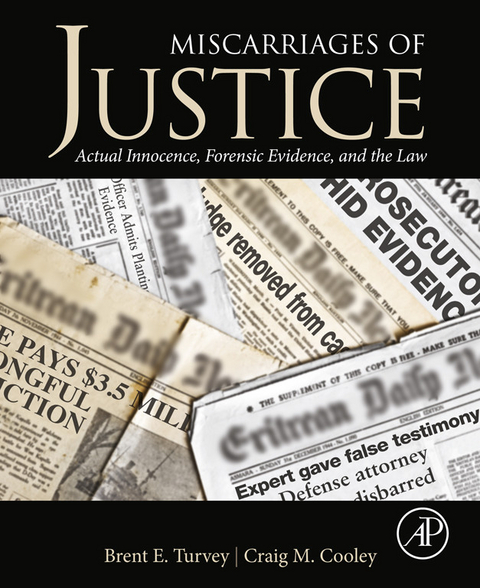
Miscarriages of Justice (eBook)
416 Seiten
Elsevier Science (Verlag)
978-0-12-409528-1 (ISBN)
Brent E. Turvey spent his first years in college on a pre-med track only to change his course of study once his true interests took hold. He received a Bachelor of Science degree from Portland State University in Psychology, with an emphasis on Forensic Psychology, and an additional Bachelor of Science degree in History. He went on to receive his Masters of Science in Forensic Science after studying at the University of New Haven, in West Haven, Connecticut. Since graduating in 1996, Brent has consulted with many agencies, attorneys, and police departments in the United States, Australia, China, Canada, Barbados and Korea on a range of rapes, homicides, and serial/ multiple rape/ death cases, as a forensic scientist and criminal profiler. He has also been court qualified as an expert in the areas of criminal profiling, forensic science, victimology, and crime reconstruction. In August of 2002, he was invited by the Chinese People's Police Security University (CPPSU) in Beijing to lecture before groups of detectives at the Beijing, Wuhan, Hanzou, and Shanghai police bureaus. In 2005, he was invited back to China again, to lecture at the CPPSU, and to the police in Beijing and Xian - after the translation of the 2nd edition of his text into Chinese for the University. In 2007, he was invited to lecture at the 1st Behavioral Sciences Conference at the Home Team (Police) Academy in Singapore, where he also provided training to their Behavioral Science Unit. In 2012 Brent completed his PhD in Criminology from Bond University in Gold Coast, Australia. He is the author of Criminal Profiling: An Introduction to Behavioral Evidence Analysis, 1st, 2nd, 3rd and 4th Editions (1999, 2002, 2008, 2011); co- author of the Rape Investigation Handbook, 1st and 2nd Editions (2004, 2011), Crime Reconstruction 1st and 2nd Editions (2006, 2011), Forensic Victimology (2008) and Forensic Fraud (2013) - all with Elsevier Science. He is currently a full partner, Forensic Scientist, Criminal Profiler, and Instructor with Forensic Solutions, LLC, and an Adjunct Professor of Justice Studies at Oklahoma City University. He can be contacted via email at: bturvey@forensic-science.com.
Miscarriages of justice are a regular occurrence in the criminal justice system, which is characterized by government agencies that are understaffed, underfunded, and undertrained across the board. We know this because, every week, DNA testing and innocence projects across the United States help to identify and eventually overturn wrongful convictions. As a result, the exonerated go free and the stage is set for addressing criminal and civil liability. Criminal justice students and professionals therefore have a need to be made aware of the miscarriage problem as a threshold issue. They need to know what a miscarriage of justice looks like, how to recognize it's many forms, and what their duty of care might be in terms of prevention. They also need to appreciate that identifying miscarriages, and ensuring legal remedy, is an important function of the system that must be honored by all criminal justice professionals. The purpose of this textbook is to move beyond the law review, casebook, and true crime publications that comprise the majority of miscarriage literature. While informative, they are not designed for teaching students in a classroom setting. This text is written for use at the undergraduate level in journalism, sociology, criminology and criminal justice programs - to introduce college students to the miscarriage phenomenon in a structured fashion. The language is more broadly accessible than can be found in legal texts, and the coverage is multidisciplinary. Miscarriages of Justice: Actual Innocence, Forensic Evidence, and the Law focuses on the variety of miscarriages issues in the United States legal system. Written by leaders in the field, it is particularly valuable to forensic scientists and attorneys evaluating evidence or preparing for trial or appeal in cases where faulty evidence features prominently. It is also of value to those interested in developing arguments for miscarriage in post-conviction review of criminal cases. Chapters focus specifically on issues of law enforcement bias and corruption; false confessions; ineffective counsel and prosecutorial misconduct; forensic fraud; and more. The book closes by examining innocence projects and commissions, and civil remedies for the wrongfully convicted.This text ultimately presents the issue of miscarriages as a systemic and multi-disciplinary criminal justice issue. It provides perspectives from within the professional CJ community, and it serves as warning to future professionals about the dangers and consequences of apathy, incompetence, and neglect. Consequently, it can be used by any CJ educator to introduce any group of CJ students to the problem. - Written by practicing criminal justice professionals in plain language for undergraduate students- Covers multiple perspectives across the criminal justice system- Informed by experience working for Innocence Projects across the United States to achieve successful exonerations- Topical case examples to facilitate teaching and learning- Companion website featuring Discussion topics, Exam questions and PowerPoint slides: http://textbooks.elsevier.com/web/Manuals.aspx?isbn=9780124115583
Front Cover 1
Miscarriages of Justice: Actual Innocence, Forensic Evidence, and the Law 4
Copyright 5
Contents 6
Preface 10
IDENTIFYING MISCARRIAGES OF JUSTICE 10
References 13
Foreword 14
WRONGFUL CONVICTIONS: UNDERSTANDING CAUSES AND CONSEQUENCE 14
About the Authors 18
About the Contributors 20
Section 1 - Miscarriages of Justice: Natureand Frequency 22
Chapter 1 - Miscarriages of Justice: An Introduction 24
THE ROLE OF THE CRIMINAL JUSTICE SYSTEM 25
MISCARRIAGES OF JUSTICE 26
MISCARRIAGES: A TYPOLOGY 27
HISTORICAL PERSPECTIVES 33
CAUSAL FACTORS 41
CONCLUSION 44
REFERENCES 44
Chapter 2 - Wrongful Conviction Rates 46
CONTEMPORARY RESEARCH 53
CORRELATES AND CAUSES 62
CONCLUSION 65
REFERENCES 65
Section 2 - Miscarriages of Justice: Investigative Causes 68
Chapter 3 - Police Corruption 70
DUTY OF CARE 70
BREAKING THE LAW TO UPHOLD IT 72
NOBLE CAUSE CORRUPTION 73
PATROL OFFICERS 74
CRIMINAL INVESTIGATORS 92
REFERENCES 107
Chapter 4 - Eyewitness Identification: Uncertainty, Error, and Miscarriages of Justice 112
A HISTORY OF UNRELIABILITY 113
MEMORY 116
SPECIFIC PROBLEMS WITH EYEWITNESS MEMORY 120
NEW JERSEY AND THE HENDERSON CASE 129
CONCLUSION 131
REFERENCES 132
Chapter 5 - Police Interrogations and False Confessions 136
WHAT IS A FALSE CONFESSION? 136
FALSE CONFESSION TYPOLOGY 140
CONFESSION LAW 142
LAW ENFORCEMENT INTERROGATION AND THE REID TECHNIQUE 144
FALSE CONFESSIONS, INEVITABILITY, AND BLAME 166
REFERENCES 166
Chapter 6 - Criminal Informants and Wrongful Convictions 170
INFORMANTS AS AN INVESTIGATIVE TOOL 170
TYPES OF INFORMANTS 173
INFORMANTS AND WRONGFUL CONVICTIONS 177
INCOMPETENT OR CORRUPTIBLE 185
SUGGESTED REFORMS 186
REFERENCES 188
Section 3 - Miscarriages of Justice: Forensic Causes 190
Chapter 7 - Forensic Science, The CSI Effect, and Wrongful Convictions 192
THE CSI EFFECT 193
FORENSIC SCIENCE UNDER SCRUTINY 197
CONCLUSION 212
REFERENCES 212
Chapter 8 - Forensic Fraud and Misconduct 218
CULTURAL CONFLICTS 219
SCIENTIFIC MISCONDUCT 222
DIFFERENTIATING FRAUD AND NEGLIGENCE 224
FALSE TESTIMONY 230
FORENSIC FRAUD 231
CONCLUSION 242
REFERENCES 243
Chapter 9 - Bitemark Evidence and Miscarriages of Justice 246
INTRODUCTION 246
PROFESSIONAL STATUS OF THOSE PRACTICING BITEMARK COMPARISON 250
BITEMARK ANALYSIS: THE EVIDENCE, METHODS, AND ASSUMPTIONS 250
A BRIEF LEGAL DISCUSSION 261
DESCRIPTIONS OF BITEMARK EXONERATIONS AND ERRONEOUS INCARCERATIONS 262
DESCRIPTIONS OF WRONGFUL ARRESTS BASED ON BITEMARK EVIDENCE 269
Section 4 - Miscarriages of Justice: LegalCauses 274
Chapter 10 - Ineffective Assistance of Counsel 276
THE RIGHT TO “EFFECTIVE” COUNSEL 277
CRIMINAL DEFENSE ATTORNEYS: STRUCTURE AND FUNCTION 279
THE PRESUMPTION OF INNOCENCE 283
INEFFECTIVE ASSISTANCE OF COUNSEL 285
PRETRIAL EFFECTIVENESS ISSUES 288
EFFECTIVENESS ISSUES AT TRIAL 290
REFERENCES 296
Chapter 11 - Prosecutorial Misconduct 298
CRIMINAL PROSECUTORS: STRUCTURE AND FUNCTION 299
PROSECUTORIAL MISCONDUCT: NUMBERS AND ORIGINS 312
MISCONDUCT WITH LAW ENFORCEMENT 314
PRETRIAL MISCONDUCT 324
ETHICAL ISSUES DURING TRIAL 342
INCENTIVIZED MISCONDUCT 351
REFERENCES 353
Section 5 - Miscarriages of Justice: Remedies 358
Chapter 12 - Forensic Reform 360
THE LEGAL COMMUNITY: A UNIQUE PERSPECTIVE 361
FORENSIC SCIENCE AND MISCARRIAGES OF JUSTICE 362
THE NAS REPORT 367
FORENSIC REFORM 371
CONCLUSION 377
REFERENCES 377
Chapter 13 - Miscarriages of Justice: Prevention and Management 380
THE PROFESSIONAL OBLIGATION TO REFORM 381
PREVENTATIVE REFORMS 383
POSTCONVICTION EFFORTS 388
CONCLUSION 394
REFERENCES 395
Glossary 398
Index 406
Wrongful Conviction Rates
Abstract
Once the reality of wrongful convictions has been confirmed anecdotally, the question of frequency arises. Researchers and other CJ professionals want to know how often miscarriages occur, and whether there are consistent correlates that can lend themselves to prediction and possibly prevention. At the outset, it must be acknowledged that despite the efforts of some very well-intentioned social scientists, good numbers are hard to find. The rate of wrongful conviction, if not entirely unexplored in a given jurisdiction, is essentially unknowable. The reason is that guilt is often a legal “truth” established by the opinion of a judge or jury. It is not a scientific fact. What stands for fact and evidence in a courtroom is often insufficient as confirmation anywhere else—to say nothing of those who are “qualified” by the courts to give evidence. To explore this and related issues, this chapter reviews the conclusions of early miscarriage research, the conclusions of contemporary research, and the systemic realities that help contextualize those results.
Keywords
Edwin M. BorchardPaleyitesExonerationDNA exonerationWrongful conviction rate
Early Research2
Borchard
Among the most shocking … [and] glaring of injustices are erroneous convictions of innocent persons. The State must necessarily prosecute persons legitimately suspected of crime; but when it is discovered after conviction that the wrong man was condemned, the least the State can do to right his essentially irreparable injury is to reimburse the innocent victim, by an appropriate indemnity, for the loss and damage suffered.
[M]isidentification, circumstantial evidence, frame-ups, overzealous police or prosecutors, prior convictions or unsavory records, community opinion demanding a conviction, and unreliability of expert evidence. In addition, erroneous convictions result[ed] from guilty pleas and confessions by innocent persons, or from the use of a false alibi by an innocent accused.
While it is true that our lax methods of administering the criminal law, the possibility of acquittal on technical grounds and the requirement of unanimity on the part of twelve jurymen, bring about nine cases of unjust acquittal to one case of unjust conviction, still the mere rarity of the occurrence is no excuse for a failure to acknowledge the principle and to remedy the evil. It makes the individual hardship, when it does occur, seem all the more distressing. That there have been numerous cases of this kind ... notwithstanding the unauthentic returns from wardens collected by the American Prison Congress and reported in this Journal (May, 1912, p. 131) to the effect that there are but few cases of unjust execution of innocent persons.
Bedau and Radelet
| Erscheint lt. Verlag | 19.5.2014 |
|---|---|
| Sprache | englisch |
| Themenwelt | Recht / Steuern ► EU / Internationales Recht |
| Recht / Steuern ► Strafrecht ► Kriminologie | |
| Recht / Steuern ► Strafrecht ► Strafverfahrensrecht | |
| Sozialwissenschaften | |
| ISBN-10 | 0-12-409528-3 / 0124095283 |
| ISBN-13 | 978-0-12-409528-1 / 9780124095281 |
| Informationen gemäß Produktsicherheitsverordnung (GPSR) | |
| Haben Sie eine Frage zum Produkt? |
 EPUB (Adobe DRM)
Kopierschutz: Adobe-DRM
Adobe-DRM ist ein Kopierschutz, der das eBook vor Mißbrauch schützen soll. Dabei wird das eBook bereits beim Download auf Ihre persönliche Adobe-ID autorisiert. Lesen können Sie das eBook dann nur auf den Geräten, welche ebenfalls auf Ihre Adobe-ID registriert sind.
Details zum Adobe-DRM
Dateiformat: EPUB (Electronic Publication)
EPUB ist ein offener Standard für eBooks und eignet sich besonders zur Darstellung von Belletristik und Sachbüchern. Der Fließtext wird dynamisch an die Display- und Schriftgröße angepasst. Auch für mobile Lesegeräte ist EPUB daher gut geeignet.
Systemvoraussetzungen:
PC/Mac: Mit einem PC oder Mac können Sie dieses eBook lesen. Sie benötigen eine
eReader: Dieses eBook kann mit (fast) allen eBook-Readern gelesen werden. Mit dem amazon-Kindle ist es aber nicht kompatibel.
Smartphone/Tablet: Egal ob Apple oder Android, dieses eBook können Sie lesen. Sie benötigen eine
Geräteliste und zusätzliche Hinweise
Buying eBooks from abroad
For tax law reasons we can sell eBooks just within Germany and Switzerland. Regrettably we cannot fulfill eBook-orders from other countries.
aus dem Bereich