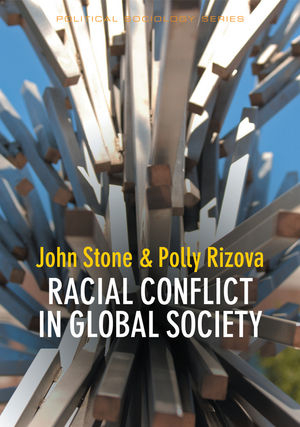
Racial Conflict in Global Society (eBook)
John Wiley & Sons (Verlag)
978-0-7456-8640-0 (ISBN)
Stone and Rizova employ a neo-Weberian comparative approach to explore how evolving systems of group conflict have been - and continue to be - impacted by changes in the world system, global capitalism, multinational corporations, and transnational alliances and institutions. The authors analyse critical debates about ‘post-racialism’, ‘exceptionalism’, ethnic warfare and diversity management in global organizations, drawing on cases from South Africa to Darfur, and from global migration to the Arab Spring uprisings. In conclusion, the search for effective strategies of conflict resolution and the quest for racial justice are evaluated from multiple perspectives.
Racial Conflict in Global Society provides stimulating insights into the basic factors underlying racial conflict and consensus in the early decades of the twenty-first century. It is essential reading for scholars and students across the social and political sciences, management and international relations.
John Stone is Professor of Sociology at Boston University. He is the founding editor of the journal Ethnic and Racial Studies.
Polly Rizova is Associate Professor of Management at Willamette University.
Despite global shifts in world power, racial conflict remains one of the major problems of contemporary social life. This concise and engaging book demonstrates the interplay between identity, power and conflict in the creation, persistence and transformation of patterns of race and ethnic relations across the globe. Stone and Rizova employ a neo-Weberian comparative approach to explore how evolving systems of group conflict have been - and continue to be - impacted by changes in the world system, global capitalism, multinational corporations, and transnational alliances and institutions. The authors analyse critical debates about post-racialism , exceptionalism , ethnic warfare and diversity management in global organizations, drawing on cases from South Africa to Darfur, and from global migration to the Arab Spring uprisings. In conclusion, the search for effective strategies of conflict resolution and the quest for racial justice are evaluated from multiple perspectives. Racial Conflict in Global Society provides stimulating insights into the basic factors underlying racial conflict and consensus in the early decades of the twenty-first century. It is essential reading for scholars and students across the social and political sciences, management and international relations.
John Stone is Professor of Sociology at Boston University. He is the founding editor of the journal Ethnic and Racial Studies. Polly Rizova is Associate Professor of Management at Willamette University.
Introduction
Chapter 1. Diversity: Conflicts in the New Millennium
Chapter 2. Power: The Changing Geo-politics of Race
Chapter 3. Boundaries: Identity in the New World Disorder
Chapter 4. Organizations: Challenges Facing Global Institutions
Chapter 5. Violence: Extreme Racial Conflict
Chapter 6. Justice: The Search for Solutions
Notes
An outstanding, thoroughly accessible account of race issues across the planet, showing impeccable scholarship and an international grasp of contemporary debates. This book is certain to have a significant impact on generations of scholars and students grappling with these questions now and in the future.
Ian Law, CERS (Centre for Ethnicity and Racism Studies), University of Leeds
This gracefully written volume corrects the narrow views of race and racism that have become increasingly dominant in recent years. Stretching across the globe and historical eras, this is a masterful survey, which manages to inform without getting the reader lost in details by developing a supple yet coherent perspective with deep roots in social theory.
Richard Alba, CUNY
Introduction
In this book, we have attempted to present an analysis of racial conflict as it has taken place historically and against a broad comparative context. Although we are both sociologists by training, this problem area requires an appreciation of other perspectives across the social sciences and historical studies in order to understand the types of debates that have occurred in a highly controversial and complex field. A fundamental premise of our approach is that no single explanatory system can provide the reader with a comprehensive appreciation of the dynamics of racial conflict and that a better strategy is to consider race relations, alongside ethnicity and nationalism, as one of a series of divisions that has been employed to shape the nature of group relations. If any one approach can be isolated to explain the manner in which racial conflict is generated or reduced it is the relative power that one group has over another. It is for this reason, and because of the subtlety of Weber’s exploration of power relationships in societies around the world, that we have chosen to adopt a neo-Weberian perspective throughout this volume, following in the tradition of the seminal writings of the great German sociologist of the early twentieth century. Furthermore, it explains why this book fits in well with a series exploring different themes within political sociology.
Weber’s writings date mainly from the first two decades of the last century, an era that was very different from today, when Europe was still the home of powerful states dominating vast areas of Africa, the Middle East, South America and Asia. And racial ideas and race relations reflected this overwhelming imbalance in power and influence between individuals and groups that were considered by many to consist of different types of peoples. In some respects, Weber’s early ideas retained some of the inherent biases of the age in which he lived and it could be argued that few of his key works focused centrally on matters of race and ethnicity. Nevertheless, the overall framework he developed to explain the emergence of modern industrial society, and its impact on social life, provides easily adaptable concepts that can be applied as readily to racial as to social stratification, and to ethnic and national struggles as much as to class conflict and political divisions. In the early chapters, we will outline some of Weber’s struggles with these issues and how race, power and conflict are key themes in the central argument in the book. Ideas about the true significance of ‘race’ have changed fundamentally over the past century; so too has our understanding of the complexities of power and our assessment of different types of conflict and their impact on group relations.
While Weber, along with Marx, is generally seen as a contributor to the conflict school of sociological theory, there are important differences between the two influential thinkers (Giddens 1971, 1981). It is not that the Weberian approach ‘refutes’ Marx’s emphasis on class conflict so much as develops it in a more complex manner to take into account a range of other factors that influence and drive social conflict and change. Recognizing the importance of ideas, values and culture as critical forces in shaping conflict and social change has particular value in a field where passionate beliefs about racial superiority and inferiority have been endemic. Thus, racial ideas cannot be simply dismissed as largely irrelevant in the struggles between different groups for privilege or justice. In the same way, the power of nationalism to mobilize populations to fight and die for ‘their’ country, to seek autonomy from dominant groups living in the same political unit or to conquer territories that they believe are historically part of the nation, should not be dismissed as mere financial or economic manipulation, as a crude Marxist interpretation might suggest. Without ignoring the strength of material factors, we argue that ideas, beliefs and values – no matter how misguided or downright bizarre they may appear to outsiders, or with the benefit of hindsight – must also be included in the analysis.
In the first chapter, we look at definitions of race, power and conflict to demonstrate the complexity of these superficially straightforward concepts. Although the idea of ‘race’ is based on false, pseudo-scientific ideas, it does not mean that racism can be simply dismissed as ignorance and folly. The powerful impact of the ‘social construction of reality’ – that once individuals and groups start to believe that something is true, it becomes very real in its consequences – must not be overlooked. There is a parallel here between the way that Weber famously discusses the central role of Calvinist belief systems in the development of early capitalist activity at the start of the Industrial Revolution, with the practical power of racism in forging racial conflict. This is followed by a discussion of Weber’s emphasis on the boundaries between groups and the importance of ‘social closure’ – building on an analogy between the tendency for capitalist markets to create monopolies in the economic sphere – as a fundamental cause of the strongly cohesive character of many racial and ethnic groups. The importance of these boundaries, and the various mechanisms that are used to enforce them, are explored in greater detail in chapter 3. Subsequent sections of the first chapter further examine how racist ideas provide legitimacy to systems of racial exploitation and stratification, and then we introduce the theme of globalization that, both in the past and increasingly in modern times, has begun to impact the balance of power between major states and the racial and ethnic groups who live within them.
The argument in chapter 2 explores some of the issues highlighted by the general shifts in power resulting from globalization and recent internal changes within major multi-racial societies. While recognizing that these are matters often associated with ‘world system’ theorists, a branch of neo-Marxism that stresses the role of economic exploitation between all societies influenced by capitalist trading and manufacturing relationships, the actual outcome of contemporary shifts in the global economy are less one-sided than the empires of previous centuries. This is because economic development and wealth are not simply being drained from the developing world to the more advanced economic states of the developed world, but have come about as a result of an increasing transformation of world production, so that much of the global manufacturing capacity, as well as the service-sector industries, are being outsourced to new locations. Enhanced migration flows, the growth of substantial middle classes in countries like China and India, and the economic strains faced by displaced factory and office workers in North America and Europe, all have serious political and social implications for global power relations.
Two illustrations of such changes can be found in a discussion of the arguments concerning the blurring boundaries between racial and national groups in the United States and Europe. We will consider the provocative arguments put forward by leading thinkers in this area, notably Rogers Brubaker and Eduardo Bonilla-Silva, to consider the degree to which we are entering a ‘post-ethnic’ or ‘post-racial’ situation, where shifts in power are fundamentally redrawing the contours of group life. Then we will look in greater detail at the debates surrounding the impact of global capitalism, both historically and in contemporary times, to see how market forces are likely to impact race and ethnic relations. The chapter concludes by exploring the development and changes in patterns of race relations in three critically important societies, China, Brazil and South Africa, to see the extent to which similar shifts in power relations have, over the centuries, helped to shape the emerging forms of group relations on three different continents. The contrasts and similarities with the experience in Europe and North America provide a useful test of the universality, or otherwise, of our general analysis.
The third chapter returns to the central issue of the nature of boundaries and identity in the changing world of the twenty-first century. We start by examining the experience of the United States and the claim that some scholars and political leaders have made that it has a unique history that makes it different from other societies in certain important respects. This concept of ‘American exceptionalism’ dates back to the foundation of the Republic and received its classic formulation in the writings of Alexis de Tocqueville in the 1830s. While Tocqueville, a French aristocrat living in the aftermath of the revolution of 1789, was focusing on the democratic political experiment in the early years of the new republic, the question remains about how exceptional the American experience actually is, and whether this applies to the patterns of race and ethnic relations in that country. One answer to this question can be explored by comparing and contrasting the United States with the societies of the European Union as far as race, ethnicity and nationalism is concerned. Our discussion includes the rising salience of Islam and the reaction of both continental powers to increasingly ethnocentric movements and political parties that have been characterized as part of a trend towards Islamophobia. The United States’ military intervention in the...
| Erscheint lt. Verlag | 8.9.2014 |
|---|---|
| Reihe/Serie | Political Sociology |
| PPSS - Polity Political Sociology series | PPSS - Polity Political Sociology series |
| Sprache | englisch |
| Themenwelt | Sozialwissenschaften ► Ethnologie ► Völkerkunde (Naturvölker) |
| Sozialwissenschaften ► Politik / Verwaltung | |
| Sozialwissenschaften ► Soziologie | |
| Schlagworte | Cultural Studies • Kulturwissenschaften • Political Sociology • Politische Soziologie • Race & Ethnicity Studies • race, ethnicity, political sociology, race relations, ethnic relations, war, discrimination • Rassenkonflikt • Rassen- u. Ethnienforschung • Social Policy & Welfare • Social Problems • Sociology • Soziale Probleme • Sozialpolitik u. Wohlfahrt • Soziologie |
| ISBN-10 | 0-7456-8640-0 / 0745686400 |
| ISBN-13 | 978-0-7456-8640-0 / 9780745686400 |
| Informationen gemäß Produktsicherheitsverordnung (GPSR) | |
| Haben Sie eine Frage zum Produkt? |
 EPUB (Adobe DRM)
Kopierschutz: Adobe-DRM
Adobe-DRM ist ein Kopierschutz, der das eBook vor Mißbrauch schützen soll. Dabei wird das eBook bereits beim Download auf Ihre persönliche Adobe-ID autorisiert. Lesen können Sie das eBook dann nur auf den Geräten, welche ebenfalls auf Ihre Adobe-ID registriert sind.
Details zum Adobe-DRM
Dateiformat: EPUB (Electronic Publication)
EPUB ist ein offener Standard für eBooks und eignet sich besonders zur Darstellung von Belletristik und Sachbüchern. Der Fließtext wird dynamisch an die Display- und Schriftgröße angepasst. Auch für mobile Lesegeräte ist EPUB daher gut geeignet.
Systemvoraussetzungen:
PC/Mac: Mit einem PC oder Mac können Sie dieses eBook lesen. Sie benötigen eine
eReader: Dieses eBook kann mit (fast) allen eBook-Readern gelesen werden. Mit dem amazon-Kindle ist es aber nicht kompatibel.
Smartphone/Tablet: Egal ob Apple oder Android, dieses eBook können Sie lesen. Sie benötigen eine
Geräteliste und zusätzliche Hinweise
Buying eBooks from abroad
For tax law reasons we can sell eBooks just within Germany and Switzerland. Regrettably we cannot fulfill eBook-orders from other countries.
aus dem Bereich