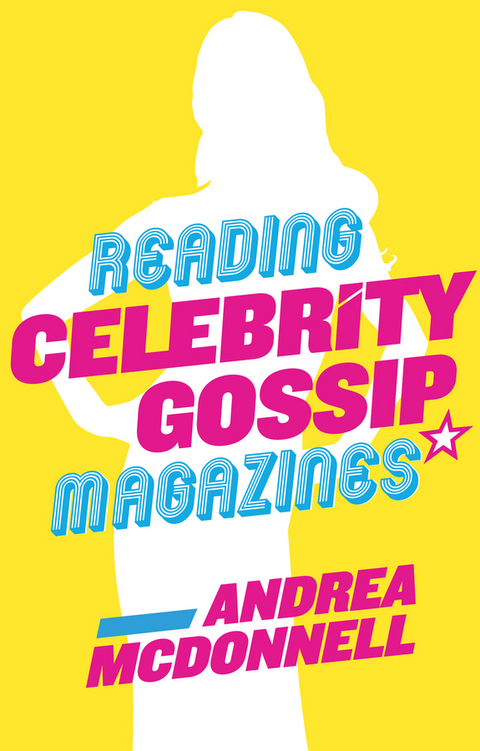
Reading Celebrity Gossip Magazines (eBook)
John Wiley & Sons (Verlag)
978-0-7456-8455-0 (ISBN)
Andrea McDonnell answers these questions with the help of interviews from editors and readers, and her own textual and visual analysis. McDonnell’s perspective is multifaceted; she examines the notorious narratives of celebrity gossip magazines as well as the genre’s core features, such as the 'Just Like Us' photo montage and the 'Who Wore It Best?' poll. McDonnell shows that, despite their trivial reputation, celebrity gossip magazines serve as an important site of engagement for their readers, who use these texts to generate conversation, manage relationships, and consider their own ideas and values.
Andrea McDonnell is Visiting Assistant Professor at Emmanuel College, Boston.
Americans are obsessed with celebrities. While our fascination with fame intensified throughout the twentieth century, the rise of the weekly gossip magazine in the early 2000s confirmed and fueled our popular culture s celebrity mania. After a decade of diets and dates, breakups and baby bumps, celebrity gossip magazines continue to sell millions of issues each week. Why are readers, especially young women, so attracted to these magazines? What pleasures do they offer us? And why do we read them, even when we disagree with the images of femininity that they splash across their hot-pink covers? Andrea McDonnell answers these questions with the help of interviews from editors and readers, and her own textual and visual analysis. McDonnell s perspective is multifaceted; she examines the notorious narratives of celebrity gossip magazines as well as the genre s core features, such as the "e;Just Like Us"e; photo montage and the "e;Who Wore It Best?"e; poll. McDonnell shows that, despite their trivial reputation, celebrity gossip magazines serve as an important site of engagement for their readers, who use these texts to generate conversation, manage relationships, and consider their own ideas and values.
Andrea McDonnell is Visiting Assistant Professor at Emmanuel College, Boston.
Introduction: Celebrity Gossip Magazines in American Popular Culture
1. Gendering Celebrity Gossip
2. All About Us: Celebrity Gossip Magazines and the Female Reader
3. Stars on Earth: The Paradox of Ordinary Celebrity
4. Making Morality Meaningful
5. Ambiguously Truthful
Conclusion: On Pleasure and the Popular
Appendices
References
"Andrea McDonnell's sympathetic study of celebrity magazines brings
a fresh and original approach to what she calls 'the popular
feminine'. With humor and understanding she shows what the
magazines mean to their twenty-something readers as they engage
with the challenges and contradictions of being female at that
particular moment in their lives. An essential read for all
students of gender and popular culture."
Paddy Scannell, University of Michigan
"Andrea McDonnell's book is a real treat. Reading Celebrity Gossip
Magazines offers a much needed integration and update of the study
of women's popular culture by integrating reader, writer and
textual perspectives in a strong analysis."
Joke Hermes, University of Amsterdam
"An outstanding analysis of the explosive rise and appeal of
celebrity magazines in the early twenty-first century.
Exceptionally well-written, thoughtful and nuanced, this study
breaks new ground in identifying the types of visual strategies the
magazines deploy, which kinds of normative messages are most
salient in them, and why these magazines, despite being recognized
as 'trashy', have enormous appeal to young women. Highly
recommended."
Susan Douglas, University of Michigan
1
Gendering Celebrity Gossip
In early 2002, Canadian magazine executive Bonnie Fuller became editor-in-chief of the newly made-over Us Weekly magazine; eight months later, with news-stand sales up over 55 percent, Fuller was named Advertising Age's editor of the year.1 But even while she was celebrated for her professional achievements, Fuller could not escape her magazine's reputation. “Us is ‘a deep-fried Twinkie’,” Claire Connors, Fuller's former colleague and entertainment director of Redbook magazine, told Advertising Age's David Carr. Carr himself likened the experience of reading Us to “eating the whole box of cookies, or ripping the top off a gumball machine and stuffing fistfuls in your mouth.”2 Such analogies are not uncommon within the world of celebrity gossip. Us Weekly and its counterparts are often compared to sweets, fluff, and treacle. This rhetoric suggests that celebrity gossip is an excessive, addictive, potentially dangerous treat, offering too-tempting-to-resist pleasures that ultimately leave you sick to your stomach. As Connors puts it, “It's so bad, it's good.”
Today, celebrity gossip magazines continue to be defined in these terms. But this discourse is not new; nor is it unique to this particular genre. The rhetoric that suggests these magazines are saccharine, trashy delights is indicative of a series of deeply held discourses, which circulate around cultural texts that are produced for, marketed to, and associated with female audiences. This chapter examines the ways in which such texts, which I call the popular feminine, come to be gendered within both the popular and academic discourse. By examining these discursive frames, we can begin to understand how the gendering of popular texts impacts our perceptions of those texts, the meanings we associate with them, and our feelings about the pleasures we derive from them.
The Popular Feminine
Celebrity gossip magazines are part of a broader set of popular cultural products produced for, marketed to, and consumed primarily by women. Soap operas. Chick flicks. Romance novels. These texts are not only linked by their emphasis on female life and their popularity with female audiences, but also by a set of discourses which are commonly applied across such genres. In both the popular and academic literature, these texts and the audiences who enjoy them are routinely delegitimized, trivialized, and problematized. In an effort to point to the way in which these texts are inextricably linked within these discursive frames, I use the term “the popular feminine” to describe popular texts that are associated with women and female life and that are subject to denigration based upon this gendered association.
I draw the term “popular feminine” from the work of Tanya Modleski, who, in her 1982 book Loving with a Vengeance: Mass-produced Fantasies for Women, examines three forms of popular culture “designed specifically for a female audience:” Harlequin romance, gothic novels, and soap operas. Modleski uses the term “popular feminine texts” to describe the objects of her study. But while Modleski is fundamentally interested in the response of female audiences, she does not insist that the audience for these texts consists entirely of women; nor does she argue that all women enjoy them. Likewise, I do not mean to imply that all women enjoy Twilight and Cosmopolitan magazine, nor do I wish to suggest that women are the only consumers of these cultural products, although many women certainly do find them entertaining. Rather, I use the term “the popular feminine” to highlight the way in which the perceived gender of popular texts impacts their meanings and value.
Popular feminine texts are inextricably linked with female audiences. And while these texts may very well have many female fans, the actual gender of their audience matters less than its perceived gender. In other words, popular feminine texts come to be understood as “female.” For example, celebrity gossip magazines, in contemporary popular discourse, are gendered feminine. This is a point that ordinary people agree upon; however, it is an academically problematic one because it is difficult to empirically prove such a cultural assumption. Yet scholarship suggests that audiences do, in fact, form consensus around the gendered nature of popular cultural texts. In her 1995 study, Hermes' participants assume that gossip magazines are women's texts (gossip, too, being a presumed female pastime). Irrespective of whether there exist men who read these magazines, or ladies who loathe them, Hermes' readers associate the genre with women. Dorothy Hobson finds a similar distinction in her 1980 study of television and radio listeners; her participants suggest that different media texts belong to specific gendered “worlds” and demonstrate a preference for those texts that belong to the “world” with which they identify.
What is troubling here is not necessarily the fact that different texts may be associated with audiences of different genders, but rather the consistency with which texts that have been gendered feminine have been linked to a web of discourses that undercut their value and underestimate the taste and intellect of those who enjoy them. As an author of young adult literature, Maureen Johnson knows this all too well. In an essay entitled “The Gender Coverup” (2013), she discusses the assumptions she routinely encounters:
When I hear people talk about “trashy” books, 95% of the time, they are talking about books written by women. When I see or hear the terms “light,” “fluffy,” “breezy,” or “beach read” … 95% of the time, they are talking about books written [and read] by women. Many times I hear people talking about books they have not read – books they've seen or heard about. I hear their predictions about those books. And then I hear people slapping labels on books they haven't read, making predictions. Again, I hear the same things. “Oh, that's just some romance.” “I'll read that when I just want something brainless.”
The books in question? You guessed it. Written by women. And some of those books, I'll note to myself, are fairly hardcore and literary, and I'll try to explain that. “Oh?” people will say. “Really? I thought it was just some chick lit book” … Somehow, we have put books into gender categories.
These gender categories, as Johnson makes clear, devalue texts that are presumed to be feminine. Further, these categorical assumptions work to shame audiences who enjoy feminine texts by perpetuating a distinction between cultural products that are “for women,” which are painted as illegitimate, and those “for men” which, by contrast, are bolstered. Thus, anyone, regardless of gender, who seeks out or enjoys the popular feminine is subject to its negative glare.3 In order to understand how it is that popular texts, and celebrity gossip magazines in particular, have come to be gendered and how it is that this gendering renders the pleasures associated with these texts taboo, “less than,” or otherwise “guilty,” we must examine those discourses which work to marginalize and trivialize the popular feminine.
Negative associations between women and popular cultural texts can be traced to the nineteenth century, as Andreas Huyssen documents in his 1986 article “Mass Culture as Woman.” During this time, as the Industrial Revolution produced major advances in printing and new books and periodicals emerged to meet the demands of a growing population of literate workers, serial novels and family magazines became increasingly popular with an expanding cohort of literate women. At the same time, these texts were condemned by bourgeois critics, who alleged that these forms of “mass culture” were unworthy substitutes for “true literature” (Huyssen, 1986).
The critiques aimed at the popular press were often gendered in nature; as Huyssen writes, “a specific traditional male image of women served as a receptacle for all kinds of projections, displaced fears, and anxieties (both personal and political), which were brought about by modernization and the new social conflicts” (1986: 52). For example, in an 1855 letter to his publisher, writer Nathaniel Hawthorne complained of “the damned mob of scribbling women” – popular female authors whose books often outsold his, reaching hundreds of thousands of readers. And 30 years later, prominent journal editor Michael Georg Conrad wrote that literature needed to be emancipated from the “tyranny of well-bred debutantes and old wives of both sexes” (Huyssen, 1986: 50).4 In order to guard themselves against the threat of the newly literate population, elite men held tight to traditional high cultural forms, contrasting literature, classical music, and the avant-garde with a bawdy, feminine mass culture in order to assert the former's legitimacy. In this way, mass-culture critiques became inextricably linked with the devaluation of female audiences and female pleasure in turn-of-the-century America. Since that time, this ideology has been used to trivialize and marginalize everything from Gossip Girl to Days of Our Lives.
The critique...
| Erscheint lt. Verlag | 8.9.2014 |
|---|---|
| Sprache | englisch |
| Themenwelt | Sozialwissenschaften ► Kommunikation / Medien ► Medienwissenschaft |
| Sozialwissenschaften ► Politik / Verwaltung | |
| Schlagworte | celebrity culture, gossip magazines, cultural studies • Communication & Media Studies • Cultural Studies • Kommunikation u. Medienforschung • Kulturwissenschaften • Media Studies • Medienforschung • popular culture • Volkskultur |
| ISBN-10 | 0-7456-8455-6 / 0745684556 |
| ISBN-13 | 978-0-7456-8455-0 / 9780745684550 |
| Informationen gemäß Produktsicherheitsverordnung (GPSR) | |
| Haben Sie eine Frage zum Produkt? |
 EPUB (Adobe DRM)
Kopierschutz: Adobe-DRM
Adobe-DRM ist ein Kopierschutz, der das eBook vor Mißbrauch schützen soll. Dabei wird das eBook bereits beim Download auf Ihre persönliche Adobe-ID autorisiert. Lesen können Sie das eBook dann nur auf den Geräten, welche ebenfalls auf Ihre Adobe-ID registriert sind.
Details zum Adobe-DRM
Dateiformat: EPUB (Electronic Publication)
EPUB ist ein offener Standard für eBooks und eignet sich besonders zur Darstellung von Belletristik und Sachbüchern. Der Fließtext wird dynamisch an die Display- und Schriftgröße angepasst. Auch für mobile Lesegeräte ist EPUB daher gut geeignet.
Systemvoraussetzungen:
PC/Mac: Mit einem PC oder Mac können Sie dieses eBook lesen. Sie benötigen eine
eReader: Dieses eBook kann mit (fast) allen eBook-Readern gelesen werden. Mit dem amazon-Kindle ist es aber nicht kompatibel.
Smartphone/Tablet: Egal ob Apple oder Android, dieses eBook können Sie lesen. Sie benötigen eine
Geräteliste und zusätzliche Hinweise
Buying eBooks from abroad
For tax law reasons we can sell eBooks just within Germany and Switzerland. Regrettably we cannot fulfill eBook-orders from other countries.
aus dem Bereich