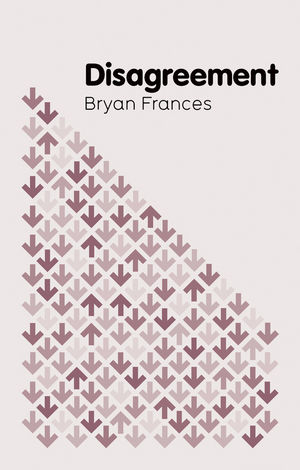
This book is devoted to exploring this quandary - what should we do when we encounter disagreement, particularly when we believe someone is more of an authority on a subject than we are? The question is of enormous importance, both in the public arena and in our personal lives. Disagreement over marriages, beliefs, friendships and more causes immense personal strife. People with political power disagree about how to spend enormous amounts of money, about what laws to pass, or about wars to fight. If only we were better able to resolve our disagreements, we would probably save millions of lives and prevent millions of others from living in poverty.
The first full-length text-book on this philosophical topic, Disagreement provides students with the tools they need to understand the burgeoning academic literature and its (often conflicting) perspectives. Including case studies, sample questions and chapter summaries, this engaging and accessible book is the perfect starting point for students and anyone interested in thinking about the possibilities and problems of this fundamental philosophical debate.
Bryan Frances is Professor of Philosophy at Fordham University
Regardless of who you are or how you live your life, you disagree with millions of people on an enormous number of topics from politics, religion and morality to sport, culture and art. Unless you are delusional, you are aware that a great many of the people who disagree with you are just as smart and thoughtful as you are - in fact, you know that often they are smarter and more informed. But believing someone to be cleverer or more knowledgeable about a particular topic usually won t change your mind. Should it? This book is devoted to exploring this quandary - what should we do when we encounter disagreement, particularly when we believe someone is more of an authority on a subject than we are? The question is of enormous importance, both in the public arena and in our personal lives. Disagreement over marriages, beliefs, friendships and more causes immense personal strife. People with political power disagree about how to spend enormous amounts of money, about what laws to pass, or about wars to fight. If only we were better able to resolve our disagreements, we would probably save millions of lives and prevent millions of others from living in poverty. The first full-length text-book on this philosophical topic, Disagreement provides students with the tools they need to understand the burgeoning academic literature and its (often conflicting) perspectives. Including case studies, sample questions and chapter summaries, this engaging and accessible book is the perfect starting point for students and anyone interested in thinking about the possibilities and problems of this fundamental philosophical debate.
Bryan Frances is Professor of Philosophy at Fordham University
List of Stories
Introduction
Part 1: Basics of Disagreement
1. Genuine vs. Illusory Disagreement
2. Easier Questions about Disagreement
3. Harder Questions about Disagreement
4. Expert Testimony and Higher-Order Evidence
5. Peers, Inferiors, and Superiors
6. Some Results
7. The Peer Rule and the Superior Rule
8. Disagreement over Facts, Values, And Religion
9. Disagreement over Beliefs vs. Actions
10. What We Should Believe vs. What We Actually Believe
11. Response to Disagreement vs. Subsequent Level Of Confidence
12. What It Means To Realize Disagreement
13. The Disagreement Question Refined
14. Disagreement with One vs. Disagreement with Many
15. Some More Results
16. Study Questions and Problems
Part 2: Conciliatory or Steadfast?
1. Introduction
2. Revising the Three Rules Of Thumb
3. Rethinking Judgments about Peers And Superiors
4. More Revision: Confidence Level vs. Evidence Level
5. When You Have No Idea Who is in the Better Position
6. Split Experts
7. Special Case: Religious Belief
8. Some Results
9. Questions on Uniqueness, Independence, and Peerhood
Uniqueness
Independence
Conditional Peers and Superiors
Feldman's Questions
10. Does Disagreement Lead To Skepticism?
11. The Disagreement Question Revisited
12. Study Questions and Problems
Index
"A fine introduction to the issues surrounding disagreement, this text will engage students with its lively prose and lucid thought."
Ernest Sosa, Rutgers University
"Frances's commitment to working with realistic examples makes for a kind of contact with everyday intellectual life that can seem missing in much of the professional literature on disagreement. Although the book is designed for students, it also gave me new things to think about."
David Christensen, Brown University
Introduction
In the summer of 2011 the USA engaged militarily in Libya, leading to the overthrow of the Libyan government. Some informed people think it was an illegal war, since war by the US government has to be approved by the US Congress, which didn't happen. Other informed people disagree, claiming that the military action was not significant enough to qualify as a “war,” so it didn't need Congressional approval in order to be legal.
Some Christians believe that Jesus rose from the dead – quite literally. Other Christians think that, while salvation occurs through Jesus, all that business about rising from the dead is metaphorical or otherwise non-literal: he didn't really, biologically, come back to life after being literally dead. Yet other people – highly intelligent, sober, and reflective non-Christian theists, agnostics, and atheists, for instance – think that Jesus didn't rise from the dead either literally or non-literally.
Disagreement is everywhere and can concern just about anything. It might arise from politics, religion, ethics, sports, philosophy, history, science, entertainment, and business. Controversy is rife.
Or just think about disagreement in your own personal life. Elena thinks that she and her partner Chris should get an apartment near the area in which the two of them work instead of getting a cheaper one that involves a significant commute. Chris thinks otherwise. So, the two of them disagree. They debate the pros and cons of the matter. Elena thinks it's pretty clear that, given the details of their combined financial situation, the hassle of the commute, and other factors, she and Chris should live in the city nearby to everything they typically go to during the week. Chris understands everything she said, but s/he adds things up differently, coming to the opposite conclusion.
Maya thinks that her father had an affair with that neighbor Martha when she and her sister Danling were little kids. Maya tells Danling her reasons but to no avail: Danling is totally unconvinced. Maya is inclined to read the evidence one way, as being very strongly supportive of the idea that Dad had an affair with Martha, whereas her sister is inclined to come to the opposite conclusion, that the evidence is not so supportive. Why should Maya think that her reading of the evidence is better than her sister's for finding the truth of the matter? Why favor her own judgment over her sister's? What if she knows full well that she is no smarter than her sister?
Devin thinks third-trimester abortion is morally unacceptable in almost all cases. But he isn't culturally clueless: he is fully aware that there are loads of people who disagree. Devin's sister Irene is newly pregnant and doesn't want to have a baby now. She doesn't want to marry the father; or maybe he is no longer around. She has little money or other resources, she has little time to devote to a baby since she is still in college and has a part-time job, etc. So, the question of abortion has come up. She discusses her options with Devin. What if Irene thinks there is virtually nothing wrong with it, especially since it's an early stage of the pregnancy? What is Devin going to say to her?
Actually, there are two issues here: Devin needs to figure out how to act and what to believe. He needs to decide what he is going to say to his sister Irene. But he also needs to figure out what to believe regarding the moral permissibility of abortion. He thinks it's almost always morally unacceptable, but he knows that there are loads of people significantly smarter than himself who have thought about the matter a lot longer than he has and have not drawn that conclusion. (And of course he knows that some of the people who agree with him are smarter and better informed than he is.) At the very least, I hope that Devin knows that, because it's just plain true! What makes him think he and the people who agree with him got the issue right and Irene and the people who agree with her got it wrong? What advantage does he think his group has over her group? Or does he think his group has no advantage over her group – in which case why on earth does he stick with his view over theirs? If Irene is similarly aware of disagreement over the moral acceptability of abortion, then she is faced with the same questions on what to believe – and a bigger question on what to do.
Devin is faced with the same two questions – how to act, what to believe – if the views are reversed: Irene thinks abortion is immoral and she says she has to go ahead with the pregnancy. Devin thinks that this move will be disastrous for Irene's future and abortion is fine in her circumstances. What should he say or do about it? And then there is the prior question: how does he know his view is even right, given that there are zillions of very intelligent people who disagree with him on the matter? No matter which side he is on, he is faced with a big problem about how to behave and what to believe.
Disagreements are everywhere, in the public square and our private lives. This book is devoted to the question of what we should do when we realize that there are people who disagree with us.
As we have seen with some of the examples above, the question is of enormous importance, both in the public arena and in our personal lives. You may disagree with your parents about where to go to college, or whom to marry. You may disagree with your spouse or partner about whether to live together, whether to get married, where you should live, or how to raise your children. People with political power disagree about how to spend enormous amounts of money, or about what laws to pass, or about wars to fight. If only we were better able to resolve our disagreements, we would probably save millions of lives and prevent millions of others from living in poverty. If only.
Here are some questions that provoke plenty of disagreement:
Political
Personal
Philosophical
Professional
Scientific
Miscellaneous
This book lies on the border between theoretical and applied epistemology. Theoretical epistemology is the study of the relations among and natures of a group of closely related notions: knowledge, belief, truth, evidence, reason, certainty, rationality, wisdom, understanding, and a few others. We will not focus on those highly theoretical issues. Our center of attention will almost always be on real-life disagreements and what one is supposed to do...
| Erscheint lt. Verlag | 25.8.2014 |
|---|---|
| Reihe/Serie | Key Concepts in Philosophy |
| Key Concepts in Philosophy | Key Concepts in Philosophy |
| Sprache | englisch |
| Themenwelt | Geisteswissenschaften ► Philosophie ► Allgemeines / Lexika |
| Geisteswissenschaften ► Philosophie ► Erkenntnistheorie / Wissenschaftstheorie | |
| Geisteswissenschaften ► Philosophie ► Ethik | |
| Geisteswissenschaften ► Philosophie ► Logik | |
| Sozialwissenschaften | |
| Schlagworte | Epistemology • epistemology, disagreement, philosophy, ethics, belief, doubt, agreement, consensus • Erkenntnistheorie • ethics • Ethik • Philosophie • Philosophy |
| ISBN-10 | 0-7456-8523-4 / 0745685234 |
| ISBN-13 | 978-0-7456-8523-6 / 9780745685236 |
| Informationen gemäß Produktsicherheitsverordnung (GPSR) | |
| Haben Sie eine Frage zum Produkt? |
 EPUB (Adobe DRM)
Kopierschutz: Adobe-DRM
Adobe-DRM ist ein Kopierschutz, der das eBook vor Mißbrauch schützen soll. Dabei wird das eBook bereits beim Download auf Ihre persönliche Adobe-ID autorisiert. Lesen können Sie das eBook dann nur auf den Geräten, welche ebenfalls auf Ihre Adobe-ID registriert sind.
Details zum Adobe-DRM
Dateiformat: EPUB (Electronic Publication)
EPUB ist ein offener Standard für eBooks und eignet sich besonders zur Darstellung von Belletristik und Sachbüchern. Der Fließtext wird dynamisch an die Display- und Schriftgröße angepasst. Auch für mobile Lesegeräte ist EPUB daher gut geeignet.
Systemvoraussetzungen:
PC/Mac: Mit einem PC oder Mac können Sie dieses eBook lesen. Sie benötigen eine
eReader: Dieses eBook kann mit (fast) allen eBook-Readern gelesen werden. Mit dem amazon-Kindle ist es aber nicht kompatibel.
Smartphone/Tablet: Egal ob Apple oder Android, dieses eBook können Sie lesen. Sie benötigen eine
Geräteliste und zusätzliche Hinweise
Buying eBooks from abroad
For tax law reasons we can sell eBooks just within Germany and Switzerland. Regrettably we cannot fulfill eBook-orders from other countries.
aus dem Bereich