Zum Hauptinhalt springen
Nicht aus der Schweiz? Besuchen Sie lehmanns.de
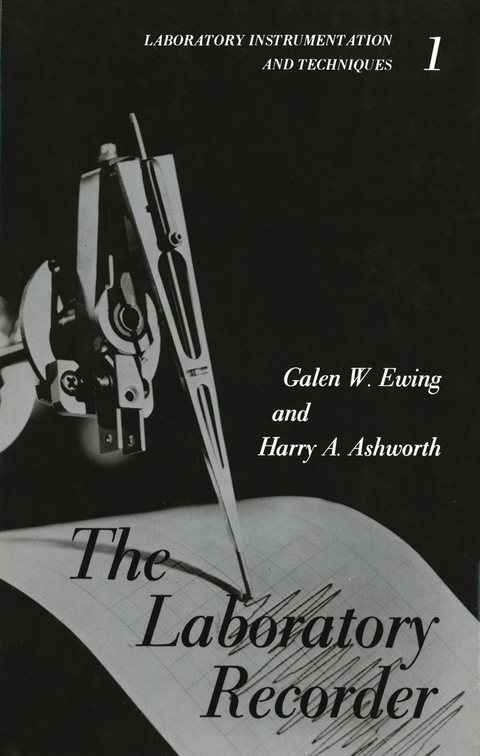
The Laboratory Recorder -

The Laboratory Recorder

Galen Ewing (Herausgeber)

Buch | Softcover
129 Seiten
2012 | Softcover reprint of the original 1st ed. 1974
Springer-Verlag New York Inc.
9781461345251 (ISBN)
CHF 74,85 inkl. MwSt
One of the most universal functions of any scientific or engineer­ ing laboratory is the gathering of data to provide answers to immediate questions or information to be filed for future refer­ ence. Such data gathering may be achieved in various ways, depending on the nature and quantity of the information. The most prevalent of such data gathering methods is undoubtedly analog recording. Electrical analog recorders are available in a variety of sizes, speeds, sensitivities, and prices. They are suitable for recording any signal which is in, or can be converted to, electrical form. These recorders are found in every modern laboratory. Without them the importance of many functional relations would be missed altogether. How could one adequately diagnose a heart ailment without a cardiographic recorder, or obtain infrared or magnetic resonance spectra on any practicable basis without a strip-chart recorder? True, various curves that are now traced automatically with a recorder can be plotted manually from point-by-point measure­ ments. This procedure, however, is not only time-consuming, but may cause valid bits of information to be overlooked entirely, simply because the points were taken too far apart. Another factor favoring the use of recorders is the ability to pinpoint faulty operation of the data-gathering system. Artifacts that might not be observable at all in point-by-point observations 1 The Laboratory Recorder 2 will often be readily identifiable on a recording. Asymmetry of a peaked curve, for example, is only dearly evident in a recording.

1 Introduction.- 2 Deflection Recorders.- Linearizing Mechanisms.- The Prevention of Loading Effects.- 3 Servo Recorders.- Attentuators.- Reference Voltage Sources.- Slidewires.- Amplifiers.- Motors.- Multichannel Recorders.- Dynamic Properties.- Special Modifications.- 4 X-Y Recorders.- Drive Mechanisms.- Input Circuitry.- 5 Oscillographs.- Light-Beam Oscillographs.- X-Y Oscillographs.- Moving Pen or Stylus Oscillographs.- Fixed-Stylus Recording.- 6 Paper Feed and Writing Mechanisms.- Paper Forms.- Strip-Chart Drive Mechanisms.- Separate Sheet Recording Paper.- Printing Mechanisms.- 7 Shielding and Grounding.- Internal Noise.- External Noise.- Grounding and Guarding.- Amplifiers.- 8 Recorder Specifications.- 9 Troubleshooting.- Maintenance.- Performance Checks.- Difficulties and Their Causes.- 10 Recorder Accessories.- Integrators.- Differentiators.- Retransmitting Potientiometers and Encoders.- Event Markers.- Sampling Recorders.- Scale Expanders.- Multiplexers.- Calibrators.- Chart Viewers.- Appendix: Sources of Laboratory Recorders.

Erscheint lt. Verlag 26.11.2012
Reihe/Serie Laboratory Instrumentation and Techniques ; 1
Zusatzinfo 54 Illustrations, black and white
Verlagsort New York
Sprache englisch
Maße 152 x 229 mm
Themenwelt Schulbuch / Wörterbuch
Geisteswissenschaften
Naturwissenschaften
Sozialwissenschaften
Technik Maschinenbau
ISBN-13 9781461345251 / 9781461345251
Zustand Neuware
Informationen gemäß Produktsicherheitsverordnung (GPSR)
Haben Sie eine Frage zum Produkt?
Mehr entdecken
aus dem Bereich