


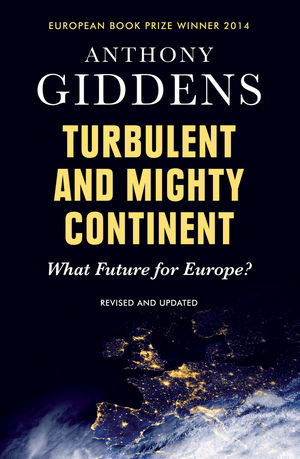
Turbulent and Mighty Continent (eBook)
John Wiley & Sons (Verlag)
978-0-7456-8127-6 (ISBN)
Today, nearly seventy years later, over 500 million people live in the member states of the European Union – a greater number than in any other political community save for China and India. The currency of the Union, the euro, is used in economic transactions world-wide. Yet the EU is mired in the greatest crisis of its history, one that threatens its very existence as an entity able to have an impact upon world affairs. Europe no longer seems so mighty, instead but faces the threat of becoming an irrelevant backwater or, worse, once again the scene of turbulent conflicts. Divisions are arising all over Europe, while the popularity of the Union sinks. How can this situation be turned around?
It is a mistake, argues Anthony Giddens, to see the misfortunes of the euro as the sole source of Europe's malaise. The Union faces problems shared by most or all of the developed states of the world. Reform in Europe must go far beyond stabilizing the euro, formidable and fraught though that task may be. Introducing an array of new ideas, Giddens suggests this is the time for a far-reaching rethink of the European project as a whole.
Anthony Giddens is former Director of the London School of Economics, Life Fellow of King’s College, Cambridge, and Member of the House of Lords, UK.
Winner of the 2014 European Book Prize. A "e;United States of Europe"e;, Winston Churchill proposed in 1946, could "e;as if by a miracle transform"e; that "e;turbulent and mighty continent"e;. "e;In this way only"e;, he continued, "e;will hundreds of millions of toilers be able to regain the simple joys and hopes which make life worth living"e;. Today, nearly seventy years later, over 500 million people live in the member states of the European Union a greater number than in any other political community save for China and India. The currency of the Union, the euro, is used in economic transactions world-wide. Yet the EU is mired in the greatest crisis of its history, one that threatens its very existence as an entity able to have an impact upon world affairs. Europe no longer seems so mighty, instead but faces the threat of becoming an irrelevant backwater or, worse, once again the scene of turbulent conflicts. Divisions are arising all over Europe, while the popularity of the Union sinks. How can this situation be turned around? Now published as a revised and updated paperback that takes account of the May 2014 elections to the European Parliament, Turbulent and Mighty Continent makes a powerful case for a far-reaching and fundamental renewal of the European project as a whole.
Anthony Giddens is former Director of the London School of Economics, Life Fellow of King's College, Cambridge, and Member of the House of Lords, UK.
Figures and Tables vi
Acknowledgements viii
Introduction 1
1 The EU as Community of Fate 18
2 Austerity and After 54
3 No More Social Model? 87
4 The Cosmopolitan Imperative 121
5 Climate Change and Energy 151
6 The Search for Relevance 182
Conclusion 209
Notes 221
Index 234
Winner of the European Book Prize for Non-Fiction
"Rich in insights on conceptualising problems and identifying solutions."
--LSE Review of Books
"A significant intervention into the debate about Europe's future."
--Gerhard Schröder, former Chancellor of Germany
"An indispensable book at a time when clear thinking about the EU is vital. Deserves to be actively debated across Europe at such a critical juncture in the continent's history."
--Javier Solana, former EU High Representative for Foreign Affairs and Security Policy and Secretary-General of NATO
"In the 1980s the famous Cecchini Report played a crucial role in fostering the single currency. I expect this book by Tony Giddens to play a similar role in the creation of the more integrated Europe essential to us all twenty five years later."
--Giuliano Amato, former Prime Minister of Italy
"A great book bout the possibilities for European social democracy in the modern world."
--Progress Online
"From the perspective of a new entrant country like Romania, Giddens' views are as relevant as they are to the founding member states. A must-read for all who are concerned about Europe's future, whatever shade of opinion they may hold."
--Ana Birchall, MP and Member of the European Affairs Commission, Romanian Parliament
"A must-read from one of the leading thinkers of our time, for all who want the European Project to adapt and progress, and preferably do so with the United Kingdom as a committed member of a stronger but also more flexible Union."
--Kemal Dervis, Vice-President for Global Economics at the Brookings Institution and former Turkish Minister of Economic Affairs
"... Giddens succeeds in cutting through much of the turgid intramural debate on Europe to offer a clear diagnosis of the European Union's dilemma, and a powerful argument in its favour."
--Survival: Global Politics and Strategy
"The author raises a wide range of subjects: global warming, energy consumption, immigration, digital economy, diplomacy. His viewpoints are clear. This oeuvre offers a logical and thought-provoking perspective."
--Politique Etrangère
"This latest work by Anthony Giddens is a brilliant and subtle contribution to the future of Europe."
--Europe's World
"The book provides a comprehensive and relatively accessible overview of the diverse problems facing contemporary Europe."
--Political Studies Review
Chapter 1
The EU as Community of Fate
The malaise of the euro does not stand on its own. It reflects issues that stretch a long way beyond Europe itself, including a series of deep economic problems shared across the industrial countries. Within the European context, the problems surrounding the euro have brought to the fore weaknesses in the Union that are of much longer standing but now demand resolution. All could yet end in disaster. If the euro were to collapse, as could still happen, the economic consequences could be calamitous not only for Europe but for the wider world economy as well.
Europe at the moment is dominated by a specific version of EU2, called into existence by the euro crisis. It features an informal ‘president’ of Europe, Angela Merkel. If Barack Obama wants to influence what is happening in Europe, he talks in the first instance to Mrs Merkel. The ‘president’ has an ‘inner cabinet’, of varying composition, with whom she takes the key decisions – especially in periods of particular difficulty – and seeks to push them through. The ‘cabinet’ consists of a small number of the leaders of influential states, the president of the ECB, plus one or two IMF officials. Of course, there is also a range of connections with EU1and its several presidents, still labouring away in the background. The German leader calls the tune because of the size of the country’s economy and its relative success in comparison with the other larger European states. That situation has to be a transitional one. It is dangerous because of noxious divisions that have opened up between member states as well as its more general ramifications in politics. Countries in the South that depend on German acquiescence to release needed funds are as resentful of that fact as are the ‘donors’. The German public is put off by the image of the ‘feckless’ Greeks that has taken root in the wake of the turmoil in the country. Meanwhile, some Greek politicians are raking over the coals of the Second World War, demanding that Germany pay reparations for its historic brutalities. Populist parties have appeared almost everywhere, although the most prominent antedate the crisis itself. Most are nationalist and Eurosceptic in one sense or another. Some, such as that led by Geert Wilders in the Netherlands, have participated in government. Democratic processes have sometimes been put in suspension. In November 2011 the prime minister of Italy, Silvio Berlusconi, resigned from his position and was replaced by a ‘technocrat’, Mario Monti. Monti initiated a reform programme in Italy, approved of by Chancellor Merkel, the then president of France, Nicolas Sarkozy, the ECB and the IMF – EU2, in other words.
Monti then stood for office in the general election of February 2013, at the head of a new coalition group. His coalition, however, finished bottom of the four main contenders. The big surprise was the success of the ‘Five Star Movement’, led by the comedian and actor Beppe Grillo. As a consequence of the division of the vote, no coherent government could initially be formed. Grillo described Mr Monti as an agent of the banks and repeatedly called for a referendum on Italy’s membership of the euro. He is not, he said, a Eurosceptic or anti-European, but a critic of how the EU has evolved. ‘Why is only Germany getting richer?’ he asked.1
The euro could in principle be wound back, one or two members could either be ejected or leave, or even the whole thing could be abandoned. I defer detailed discussion of these possibilities to the end of the book. Even the more limited options could prove far more difficult than many who have proposed such courses of action seem to imagine. Following the path of further integration is the only way the Union can effectively deal with the problems it faces today. The basic theorem is simple. Saving the euro means moving towards greater economic cohesion within the eurozone. Because EU2 leadership is inherently too unstable and divisive, this in turn presumes a transformation of the EU’s political institutions. The deep, and connected, flaws that have haunted the European project since its inception must be dealt with – its lack of both democratic legitimacy and effective leadership. The politics of getting from here to there, however, are testing indeed, since they reflect the very limitations of the system that needs to be replaced.
Progress so far has been substantial, if erratically so. Since reform is crisis-driven, decisions are quite often taken, and interventions made, at the last minute. Once things appear a bit more placid, the impetus to push through major change can be lost. The personalities involved count for a lot, as does how well they get on with one another at any particular point, since their association is informal – that is, not based upon an established institutional system. Moreover, EU2 is unstable because of the vagaries of national election processes which, being timed differently, act against continuity of leadership. Thus for some while commentators used to speak of Europe being led by ‘Merkozy’ – the duo of Angela Merkel and Nicolas Sarkozy. Some newspapers even published photos in which the traits of the two were combined to form a single face. The German tabloid Bild carried a headline: ‘Merkozy – sieht so das neue Europa aus?’ (‘Merkozy – is this how the new Europe looks?’)2 Although in the early days there were many tensions between them, Merkel and Sarkozy became ‘Europe’s indispensable couple’. Sarkozy explained in private the dynamics of the ‘marriage’ and he put it very appropriately: ‘Germany without France frightens everyone. France without Germany frightens no one.’3 By acting together they could mute each of these qualities and could also underpin the wider activities of EU2.
Germany has become Europe’s indispensable nation. Merkozy, however, proved more transitory than many imagined. Suddenly, Sarkozy was gone. In his place came François Hollande, a different personality from his predecessor and one holding different political views. The newspapers tried, but they could not come up with a catchy merging of the names of the German chancellor with that of the new French president. The abortive attempt matched up to reality. Hollande became part of EU2, but its inner dynamics changed. No one would think of making a composite face for the two of them. Nonetheless they are obliged to work together.
The dialectic of EU1 and EU2 has always been Europe’s way of doing things. However, since the crisis, a new player, the IMF, has become involved and is a key member of the Troika. The involvement of the IMF is humiliating for the Union, but has proved absolutely essential. Its current head, Christine Lagarde, is a former finance minister of France and thus intimately familiar with European politics. She is the first ever female head of the IMF. Apart from Mario Draghi, the president of the ECB, she and Merkel are the most prominent leaders in EU2 at the moment, a unique moment in the history of the EU, which has long been a resolutely male affair. The EU claims many founding fathers, but so far as I know there are no founding mothers at all. Lagarde and Merkel appear to have a good relationship, although they have had their public disagreements. Lagarde has said that Merkel is the ‘unchallenged leader’ on the European scene. The two exchange presents and sometimes dine alone with each other. Lagarde thinks, however, that the progress of reform in the EU has been too slow. She has advised Europe’s leaders to ‘get on with the union. Make sure you have a banking union, down the road fiscal union, and that you keep that currency zone together and solid.’4
There have been other tensions within the Troika. An IMF report published in June 2013 criticised the EU’s handling of the first bailout given to Greece in 2010, which amounted to about €110 billion.5 It was a mistake, the IMF said, not to oblige investors in Greek bonds to accept losses at that point, rather than waiting until late in 2011. If this had been done, the government would not have had to make such swingeing cuts in expenditure. Olli Rehn, the European commissioner for economic affairs, rejected the criticisms. ‘I don’t think it’s fair just for the IMF to wash its hands and throw the dirty water on the Europeans’, he said. He pointed out that Lagarde had resisted any debt restructuring when she was a member of Sarkozy’s government. The Greek government at the time also came in for forthright criticism, for moving too slowly to begin with in making the reforms that were part of the bargain.6
HOW MUCH PROGRESS HAS BEEN MADE?
‘It is imperative to break the vicious circle between banks and sovereigns’ – the declaration was first made in an EU communiqué in June 2012 and repeated following a European Council meeting a year later.7 To achieve such an end, as is very widely recognised, a banking union must be set up, accompanied at some point by a version of fiscal union. The one will not be water-tight without the other. Most banking unions have three elements: powers of supervision, powers of resolution of debts and a deposit guarantee. So far as the first of these is concerned, an important threshold was crossed in March 2013...
| Erscheint lt. Verlag | 18.12.2013 |
|---|---|
| Sprache | englisch |
| Themenwelt | Sozialwissenschaften ► Politik / Verwaltung ► Europäische / Internationale Politik |
| Wirtschaft ► Volkswirtschaftslehre ► Makroökonomie | |
| Schlagworte | Economics • Europa • Europa / Ãkonomie u. Handel • Europa / Ökonomie u. Handel • Europapolitik • Europa /Wirtschaft, Volkswirtschaft • Europe • European politics • European Union, the euro, financial crisis • Internationale Beziehungen • International Relations • Political Science • Politik / Europa • Politikwissenschaft • Volkswirtschaftslehre |
| ISBN-10 | 0-7456-8127-1 / 0745681271 |
| ISBN-13 | 978-0-7456-8127-6 / 9780745681276 |
| Informationen gemäß Produktsicherheitsverordnung (GPSR) | |
| Haben Sie eine Frage zum Produkt? |
 EPUB (Adobe DRM)
Kopierschutz: Adobe-DRM
Adobe-DRM ist ein Kopierschutz, der das eBook vor Mißbrauch schützen soll. Dabei wird das eBook bereits beim Download auf Ihre persönliche Adobe-ID autorisiert. Lesen können Sie das eBook dann nur auf den Geräten, welche ebenfalls auf Ihre Adobe-ID registriert sind.
Details zum Adobe-DRM
Dateiformat: EPUB (Electronic Publication)
EPUB ist ein offener Standard für eBooks und eignet sich besonders zur Darstellung von Belletristik und Sachbüchern. Der Fließtext wird dynamisch an die Display- und Schriftgröße angepasst. Auch für mobile Lesegeräte ist EPUB daher gut geeignet.
Systemvoraussetzungen:
PC/Mac: Mit einem PC oder Mac können Sie dieses eBook lesen. Sie benötigen eine
eReader: Dieses eBook kann mit (fast) allen eBook-Readern gelesen werden. Mit dem amazon-Kindle ist es aber nicht kompatibel.
Smartphone/Tablet: Egal ob Apple oder Android, dieses eBook können Sie lesen. Sie benötigen eine
Geräteliste und zusätzliche Hinweise
Buying eBooks from abroad
For tax law reasons we can sell eBooks just within Germany and Switzerland. Regrettably we cannot fulfill eBook-orders from other countries.


