


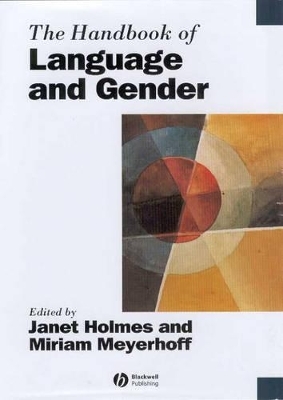
The Handbook of Language and Gender
Blackwell Publishers (Verlag)
9780631225027 (ISBN)
- Titel erscheint in neuer Auflage
- Artikel merken
The Handbook of Language and Gender is a collection of articles written by leading specialists in the field that examines the dynamic ways in which women and men develop and manage gendered identities through their talk. * Provides a comprehensive, up-to-date, and stimulating picture of the field for students and researchers in a wide range of disciplines * Features data and case studies from interactions in different social contexts and from a range of different communities
Janet Holmes holds a personal Chair in Linguistics at Victoria University of Wellington and is Director of the Wellington Language in the Workplace Project and the Wellington Corpus of Spoken New Zealand English. She is the author of numerous books and articles, including Introduction to Sociolinguistics (second edition, 2001) and Women, Men and Politeness (1995). She is editor of Gendered Speech in Social Context (2000). Miriam Meyerhoff is Lecturer in Linguistics at the University of Edinburgh, before which she was Assistant Professor at the University of Hawai'i, Manoa. She has published articles on language and gender, language change in creoles, and is the author of Constraints on Null Subjects in Bislama (Vanuatu) (2000).
Notes on Contributors. Different Voices, Different Views: An Introduction to Current Research in Language and Gender: Janet Holmes and Miriam Meyerhoff, Victoria University of Wellington and University of Edinburgh. Part I: History and Theoretical Background to the Study of Language and Gender:. 1. Theorizing gender in sociolinguistics and linguistic anthropology: Bonnie McElhinny, University of Toronto. 2. Theories of discourse as theories of gender: discourse analysis in language and gender studies: Mary Bucholtz, Texas A&M University. 3. "What's in a name?": Social labeling and gender practices: Sally McConnell-Ginet, Cornell University. 4. Variation in language and gender: Suzanne Romaine, Merton College. 5. Language and desire: Don Kulick, New York University. 6. "One man in two is a woman": linguistic approaches to gender in literary texts: Anna Livia, University of California, Berkeley. Part II: Negotiating Relations:. 7. Language, gender, and politics: putting "women" and "power" in the same sentence: Robin Lakoff, University of California, Berkeley. 8. Gender and family interaction: Deborah Tannen, Georgetown University. 9. Gender and power in on-line communication: Susan C. Herring, Indiana University, Bloomington. 10. The relevance of ethnicity, class, and gender in children's peer negotiations: Marjorie Harness Goodwin, University of California, Los Angeles. 11. The power of gender ideologies in discourse: Susan U. Philips, University of Arizona. Part III: Authenticity and Place:. 12. Crossing genders, mixing languages: the linguistic construction of transgenderism in Tonga: Niko Besnier, Victoria University of Wellington. 13. Claiming a place: gender, knowledge, and authority as emergent properties: Miriam Meyerhoff, University of Edinburgh. 14. Constructing and managing male exclusivity in talk-in-interaction conversations: Jack Sidnell, Northwestern University. 15. Exceptional speakers: contested and problematized gender identities: Kira Hall, University of Colorado, Boulder. 16. Language and gender in adolescence: Penelope Eckert, Stanford University. 17. Language and gendered modernity: William L. Leap, American University. 18. A marked man: the contexts of gender and ethnicity: Sara Trechter, Chico State University. Part IV: Stereotypes and Norms:. 19. Gender and language ideologies: Deborah Cameron, University of London. 20. Gender stereotypes: reproduction and challenge: Mary Talbot, University of Sunderland. 21. Gender and identity: representation and social action: Ann Weatherall and Cindy Gallois, Victoria University of Wellington and University of Queensland. 22. Prestige, cultural models, and other ways of talking about underlying norms and gender: Scott Fabius Kiesling, University of Pittsburgh. 23. Communicating gendered professional identity: competence, cooperation, and conflict in the workplace: Caja Thimm, Sabine C. Koch and Sabine Schey, all University of Heidelberg. 24. Linguistic sexism and feminist linguistic activism: Anne Pauwels, University of Wollongong. Part V: Institutional Discourse:. 25. "Feminine" workplaces: stereotype and reality: Janet Holmes and Maria Stubbe, both Victoria University of Wellington. 26. Creating gendered demeanors of authority at work and home: Shari Kendall, Georgetown University. 27. Schooled language: language and gender in educational settings: Joan Swann, Open University. 28. Coercing gender: language in sexual assault adjudication processes: Susan Ehrlich, York University. 29. Multiple identities: the roles of female parliamentarians in the EU parliament: Ruth Wodak, Austrian Academy of Sciences. Epilogue:Reflections on language and gender research: Alice F. Freed, Montclair State University. Index.
| Erscheint lt. Verlag | 3.1.2003 |
|---|---|
| Reihe/Serie | Blackwell Handbooks in Linguistics |
| Zusatzinfo | 10 |
| Verlagsort | Oxford |
| Sprache | englisch |
| Maße | 176 x 256 mm |
| Gewicht | 1550 g |
| Themenwelt | Geisteswissenschaften ► Sprach- / Literaturwissenschaft ► Sprachwissenschaft |
| Sozialwissenschaften ► Soziologie ► Gender Studies | |
| ISBN-13 | 9780631225027 / 9780631225027 |
| Zustand | Neuware |
| Informationen gemäß Produktsicherheitsverordnung (GPSR) | |
| Haben Sie eine Frage zum Produkt? |
aus dem Bereich


