


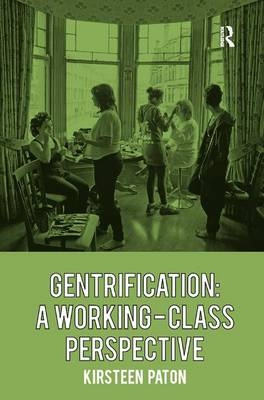
Gentrification: A Working-Class Perspective
Seiten
2014
Routledge (Verlag)
978-1-4724-1850-0 (ISBN)
Routledge (Verlag)
978-1-4724-1850-0 (ISBN)
This book reconnects class and the urban through an ethnographically detailed analysis of a neighbourhood undergoing gentrification which historicises class formation.
Focusing on the working-class experience of gentrification, this book re-examines the enduring relationship between class and the urban. Class is so clearly articulated in the urban, from the housing crisis to the London Riots to the evocation of housing estates as the emblem of ’Broken Britain’. Gentrification is often presented to a moral and market antidote to such urban ills: deeply institutionalised as regeneration and targeted at areas which have suffered from disinvestment or are defined by ’lack’. Gentrification is no longer a peripheral neighbourhood process: it is policy; it is widespread; it is everyday. Yet comparative to this depth and breadth, we know little about what it is like to live with gentrification at the everyday level. Sociological studies have focused on lifestyles of the middle classes and the working-class experience is either omitted or they are assumed to be victims. Hitherto, this is all that has been offered. This book engages with these issues and reconnects class and the urban through an ethnographically detailed analysis of a neighbourhood undergoing gentrification which historicises class formation, critiques policy processes and offers a new sociological insight into gentrification from the perspective of working-class residents. This ethnography of everyday working-class neighbourhood life in the UK serves to challenge denigrated depictions which are used to justify the use of gentrification-based restructuring. By exploring the relationship between urban processes and working-class communities via gentrification, it reveals the ’hidden rewards’ as well as the ’hidden injuries’ of class in post-industrial neighbourhoods. In doing so, it provides a comprehensive ’sociology of gentrification’, revealing not only how gentrification leads to the displacement of the working class in physical terms but how it is actively used within urban policy to culturally displace the working-class subject and traditional
Focusing on the working-class experience of gentrification, this book re-examines the enduring relationship between class and the urban. Class is so clearly articulated in the urban, from the housing crisis to the London Riots to the evocation of housing estates as the emblem of ’Broken Britain’. Gentrification is often presented to a moral and market antidote to such urban ills: deeply institutionalised as regeneration and targeted at areas which have suffered from disinvestment or are defined by ’lack’. Gentrification is no longer a peripheral neighbourhood process: it is policy; it is widespread; it is everyday. Yet comparative to this depth and breadth, we know little about what it is like to live with gentrification at the everyday level. Sociological studies have focused on lifestyles of the middle classes and the working-class experience is either omitted or they are assumed to be victims. Hitherto, this is all that has been offered. This book engages with these issues and reconnects class and the urban through an ethnographically detailed analysis of a neighbourhood undergoing gentrification which historicises class formation, critiques policy processes and offers a new sociological insight into gentrification from the perspective of working-class residents. This ethnography of everyday working-class neighbourhood life in the UK serves to challenge denigrated depictions which are used to justify the use of gentrification-based restructuring. By exploring the relationship between urban processes and working-class communities via gentrification, it reveals the ’hidden rewards’ as well as the ’hidden injuries’ of class in post-industrial neighbourhoods. In doing so, it provides a comprehensive ’sociology of gentrification’, revealing not only how gentrification leads to the displacement of the working class in physical terms but how it is actively used within urban policy to culturally displace the working-class subject and traditional
Kirsteen Paton is lecturer in the School of Sociology and Social Policy at the University of Leeds, UK.
Contents: Introduction; Restructuring theory; Restructuring class identity; Elective belonging and fixity to place; Gentrifying working-class subjects: participating in consumer citizenship; The paradox of gentrification: displacing the working-class subject; Conclusions: reinvigorating urban class analysis; Appendix; Bibliography; Index.
| Erscheint lt. Verlag | 17.10.2014 |
|---|---|
| Verlagsort | London |
| Sprache | englisch |
| Maße | 156 x 234 mm |
| Gewicht | 640 g |
| Themenwelt | Naturwissenschaften ► Geowissenschaften ► Geografie / Kartografie |
| Sozialwissenschaften ► Soziologie ► Makrosoziologie | |
| ISBN-10 | 1-4724-1850-6 / 1472418506 |
| ISBN-13 | 978-1-4724-1850-0 / 9781472418500 |
| Zustand | Neuware |
| Informationen gemäß Produktsicherheitsverordnung (GPSR) | |
| Haben Sie eine Frage zum Produkt? |
Mehr entdecken
aus dem Bereich

aus dem Bereich
Buch | Hardcover (2024)
Schweizerbart'sche, E. (Verlag)
CHF 33,55
Sammlung vermessungstechnischer Aufgaben mit ausführlichen Lösungen
Buch | Softcover (2025)
Wichmann, H (Verlag)
CHF 37,80
über eine faszinierende Welt zwischen Wasser und Land und warum sie …
Buch | Hardcover (2023)
dtv (Verlag)
CHF 33,55


