


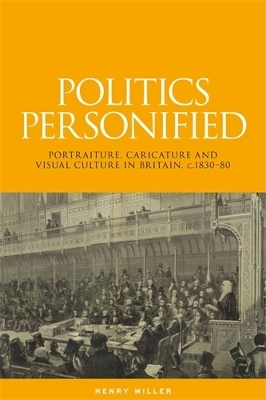
Politics Personified
Portraiture, Caricature and Visual Culture in Britain, C.1830–80
Seiten
2015
Manchester University Press (Verlag)
978-0-7190-9084-4 (ISBN)
Manchester University Press (Verlag)
978-0-7190-9084-4 (ISBN)
The first study of the role of commercial imagery in nineteenth-century politics, Politics personified shows how visual images projected a favourable public image of politics and politicians. Drawing on a vast and diverse range of sources, this book highlights how and why politics was visualised. -- .
The remarkable popularity of political likenesses in the Victorian period is the central theme of this book, which explores how politicians and publishers exploited new visual technology to appeal to a broad public. The first study of the role of commercial imagery in nineteenth-century politics, Politics personified shows how visual images projected a favourable public image of politics and politicians. Drawing on a vast and diverse range of sources, this book highlights how and why politics was visualised.
Beginning with an examination of the visual culture of reform, the book goes on to study how Liberals, Conservatives and Radicals used portraiture to connect with supporters, the role of group portraiture, and representations of Victorian MPs. The final part of the book examines how major politicians, including Palmerston, Gladstone and Disraeli, interacted with mass commercial imagery.
The book will appeal to a broad range of scholars and students across political, social and cultural history, art history and visual studies, cultural and media studies and literature. -- .
The remarkable popularity of political likenesses in the Victorian period is the central theme of this book, which explores how politicians and publishers exploited new visual technology to appeal to a broad public. The first study of the role of commercial imagery in nineteenth-century politics, Politics personified shows how visual images projected a favourable public image of politics and politicians. Drawing on a vast and diverse range of sources, this book highlights how and why politics was visualised.
Beginning with an examination of the visual culture of reform, the book goes on to study how Liberals, Conservatives and Radicals used portraiture to connect with supporters, the role of group portraiture, and representations of Victorian MPs. The final part of the book examines how major politicians, including Palmerston, Gladstone and Disraeli, interacted with mass commercial imagery.
The book will appeal to a broad range of scholars and students across political, social and cultural history, art history and visual studies, cultural and media studies and literature. -- .
Henry Miller is Lecturer in Nineteenth-Century British History at the University of Manchester -- .
Introduction
1. The visual culture of reform, 1830–32
2. Party politics and portraiture, 1832–46
3. Radical visual culture: from caricature to portraiture
4. Reforming pantheons: political group portraiture and history painting
5. Representing the representatives: MPs and portraiture
6. Palmerston and his rivals
7. Disraeli, Gladstone and the personification of party, 1868–80
Conclusion
Select bibliography
Index -- .
| Erscheint lt. Verlag | 31.1.2015 |
|---|---|
| Zusatzinfo | Illustrations, black & white|Tables, black & white |
| Verlagsort | Manchester |
| Sprache | englisch |
| Maße | 156 x 234 mm |
| Gewicht | 540 g |
| Themenwelt | Kunst / Musik / Theater ► Kunstgeschichte / Kunststile |
| Sozialwissenschaften ► Politik / Verwaltung | |
| ISBN-10 | 0-7190-9084-9 / 0719090849 |
| ISBN-13 | 978-0-7190-9084-4 / 9780719090844 |
| Zustand | Neuware |
| Informationen gemäß Produktsicherheitsverordnung (GPSR) | |
| Haben Sie eine Frage zum Produkt? |
Mehr entdecken
aus dem Bereich



aus dem Bereich
kleine Kulturgeschichte einer brillanten Allianz
Buch | Softcover (2025)
Iudicium (Verlag)
CHF 33,90


