Zum Hauptinhalt springen
Nicht aus der Schweiz? Besuchen Sie lehmanns.de
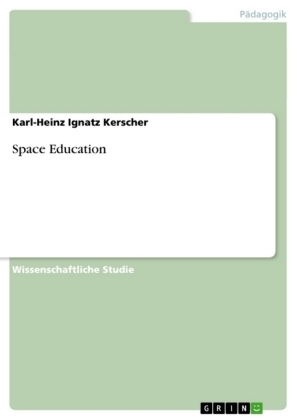
Space Education - Karl-Heinz Ignatz Kerscher

Space Education

Buch | Softcover
96 Seiten
2014 | 14001 A. 1. Auflage
GRIN Verlag
978-3-656-64076-9 (ISBN)
CHF 67,10 inkl. MwSt
  • Titel nicht im Sortiment
  • Artikel merken
Wissenschaftliche Studie aus dem Jahr 2014 im Fachbereich Pädagogik - Sonstiges, , Sprache: Deutsch, Abstract: "Homo Spaciens" comes from the Latin words homo, in the sense of "human being", and spatium "space" which combined form the meaning of "human being originated in space". Homo Spaciens is a forthcoming species of the genus Homo, being evolved from Homo Sapiens, born from the cradle of Earth to live in outer space and spread to inhabit other planets.The Russian scientist Konstantin TSIOLKOVSKY (1857-1935), considered as the father of cosmonautics and human space flight, already envisioned a forthcoming new species of man, who would explore the entire solar system and then would expand into the depth of the cosmos to create cosmic civilizations. He believed that human exploration of space was inevitable and would enhance human evolution. Almost every author in the field of space exploration today cites him as a primary influence. TSIOLKOVSKY clearly understood that the primary issue in the future of space exploration was one of human evolution, and he saw it so early. Today, it is becoming increasingly clear to us that the universe is an infinite environment, the exploration of which will almost inevitably generate fundamental changes in human beings. Perhaps, Homo Sapiens may well evolve into a new species, Homo Spaciens, which will be more suited to life on the outer space than on Earth.The benefit from the integration of Outer Space Affairs in the classroom is specifically assessed. The impact of this on employment, participation, benefits, memory, learning progress, motivation and student behavior are clearly determined. In the higher classes, the effect of space-related issues at the choice of physics as a learning and study is systematically to investigate. In future the effect assessment for the space-related issues and also to the mapping of science, technology, engineering and mathematics have to be applied. Teachers is to offer the use of the space-related issues on the teaching and on the education. This applies to the objectives of the international science and innovation programs and the treatment of Space Issues in science, technology, engineering and mathematics and in addition, in adventure and environmental projects.According to Maria MONTESSORI Cosmic Education introduces the possibility that humanity might have a "cosmic" task.

Prof. Dr. phil. Karl- Heinz Ignatz KerscherGeboren 1943 in Hamburg; Universitätsstudium Volkswirtschaft, Soziologie, Erziehungswissenschaft, Kunst, Jura und Sozialpädagogik; Ausbildung zum Volks-, Realschul- und Waldorfschul-Lehrer, Promotion zum Dr. phil.; Professor der Leuphana Universität zu Lüneburg im Ruhestand; Pionier der emanzipatorischen Sexualpädagogik, namhaftester Vertreter der Postmodernen Pädagogik; Erziehungswissenschaftler, Sexualforscher, Hochschuldozent, fachwissenschaftlicher Sachbuchautor, Zirkusdirektor beim Circus Tabasco, Feuerläufer, Straßenmusiker, Senioren-Residenz-Entertainer, ehrenamtlicher Lektor auf Kreuzfahrtschiffen,Neueste Publikationen: "Kreativ und Innovativ. Bausteine Postmoderner Pädagogik." München 2011. "Fasziniert und Aktiviert. Intentionen Postmoderner Pädagogik." München 2011. "Kulturell und Intellektuell. Perspektiven Postmoderner Pädagogik." München 2012. "Tolerant und Human. Leitideen Postmoderner Pädagogik." München 2012. "Lustbetont und Sinnenfroh. Positionen Postmoderner Sexual-Pädagogik." München 2012. "Schaffensfroh und Qualifiziert. Akzente Postmoderner Pädagogik." München 2013. "Orientierungssuche postmoderner Pädagogik. Zwischen Bangen und Hoffen." München 2013. "Peace Education. Ideas for a Postmodern Pedagogy." München 2013. "Pazifistisch und Altruistisch. Leitsterne Postmoderner Pädagogik." München 2013. "Weltraum Pädagogik. Erziehung und Bildung im Zeitalter der Raumfahrt." München 2014. "Space Education. Pedagogy in the Era of Space Missions." München 2014.

Erscheint lt. Verlag 22.4.2014
Sprache deutsch
Maße 148 x 210 mm
Gewicht 150 g
Themenwelt Sozialwissenschaften Pädagogik Bildungstheorie
Schlagworte Aerospace Education Initiative • AerospaceEducationInitiative • All you need is Space • AllyouneedisSpace • crisotainment • Dystopia • Future Society • FutureSociety • Homo Spaciens Education • HomoSpaciensEducation • International Space Programs • InternationalSpacePrograms • Maria MONTESSORI's Cosmic • MariaMONTESSORI'sCosmic • Permission to Dream • PermissiontoDream • Physics of the Future • PhysicsoftheFuture • Riks to Humans and Planet Earth • RikstoHumansandPlanetEarth • Scientific Visions • ScientificVisions • Space Camps • SpaceCamps • Space Education • SpaceEducation • Space-related Issues in Education • Space-relatedIssuesinEducation • Utopia
ISBN-10 3-656-64076-9 / 3656640769
ISBN-13 978-3-656-64076-9 / 9783656640769
Zustand Neuware
Informationen gemäß Produktsicherheitsverordnung (GPSR)
Haben Sie eine Frage zum Produkt?
Mehr entdecken
aus dem Bereich
Analysen und Beispiele aus Wissenschaft und Praxis

von Thorsten Bohl; Kathi Kösters; Alexander Gröschner

Buch (2025)
Kallmeyer (Verlag)
CHF 49,90
Grundbegriffe klären und Forschungszugänge eröffnen

von Marcus Syring; Thorsten Bohl; Alexander Gröschner …

Buch | Softcover (2025)
UTB (Verlag)
CHF 41,85