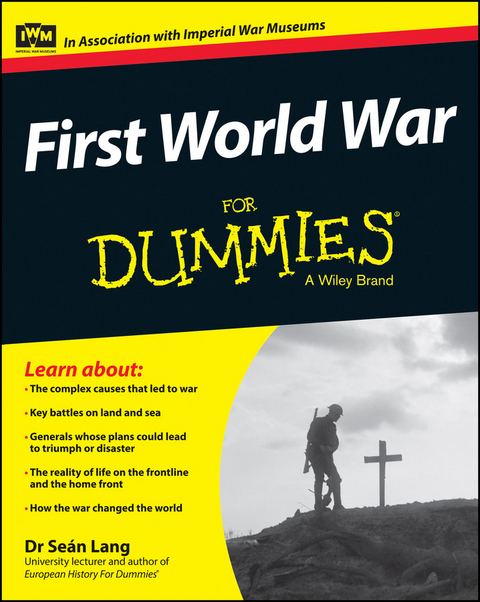
First World War For Dummies (eBook)
John Wiley & Sons (Verlag)
978-1-118-67996-8 (ISBN)
From the Somme to Gallipoli to the home front, First World War For Dummies provides an authoritative, accessible, and engaging introduction to the War to End All Wars. It takes a global perspective of this global conflict, proving insight into the actions and motivations of the participants and how each nation's story fits into the wider one.
Coverage also includes:
- The origins of the war and a snapshot of what the world looked like at the beginning of the 20th century
- The battles of Western Europe, and action in the Southern and Eastern Fronts
- The war at home - the civilian war, propaganda, opposition, politics, protests, and more
- 1918: The German spring offensive, the Allied success and the beginning of the end
- The Treaty of Versailles, the League of Nations, and the effect on the future
First World War For Dummies is the go-to source for readers seeking to learn more about the fundamental event of the 20th century.
Dr Seán Lang is a Senior Lecturer in History at Anglia Ruskin University and has been teaching history to college and university students for more than three decades. Lang is the author of a number of books on history, including British History For Dummies and European History For Dummies.
From the Somme to Gallipoli to the home front, First World War For Dummies provides an authoritative, accessible, and engaging introduction to the War to End All Wars. It takes a global perspective of this global conflict, proving insight into the actions and motivations of the participants and how each nation s story fits into the wider one. Coverage also includes: The origins of the war and a snapshot of what the world looked like at the beginning of the 20th century The battles of Western Europe, and action in the Southern and Eastern Fronts The war at home the civilian war, propaganda, opposition, politics, protests, and more 1918: The German spring offensive, the Allied success and the beginning of the end The Treaty of Versailles, the League of Nations, and the effect on the future First World War For Dummies is the go-to source for readers seeking to learn more about the fundamental event of the 20th century.
Dr Seán Lang is a Senior Lecturer in History at Anglia Ruskin University and has been teaching history to college and university students for more than three decades. Lang is the author of a number of books on history, including British History For Dummies and European History For Dummies.
Introduction 1
Part I: Origins of War 7
Chapter 1: The First World War: An Overview 9
Chapter 2: The World in 1900 29
Chapter 3: Crisis Mismanagement: Unpicking the Causes of the First World War 55
Part II: Europe at War, 1914-1916 75
Chapter 4: 1914: The First World War Starts Here 77
Chapter 5: 1915: Cunning Plans to Win the War 101
Chapter 6: 1916: The Big Battles 117
Part III: A World at War 137
Chapter 7: Welcome to the World of the Trenches 139
Chapter 8: War at Sea, War in the Air 155
Chapter 9: Turkish Delights 175
Chapter 10: The Imperial War 195
Chapter 11: America Goes to War 213
Part IV: Home Fronts 229
Chapter 12: The Civilian War 231
Chapter 13: Women at War 249
Chapter 14: Struggles for Power 265
Part V: Armistice and Aftermath, 1917-1918 and Beyond 281
Chapter 15: 1917: The Year of Big Changes 283
Chapter 16: 1918: Victory and Defeat 303
Chapter 17: Aftermath: The World After the War 323
Chapter 18: Remembering the War 343
Part VI: The Part of Tens 359
Chapter 19: Ten Key Generals of the First World War 361
Chapter 20: Ten Great First World War Films 367
Chapter 21: Ten Famous Wartime Writers and Poets 371
Chapter 22: Ten Enlightening Places to Visit 377
Index 381
Introduction
Some years ago I had a job at Exeter University training student teachers to teach history in secondary schools. One day we were talking about the First World War and how to teach children about it, and one of them said, ‘Why don’t we just go there?’ So we hired a minibus, took the ferry and spent a few days visiting the battlefields around the area of the Battle of the Somme in northern France. We visited cemeteries and museums; we looked at maps and traced where the lines of trenches had run, and worked out where this advance had taken place and where that machine gun had been positioned: all very useful experience. The most useful lesson of the trip, however, was entirely unexpected.
During our trip, we visited the memorial park that commemorates the men from Newfoundland who fought on the Somme. It has an impressive memorial, a cemetery and a large area where the trenches and shell holes have been preserved. By the entrance we found a group from an English boys’ school. The boys were sitting on the ground and their history teacher was telling them about the war. I caught words like ‘Sarajevo’ and ‘invaded Belgium’, so I guessed he was taking them through the events of 1914. They didn’t look very gripped. We went on and visited the monument, explored the trenches and worked out what had happened where. One student even found her grandfather’s grave in the cemetery, which was a poignant moment. And then we headed back to the minibus.
When we got to the entrance, the school party was still there. They’d advanced four or five yards, but the boys were still sitting on the ground and the teacher was still talking. This time I heard the words ‘Loos’ and ‘Ypres’ and I realised that in all the time we’d been exploring, these poor boys had been sitting down while their teacher talked his way through the history of the war – and he’d only reached 1915! When we reached the minibus I told my group, ‘That’s a perfect example of how you should never, ever teach children – or anyone – about the First World War’.
And I promise not to do it to you.
About This Book
Like all the For Dummies books, you can read this one how you like. You can read it cover to cover, you can dip into it, you can go straight to the bit you want or you can hop about. Wherever you start reading, I try to make sure you know where you are and what’s been happening while you’ve been away.
This book is called First World War For Dummies. That doesn’t mean you’re a dummy, but you might feel like one when you run into someone who appears to know all there is to know about the war. And such people undoubtedly exist. They spend their lives studying the war in minute detail, and they can tell you exactly which battalion was based where and who commanded whom and what the soldiers on each side wore and when they wore it. Don’t get me wrong: I’m full of admiration for these people. I just try not to get stuck with them at parties.
Most people tend to have a rather less precise idea of the First World War. You may well have studied some aspects of the war at school, either in history or possibly in your English lessons. The war produced some very powerful poetry that pupils often study at school, and modern writers such as Pat Barker and Sebastian Faulks have written successful novels set in the war. But even if you’ve looked at the war before, you may not have a full picture of what was going on. You may well know that life in the trenches could be appalling, but why were the men sitting in trenches in the first place? And how did they plan to get out of them? Even more importantly: what did they think the war was actually for?
I’ve designed this book to give you an overview of the way the war developed and how it changed the world. I take you through the causes of the war and who the men and women were who got caught up in it. I do take you through various battles – you can’t really avoid that – but I try to explain why people felt the need to fight them in the first place. (No, they weren’t doing so just for fun or to give future generations lots of historical details to learn.) My aim isn’t to fill you with more pieces of information than you can take in – that’s what our fact-collecting friends are for – but to explain what happened, why it happened and what the people at the time hoped (often wrongly) would follow from their actions.
Having an understanding of the First World War is crucial for being able to understand the modern world. The war marks the point when the old certainties of the Victorian age ended and the 20th century really got going. It was the first war of mass production – and mass destruction. It was the first war in history to be fought on land, on sea, under the sea, in the air and even in the home. And it was truly a world war. In the west, awareness of the war tends to be dominated by the trenches of the Western Front, but the war was fought across eastern and southern Europe, in the Middle East, the Pacific, in the Atlantic and across Africa. It brought in countries from every continent. The war led to a huge range of major developments in world history, including the Russian Revolution, the rise of fascism and of the Nazis, the Second World War, the Cold War, the Arab–Israeli conflict and even the British love affair with irony.
Like any historical topic, historians have sharply differing views on the First World War. For many years they saw it essentially as a tragedy, in which a whole generation of young men paid a terrible price for the self-indulgent follies of their leaders. Writers and filmmakers were haunted by the image of troops going ‘over the top’ (that’s a phrase from the First World War), only to be mown down in ‘no-man’s-land’ (and that’s another one) by machine guns, while their generals sat sipping brandy in comfortable chateaux located miles behind the lines. ‘Lions led by donkeys’ was how one German general is said to have described his British opponents – brave Tommies let down by their own uncaring and inept generals. It’s a powerful narrative and you can find it in many books and films about the war.
More recently, historians have challenged that stereotype. They’ve shown that these generals were far from inept, and that they actually showed considerable ingenuity and imagination in coping with a type of warfare that was completely new to them – and to everyone else. Perhaps even more importantly, more historians have made a powerful case that the First World War, like the Second, was a war worth fighting, that it was about important issues and that it did achieve something important. You’re not convinced? Well, I look at the question from both sides in the book so keep an open mind for now.
Foolish Assumptions
Like any author I have to make certain assumptions about you, the reader, and these assumptions may be right or they may be wrong.
Firstly, I’m assuming that you’ve heard a bit about the war but don’t know much about it in any detail. Secondly, I’m assuming that you’ve probably gathered, from TV, from films or from what you did at school, that the war was a pretty grim affair from which no one, and certainly no one in charge, emerges with much credit. You may very well know of one of your family who fought, and possibly died, in the war and you may wonder what, if anything, that person fought and died for. And, of course, I’m assuming you’ve picked up this book to try to find out more, to get a better grasp on the war and what it all meant. If even some of those assumptions are right then you’ve come to the right place.
I’m also making another assumption, and this one may not be quite so secure. I’m assuming that you’re ready to have your eyes opened, your own assumptions challenged and, if need be, your ideas changed. History isn’t about confirming people’s stories, however important these stories might be to them. History is about looking at the past as objectively as possible and working out what happened, how it happened, why it happened and what it led to. Along the way those who consider history tend to overturn many cherished versions of the past, many legends and many comforting stories. I’m assuming you’re ready for that. If not, brace yourself now.
Icons Used in This Book
History isn’t the same as the past. The past is what you’re trying to find out about; history is what you make of the past and how you communicate your thoughts about it. This means that at various points I want to highlight for you my own – and it is only my own – view of some of the details. Most of the time you’ll be able to pick that up from the way I write about them, but at some points I highlight what I think is important for you to realise with one of these symbols:
Or, alternatively, ‘Who you gonna call? Mythbusters!’ History is full of famous stories that people hand down and repeat without anyone really checking whether they happened. Some did, but a lot didn’t. The First World War has its fair share of such stories. But did they actually happen? When you see this sign, you can find out.
The First World War...
| Erscheint lt. Verlag | 17.4.2014 |
|---|---|
| Sprache | englisch |
| Themenwelt | Sachbuch/Ratgeber ► Geschichte / Politik ► Allgemeines / Lexika |
| Geschichte ► Allgemeine Geschichte ► Neuzeit (bis 1918) | |
| Geisteswissenschaften ► Geschichte ► Regional- / Ländergeschichte | |
| Sozialwissenschaften ► Politik / Verwaltung | |
| Schlagworte | first world war books • Geschichte • Geschichte u. Zeitgeschichte des 20./21. Jahrhunderts • Geschichte /Weltgeschichte • History • Twentieth Century & Contemporary History • Weltgeschichte • Weltkrieg I • World War 1 • world war 1 books • world war 1 for dummies • world war 1 history • World War I • world war i books • world war I for dummies • world war I history |
| ISBN-10 | 1-118-67996-2 / 1118679962 |
| ISBN-13 | 978-1-118-67996-8 / 9781118679968 |
| Informationen gemäß Produktsicherheitsverordnung (GPSR) | |
| Haben Sie eine Frage zum Produkt? |
 PDF (Adobe DRM)
Kopierschutz: Adobe-DRM
Adobe-DRM ist ein Kopierschutz, der das eBook vor Mißbrauch schützen soll. Dabei wird das eBook bereits beim Download auf Ihre persönliche Adobe-ID autorisiert. Lesen können Sie das eBook dann nur auf den Geräten, welche ebenfalls auf Ihre Adobe-ID registriert sind.
Details zum Adobe-DRM
Dateiformat: PDF (Portable Document Format)
Mit einem festen Seitenlayout eignet sich die PDF besonders für Fachbücher mit Spalten, Tabellen und Abbildungen. Eine PDF kann auf fast allen Geräten angezeigt werden, ist aber für kleine Displays (Smartphone, eReader) nur eingeschränkt geeignet.
Systemvoraussetzungen:
PC/Mac: Mit einem PC oder Mac können Sie dieses eBook lesen. Sie benötigen eine
eReader: Dieses eBook kann mit (fast) allen eBook-Readern gelesen werden. Mit dem amazon-Kindle ist es aber nicht kompatibel.
Smartphone/Tablet: Egal ob Apple oder Android, dieses eBook können Sie lesen. Sie benötigen eine
Geräteliste und zusätzliche Hinweise
Buying eBooks from abroad
For tax law reasons we can sell eBooks just within Germany and Switzerland. Regrettably we cannot fulfill eBook-orders from other countries.
aus dem Bereich