


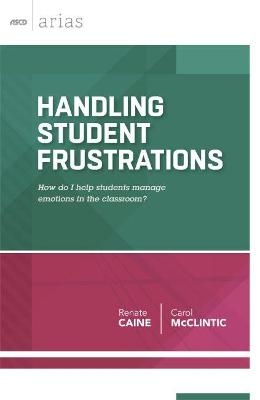
Handling Student Frustrations
How Do I Help Students Manage Emotions in the Classroom?
Seiten
2014
Association for Supervision & Curriculum Development (Verlag)
978-1-4166-1913-0 (ISBN)
Association for Supervision & Curriculum Development (Verlag)
978-1-4166-1913-0 (ISBN)
When students' fears, stresses, and frustrations creep into the classroom and disrupt the learning process, how can you respond in a positive way that results in better relationships and higher levels of motivation and achievement? Renate Caine and Carol McClintic draw on their experience to propose the APA method: Acknowledge, Process, Act.
When students' fears, stresses, and frustrations creep into the classroom and disrupt the learning process, how can you respond in a positive way that results in better relationships and higher levels of motivation and achievement? Renate Caine and Carol McClintic draw on their decades of teaching experience to propose the APA method:
Acknowledge. Help the student accept the situation, including his or her own reaction.
Process. Help the student clarify what is actually taking place. Then mutually come up with an action plan for moving forward.
Act. Help the student implement the action plan.
This approach pulls back the curtain on emotional flare-ups and not only encourages students to recognize emotions in themselves and others but also motivates them to implement proactive solutions rather than let negative emotions sabotage their academic goals. Caine and McClintic also include several grade-appropriate classroom scenarios and relevant strategies that will help you create more peaceful, respectful, and productive learning environments.
When students' fears, stresses, and frustrations creep into the classroom and disrupt the learning process, how can you respond in a positive way that results in better relationships and higher levels of motivation and achievement? Renate Caine and Carol McClintic draw on their decades of teaching experience to propose the APA method:
Acknowledge. Help the student accept the situation, including his or her own reaction.
Process. Help the student clarify what is actually taking place. Then mutually come up with an action plan for moving forward.
Act. Help the student implement the action plan.
This approach pulls back the curtain on emotional flare-ups and not only encourages students to recognize emotions in themselves and others but also motivates them to implement proactive solutions rather than let negative emotions sabotage their academic goals. Caine and McClintic also include several grade-appropriate classroom scenarios and relevant strategies that will help you create more peaceful, respectful, and productive learning environments.
| Erscheint lt. Verlag | 18.7.2014 |
|---|---|
| Reihe/Serie | ASCD Arias |
| Sprache | englisch |
| Maße | 127 x 197 mm |
| Themenwelt | Geisteswissenschaften ► Psychologie ► Pädagogische Psychologie |
| Sozialwissenschaften ► Pädagogik ► Berufspädagogik | |
| Sozialwissenschaften ► Pädagogik ► Erwachsenenbildung | |
| ISBN-10 | 1-4166-1913-5 / 1416619135 |
| ISBN-13 | 978-1-4166-1913-0 / 9781416619130 |
| Zustand | Neuware |
| Informationen gemäß Produktsicherheitsverordnung (GPSR) | |
| Haben Sie eine Frage zum Produkt? |
Mehr entdecken
aus dem Bereich


aus dem Bereich
Buch | Softcover (2022)
Springer (Verlag)
CHF 69,95
Grundlagen, Diagnostik und Förderung
Buch | Softcover (2023)
Kohlhammer (Verlag)
CHF 39,95


