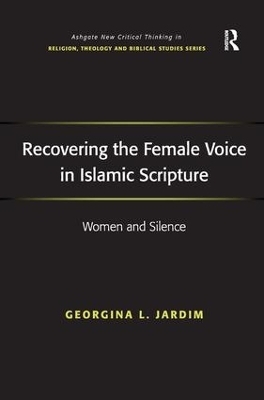
Recovering the Female Voice in Islamic Scripture
Routledge (Verlag)
978-1-4724-2637-6 (ISBN)
Protest is an activity not associated with the pious and collectively-minded, but more often seen as an activity of the liberal and rebellious. Judaism, Christianity and Islam are commonly understood as paragons of submission and obedience following Abraham’s example. Yet, the scriptures of all three faiths are founded in the prophets protesting wrongs in the social order. The Qur'an claims that men and women, and the relations between them are a sign from God. The question is to what extent are women silenced in the text, and do they share with men in shaping the prophetic scriptures? This book finds that far from silencing women, the Qur'an affirms the female voice as protester for justice and as questioner of Theology. In this reading of the female role in divine revelation in the Islamic text, Georgina Jardim returns to the scriptures of the Judeo-Christian counterpart of the Abrahamic faiths, to investigate whether the Bible may claim women as brokers of revelation. The result is an enriched understanding of divine communication in the Abrahamic scriptures and a commonplace for reasoning about the female voice as speaker in the Word of God.
Georgina L. Jardim read a PhD at the University of Gloucestershire, UK on obscure female characters in the Qur'an, bringing these conversations about community formation and the roles of women to bear on her study of the Qur'an as a Christian woman. She has taught in tertiary institutions in South Africa, and was a lecturer in Semitic languages at a Theological Seminary of the North West University in South Africa. She has also taught in the United Kingdom in both secondary and tertiary education and is currently pursuing ways to engage in, and further, cross-cultural dialogue within the Abrahamic religions.
Introduction: Women’s Voice and the Public Space 1 Theology of Religions and Interfeminist Dialogue 2 Deconstructing the Qur`an’s Paradigmatic Women 3 Towards a Qur`anic Hermeneutic for Gendered Reading: Theological Approaches 4 Towards a Qur`anic Hermeneutic for Gendered Reading: Literary Approaches 5 Sign as Qur`anic Hermeneutic 6 From Signs, to Titles, to Women 7 Prophetic Disagreement in the Qur`an 8 Narratological Analysis of the Mujādilah 9 The Mujādilah as Trope for Interfeminist Dialogue Conclusion
| Erscheint lt. Verlag | 11.8.2014 |
|---|---|
| Reihe/Serie | Routledge New Critical Thinking in Religion, Theology and Biblical Studies |
| Verlagsort | London |
| Sprache | englisch |
| Maße | 156 x 234 mm |
| Gewicht | 657 g |
| Themenwelt | Geisteswissenschaften ► Religion / Theologie ► Islam |
| Sozialwissenschaften ► Soziologie ► Gender Studies | |
| ISBN-10 | 1-4724-2637-1 / 1472426371 |
| ISBN-13 | 978-1-4724-2637-6 / 9781472426376 |
| Zustand | Neuware |
| Informationen gemäß Produktsicherheitsverordnung (GPSR) | |
| Haben Sie eine Frage zum Produkt? |
aus dem Bereich