Cities in Relations (eBook)
John Wiley & Sons (Verlag)
978-1-118-63277-2 (ISBN)
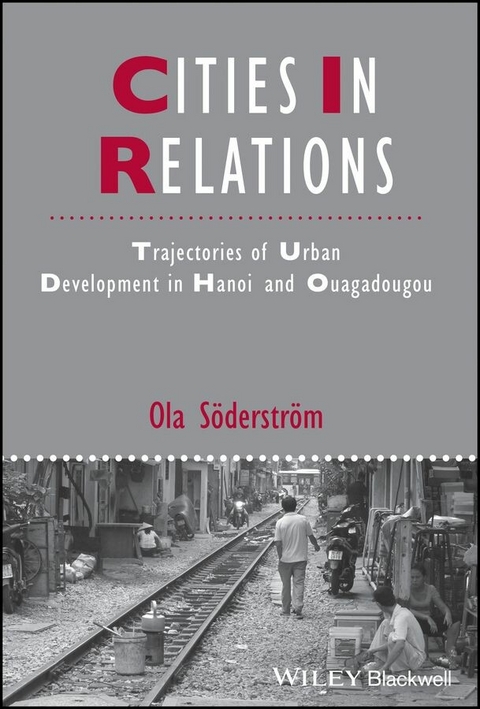
Cities in Relations advances a novel way of thinking about urban transformation by focusing on transnational relations in the least developed countries.
- Examines the last 20 years of urban development in Hanoi, Vietnam, and in Ouagadougou, Burkina Faso
- Considers the ways in which a city’s relationships with other places influences its urban development
- Provides fresh ideas for comparative urban studies that move beyond discussions of economic and policy factors
- Offers a clear and concise narrative accompanied by more than 45 photos and maps
Ola Söderström is Professor of Social and Cultural Geography at the Institute of Geography, University of Neuchâtel, Switzerland. He has published extensively on urban material culture, visual thinking in urban planning, and urban globalization. His current research focuses on a comparative ethnography of contemporary urban ways of life. He is the co-author of Urban Cosmographies (2009) and the co-editor of Critical Mobilities (2013) and Re-shaping Cities: How Global Mobility Transforms Architecture and Urban Form (2010).
Cities in Relations advances a novel way of thinking about urban transformation by focusing on transnational relations in the least developed countries. Examines the last 20 years of urban development in Hanoi, Vietnam, and in Ouagadougou, Burkina Faso Considers the ways in which a city s relationships with other places influences its urban development Provides fresh ideas for comparative urban studies that move beyond discussions of economic and policy factors Offers a clear and concise narrative accompanied by more than 45 photos and maps
Ola Söderström is Professor of Social and Cultural Geography at the Institute of Geography, University of Neuchâtel, Switzerland. He has published extensively on urban material culture, visual thinking in urban planning, and urban globalization. His current research focuses on a comparative ethnography of contemporary urban ways of life. He is the co-author of Urban Cosmographies (2009) and the co-editor of Critical Mobilities (2013) and Re-shaping Cities: How Global Mobility Transforms Architecture and Urban Form (2010).
List of Figures vii
List of Tables x
Acronyms xi
Series Editors' Preface xiii
Preface and Acknowledgements xiv
1 Comparing Cities in Relations 1
Relating Hanoi, Ouagadougou ... and Palermo 4
A Brief Introduction to Two Distant Cousins 5
World-city Research Beyond the West 9
Relational Geographies 12
Comparing Cities 17
The Structure of the Book 26
2 Trajectories of Urban Change in Two Ordinary Cities
31
Regime Change in Hanoi and Ouagadougou 33
Forms of Relatedness 42
Conclusion 55
3 Transnational Policy Relations 60
Mobile Planners and City Networks 63
Concrete and Paper in Hanoi's Urban Development 64
Ouagadougou's Competing Worlds of Policy Relations 76
Conclusion 87
4 Public Space Policies on the Move 92
A Repertoire of Translocal Connections 94
Public Space: Understandings, Practices and Things 97
Translocal Connections and Public Space Policy in the Making
103
The Politics of Translocal Connections 108
Traveling Participation and Public Space Design 110
Conclusion 116
5 Connecting to Circuits of Architectural Design 120
Stretched Geographies of Design 121
Circuits of Architectural Design in Hanoi and Ouagadougou
123
Hanoi: Design Spaces of an Emerging Economy 125
Ouagadougou: Architectures of Development 131
Grounding Design 136
Conclusion: Transnational Learning Processes and
"Banal" Nationalism 140
6 On Road Interchanges and Shopping Malls: What Traveling
Types Do 145
Modernization as Morality and Power 147
Modernization Through Ouagadougou's Built Environment
150
Staging New Social Identities in Hanoi's Shopping Malls
159
Conclusion 166
Conclusion: For a Politics of Urban Relatedness 171
Comparing Processes, Worlds of Relations, and Relational Effects
172
The Evolving Relational Worlds of Cities 175
An Assets-based Politics of Relatedness 178
References 181
Index 196
"This would be especially valuable in continuing the study of urban developments in the post-communist environment." (Geographica Helvetica, 1 May 2015)
'Cities in Relations is a book of immense
methodological and political importance. At a time when
neoliberalism and globalization are thought to shape much of urban
life, Ola Söderström offers a more imaginative way to
grasp what is distinctive about worldly cities. The book is an
invitation to urban studies to think again about the bases for
comparison in a world where cities beyond the West have to
negotiate different ways of being global.'
--John Allen, Professor of Economic Geography, The Open
University, UK
'The idea that urbanism is relational is by now taken for
granted, but what is far less common are detailed accounts of the
forms, politics and implications of relationality, especially for
cities too often neglected in urban theory. Through detailed and
nuanced discussion of two quite different contexts - Hanoi
and Ouagadougou - Söderström's rigorous and lively
book provides an insightful investigation of the variegated and
increasingly translocal politics of urban development, and offers
important contributions to debates on both relational and
comparative urbanism.'
--Colin McFarlane, Reader in Human Geography, Durham
University, UK
1
Comparing Cities in Relations
On June 26 2008, Burkina Faso’s first large road interchange was inaugurated in the capital Ouagadougou. Partly financed by Libyan funds, it was celebrated by the president as a symbol of the country’s modernization. Three days later, the breaking news in local media was that a truck was trapped under the bridge of the interchange. The unfortunate truck driver had not checked the height of the new bridge and realized too late that his vehicle was too high to pass under it. A few months later, a friend in Ouagadougou told me about her cousin who had fallen from the same bridge on her motorbike and was badly hurt. Later, a taxi driver told me about his sophisticated tactics for avoiding the celebrated new infrastructure. These are some of the numerous “interchange stories” that have been circulating in Ouagadougou since the summer of 2008.
In October 2011, after having participated in a workshop on public space policy in Vietnam, I was walking at night with a group of other participants and organizers in the streets of Hanoi. At one point, one of us – the former director of Bogotà’s Parks and Sports Department, now an international consultant – burst out criticizing the invasion of sidewalks by motorbikes. “It’s easy though,” he said, “we should do here what we did in Bogotà: reclaim the sidewalks for pedestrians and put obstacles that will make motorbike parking impossible.”
A few days later, I was sitting in the office of one of Vietnam’s largest construction companies interviewing a Hanoi architect on the recently emerging “starchitecture” in the city. My interviewee was explaining how he had contacted Foster and Partners on behalf of the CEO of a large Vietnamese bank to build their new headquarters. At that point two “Foster” engineers entered the room for a videoconference with their London office on technical aspects of this building, in construction at the time.
What these three stories about two cities have in common is probably not immediately obvious, but this is precisely what this book is about. These stories each tell us something different about how transnational relations feed into the ways of life of two globalizing cities of the South. The truck trapped under the Ouagadougou interchange shows how “imported” built forms shape new ways of getting around the city. The solutions of the Colombian consultant for Hanoi’s sidewalks show how an increasingly dense web of inter-urban policy connections influences local urban policies. And, finally, the examples of the Hanoi “broker in iconic architecture” as well as the “Foster” videoconference with London, point to the processes through which urban landscapes are increasingly shaped by design processes that stretch across space, moving ideas, built forms, and symbolic capital from place to place. So, to put it succinctly, this book is about cities in relations. It looks at how relations across borders, rather than resources in place or in cities’ hinterlands, make cities the way they are today.
In order to explore these different dimensions of urban relatedness, I look at two cities which, not long ago, were “relation-poor.” Cities have, of course, always been in relation with distant elsewheres, but in some periods of their development, they can be more isolated, more marginal. This happened to Hanoi during the Cold War and Ouagadougou during Burkina Faso’s revolutionary socialist regime in the 1980s. In the 1990s, both of these cities became re-connected to a variety of global flows. As a result, the pace and intensity of change in different aspects of urban life have been very spectacular in the period during the past two decades both in Burkina Faso’s and in Vietnam’s capital. Hanoi and Ouagadougou are therefore interesting places – real laboratories – in which the role of transnational relations in urban development can be observed.
There is second reason why these two cities are particularly interesting to research and compare: since 1990 they have followed different trajectories of globalization. In Ouagadougou, a city very dependent on foreign donor countries and city-to-city relations, political connectedness has been central, whereas in Hanoi economic connectedness, through foreign investments, international trade, and migrant remittances, has been the major factor of urban change. Moreover, the orientation of their cross-border relations is different: Ouagadougou looks to Europe, North Africa and other West African cities, whereas Hanoi has increasingly developed its connections with its Asian neighbors (Indonesia, Japan, South Korea). This means that the two cities differ not only in specific variables, such as economic productivity, but also in their relatedness with “elsewhere” and in how this has evolved through time. This is what this book proposes – a relational comparison: it takes relations, their evolution, form, intensity, and orientation as the elements of comparison.
By doing this, on one hand, the book tries to advance theoretical and methodological debates about relationality and comparative urbanism and, on the other, it makes an argument about the increasingly transnational and translocal dimensions of urban development.
First, Cities in Relations argues that a relational analysis of cities requires that we abandon abstract conceptions of relations as “swirls of flows” to consider them as historical products, moored in material forms and generating change through power-mediated processes. I also argue that we need to widen our imagination regarding what city relations are made of. Drawing on the distinction in French between globalisation (economic globalization) and mondialisation (the different aspects and effects of global interconnectedness), this book thus moves beyond the economic reductionism of most world-city literature. It looks at how policies, urban forms, and people’s urban practices are shaped by relations with elsewhere according to distinct logics. I thereby develop a set of grounded narratives of urban mondialisation – staging for instance the role of traditional chiefdoms in Ouagadougou or the Communist party in Hanoi – that are not easily captured by the mantra of neoliberalization.
Second, I bring an innovative way of seeing and making urban comparison. Pushing further recent discussions on relational comparison I focus on cities’ worlds of relations – defined by their type, intensity, and orientation. This book shows that if we want to understand the role of city relations, we need to compare not only cities but how they are inscribed in worlds of relations and how these relations shape urban development in different ways. This comparative strategy results in the cases of Hanoi and Ouagadougou in the identification of distinct trajectories of urban globalization where we would normally describe quite similar “transitions from socialism to free market.”
Third, this book shows how these relations are appropriated and what their effects are on the ground. On the one hand, this brings to the fore the mediating role of state or non-state actors and the fact that urban politics today is often a battleground where different transnational relations (and their “embedded” political programs) are played against each other. On the other hand, it highlights that traditional categories of analysis – city branding, capital accumulation, domination, resistance – quite often do not suffice to make sense of urban development, notably in cities of the Global South. In my narratives about Hanoi and Ouagadougou I therefore borrow or develop a set of concepts and methodologies – object biographies, ethopower, design in the wild, script, affordance, etc. – in order to enlarge the lexicon of world-city literature.
Finally, on a political level, I argue that relations are not only pervasive in cities today but that they also constitute important resources for urban development. Here as well, a wider imagination regarding city relations is called for. In order to conceive development strategies that do more than try to imitate cities at the top of world-city rankings, cities need to use the full potential of the dense web of relations in which they are situated today. I believe that exploring the mondialisation of cities is necessary not only for the advancement of urban studies but in order to mobilize relational resources for context-relevant policies, or, what I call, drawing on Friedmann (2007), an assets-based politics of city relatedness.
Relating Hanoi, Ouagadougou … and Palermo
When I chose to work on Hanoi and Ouagadougou, I was finishing a book on the city of Palermo in Sicily (Söderström et al., 2009).1 Together with a team of Italian colleagues I had studied how the city had “cosmopolitanized” since the early 1990s. In 1993, in the wake of the assassination of the two anti-Mafia judges Giovanni Falcone and Paolo Borsellino, a new (anti-Mafia) mayor, Leoluca Orlando, was elected. As a result, the city opened up in many ways: more tourists arrived, a young cultural elite was attracted by the city’s unusual charm, and new models of urban development were “imported” from abroad. To grasp the logic of these changes, we studied the recent history...
| Erscheint lt. Verlag | 19.3.2014 |
|---|---|
| Reihe/Serie | IJURR Studies in Urban and Social Change Book Series |
| Studies in Urban and Social Change | Studies in Urban and Social Change |
| Sprache | englisch |
| Themenwelt | Naturwissenschaften ► Geowissenschaften ► Geografie / Kartografie |
| Sozialwissenschaften ► Soziologie | |
| Technik ► Architektur | |
| Schlagworte | Geographie • Geography • Hanoi, Ouagadougou, Burkina Faso, urban development, urban change, transnational relations, urban studies, city planners, public policy, city modernization, cosmopolitanism, cultural geography, urban anthropology, architecture, city planning, urban ethnography, Studies in Urban and Social Change, SUSC • Sociology • Soziologie • Stadtentwicklung • Stadtforschung • Stadtgeographie • Stadtsoziologie • Urban Geography • Urban sociology • urban studies |
| ISBN-10 | 1-118-63277-X / 111863277X |
| ISBN-13 | 978-1-118-63277-2 / 9781118632772 |
| Informationen gemäß Produktsicherheitsverordnung (GPSR) | |
| Haben Sie eine Frage zum Produkt? |
 EPUB (Adobe DRM)
Kopierschutz: Adobe-DRM
Adobe-DRM ist ein Kopierschutz, der das eBook vor Mißbrauch schützen soll. Dabei wird das eBook bereits beim Download auf Ihre persönliche Adobe-ID autorisiert. Lesen können Sie das eBook dann nur auf den Geräten, welche ebenfalls auf Ihre Adobe-ID registriert sind.
Details zum Adobe-DRM
Dateiformat: EPUB (Electronic Publication)
EPUB ist ein offener Standard für eBooks und eignet sich besonders zur Darstellung von Belletristik und Sachbüchern. Der Fließtext wird dynamisch an die Display- und Schriftgröße angepasst. Auch für mobile Lesegeräte ist EPUB daher gut geeignet.
Systemvoraussetzungen:
PC/Mac: Mit einem PC oder Mac können Sie dieses eBook lesen. Sie benötigen eine
eReader: Dieses eBook kann mit (fast) allen eBook-Readern gelesen werden. Mit dem amazon-Kindle ist es aber nicht kompatibel.
Smartphone/Tablet: Egal ob Apple oder Android, dieses eBook können Sie lesen. Sie benötigen eine
Geräteliste und zusätzliche Hinweise
Buying eBooks from abroad
For tax law reasons we can sell eBooks just within Germany and Switzerland. Regrettably we cannot fulfill eBook-orders from other countries.
aus dem Bereich