


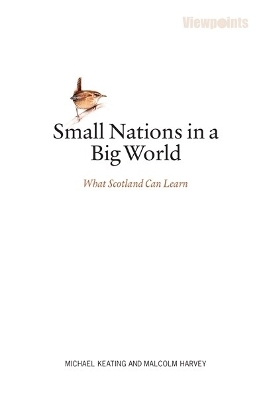
Small Nations in a Big World
What Scotland Can Learn
Seiten
2014
Luath Press Ltd (Verlag)
978-1-910021-20-0 (ISBN)
Luath Press Ltd (Verlag)
978-1-910021-20-0 (ISBN)
- Titel erscheint in neuer Auflage
- Artikel merken
Zu diesem Artikel existiert eine Nachauflage
Small northern European states have been a major point of reference in the Scottish independence debate. For nationalists, they have been an ‘arc of prosperity’ while in the aftermath of the financial crash, unionists lampooned the ‘arc of insolvency’.
Both characterisations are equally misleading. Small states can do well in the global market place, but they face the world in very different ways. Some accept market logic and take the ‘low road’ of low wages, low taxes and light regulation, with a correspondingly low level of public services. Others take the ‘high road’ of social investment, which entails a larger public sector and higher taxes. Such a strategy requires innovative government, flexibility and social partnership.
Keating and Harvey compare the experience of the Nordic and Baltic states and Ireland, which have taken very different roads and ask what lessons can be learnt for Scotland. They conclude that success is possible but that hard choices would need to be taken. Neither side in the independence debate has faced these choices squarely.
Both characterisations are equally misleading. Small states can do well in the global market place, but they face the world in very different ways. Some accept market logic and take the ‘low road’ of low wages, low taxes and light regulation, with a correspondingly low level of public services. Others take the ‘high road’ of social investment, which entails a larger public sector and higher taxes. Such a strategy requires innovative government, flexibility and social partnership.
Keating and Harvey compare the experience of the Nordic and Baltic states and Ireland, which have taken very different roads and ask what lessons can be learnt for Scotland. They conclude that success is possible but that hard choices would need to be taken. Neither side in the independence debate has faced these choices squarely.
MICHAEL KEATING is Professor of Politics at the University of Aberdeen and the University of Edinburgh and is Director of the ESRC Scottish Centre on Constitutional Change. He is a fellow of the British Academy, the Royal Society of Edinburgh and the Academy of Social Science. He has been writing about Scottish politics for forty years and is published extensively on nationalism and territorial politics throughout Europe. MALCOLM HARVEY is a researcher at the University of Aberdeen and the Scottish Centre on Constitutional Change. His research interests include nationalist movements, party systems and constitutional change. He has written online for The Herald and Better Nation, a political website he co-founded.
| Erscheint lt. Verlag | 1.5.2014 |
|---|---|
| Verlagsort | Edinburgh |
| Sprache | englisch |
| Maße | 158 x 234 mm |
| Gewicht | 260 g |
| Themenwelt | Sozialwissenschaften ► Politik / Verwaltung ► Politische Systeme |
| Sozialwissenschaften ► Politik / Verwaltung ► Politische Theorie | |
| ISBN-10 | 1-910021-20-2 / 1910021202 |
| ISBN-13 | 978-1-910021-20-0 / 9781910021200 |
| Zustand | Neuware |
| Informationen gemäß Produktsicherheitsverordnung (GPSR) | |
| Haben Sie eine Frage zum Produkt? |
Mehr entdecken
aus dem Bereich


aus dem Bereich
Das politische System der USA und die Zukunft der Demokratie
Buch | Hardcover (2025)
C.H.Beck (Verlag)
CHF 39,20
Russland, Europa, Amerika
Buch | Softcover (2025)
C.H.Beck (Verlag)
CHF 25,20


