


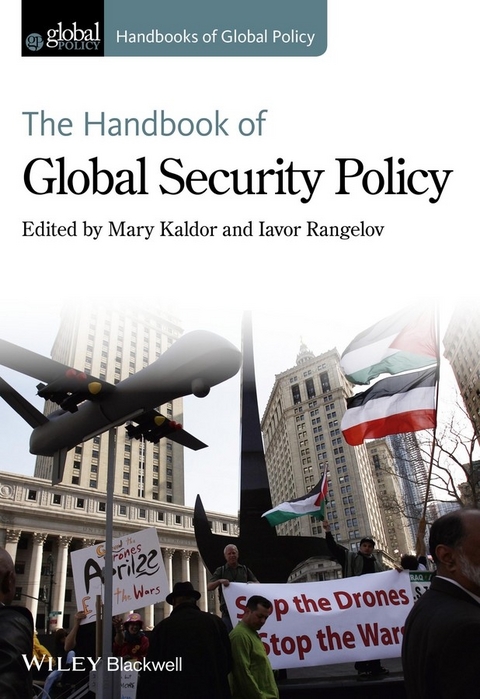
The Handbook of Global Security Policy (eBook)
John Wiley & Sons (Verlag)
978-1-118-44299-9 (ISBN)
This Handbook brings together 30 state-of-the-art essays covering the essential aspects of global security research and practice for the 21st century.
- Embraces a broad definition of security that extends beyond the threat of foreign military attack to cover new risks for violence
- Offers comprehensive coverage framed around key security concepts, risks, policy tools, and global security actors
- Discusses pressing contemporary issues including terrorism, disarmament, genocide, sustainability, international peacekeeping, state-building, natural disasters, energy and food security, climate change, and cyber warfare
- Includes insightful and accessible contributions from around the world aimed at a broad base of scholars, students, practitioners, and policymakers
Mary Kaldor is Professor of Global Governance and Director of the Civil Society and Human Security Research Unit at the London School of Economics. She is the author of many books, including New & Old Wars: Organized Violence in a Global Era (2013) and The Ultimate Weapon is No Weapon: Human Security and the Changing Rules of War and Peace (2010). She was a founding member of European Nuclear Disarmament and of the Helsinki Citizen’s Assembly.
Iavor Rangelov is Global Security Research Fellow at the Civil Society and Human Security Research Unit at the London School of Economics. He is co-chair of the London Transitional Justice Network and author of Nationalism and the Rule of Law: Lessons from the Balkans and Beyond (2014).
This Handbook brings together 30 state-of-the-art essays covering the essential aspects of global security research and practice for the 21st century. Embraces a broad definition of security that extends beyond the threat of foreign military attack to cover new risks for violence Offers comprehensive coverage framed around key security concepts, risks, policy tools, and global security actors Discusses pressing contemporary issues including terrorism, disarmament, genocide, sustainability, international peacekeeping, state-building, natural disasters, energy and food security, climate change, and cyber warfare Includes insightful and accessible contributions from around the world aimed at a broad base of scholars, students, practitioners, and policymakers
Mary Kaldor is Professor of Global Governance and Director of the Civil Society and Human Security Research Unit at the London School of Economics. She is the author of many books, including New & Old Wars: Organized Violence in a Global Era (2013) and The Ultimate Weapon is No Weapon: Human Security and the Changing Rules of War and Peace (2010). She was a founding member of European Nuclear Disarmament and of the Helsinki Citizen's Assembly. Iavor Rangelov is Global Security Research Fellow at the Civil Society and Human Security Research Unit at the London School of Economics. He is co-chair of the London Transitional Justice Network and author of Nationalism and the Rule of Law: Lessons from the Balkans and Beyond (2014).
The Handbook of Global Security Policy 3
Contents 7
Notes on Contributors 11
Introduction: Global Security Policy in the Twenty-First Century 19
Structure and Organization of the Book 21
References 26
Part I Key Concepts 27
Chapter 1 Global Security 29
What is a Global Security Issue? Existential and Emancipatory Threats 29
“Security” 29
“Global” 30
“Global Security Threats” 31
Where Are We In History? The Paradoxes of Proximity 33
Where Are We Going? The Evolving Global Securityscape and the Inconvenient Truth of the International 35
Global Existential Threats 35
Global Emancipatory Threats 38
The Challenge: Can we Escape the “Madness of Sanity”? 40
Global Consciousness 41
Individual Engagement 42
Global Identity Formation 43
Global Institutional Reform 44
Notes 46
References 46
Chapter 2 Security and Social Critique 49
Security Studies Meets Social Critique 50
Feminism and the Critique of Violence 51
United Nations Security Council Resolution 1325 55
After Frankfurt: Security as Emancipation 56
Zuccotti Park as Security “Policy” 58
The Radical Promise of Poststructuralism 59
The Biometric Border 62
Conclusion 64
Notes 65
References 66
Chapter 3 Gender and Security 69
State-Centric Security and Gendered Violences 70
The Securitization of Sexual and Gender-Based Violence 72
Humanizing Security, Gendering Security? 75
Gender Narratives and the “War on Terror” 79
Conclusion 80
Notes 81
References 81
Chapter 4 Security Policy and (Global) Risk(s) 86
Introduction 86
The Modern Invention Called “Risk” 87
Security Policies and the Logic of “Risk’ 88
The Dynamic of the Decoupling of Political Acts from the Grounds of Actuality 90
The Dynamic of a Depolitization of (Security) Policymaking 90
The Dynamic of an “Internalization” of (Global) Security Issues and the Process of Responsibilization 92
The Dynamic of an Expanding Process of “Securitization’ 93
Summary 94
“Global Risks” and the Imperative to Rethink Modern (Security) Institutions 95
“Global Risks” 95
“Risk Society” and “Reflexive Modernity” 97
Summary 99
Conclusion 100
Note 100
References 100
Chapter 5 Human Security 103
The Evolution of the Concept of Human Security 104
Origins 104
The Context 106
The Barcelona Version of Human Security 109
The Impact of the War on Terror 112
The Critiques of Human Security 114
What it is to be Human 114
The Meaning of Security 115
Biopower 117
Reconstructing Human Security 118
Notes 118
References 119
Part II Policy Arenas 121
Chapter 6 Nuclear Disarmament and Nonproliferation 123
Deconstructing Nonproliferation and Disarmament 123
Nuclear Nonproliferation 125
History of the Nuclear Nonproliferation Regime 125
The Causes of Nuclear Restraint 126
Restraint, Hedging, or Ambiguity? 129
Nuclear Disarmament 130
History of Negotiations for Nuclear Disarmament 130
Is Disarmament Desirable? 133
Is Disarmament Achievable? 134
New Frontiers in Policy and Research 135
Questioning Deterrence 135
Norm Entrepreneurs: Promoting Both Disarmament and Proliferation? 136
The Individual: Future Plains of Research 136
Comparative Conclusions: Beyond Nuclear Politics 137
Notes 139
References 139
Chapter 7 Terrorism and Antiterrorism 144
Progress in Defining Terrorism 144
The Rise of Terrorism in the Early Twenty-First Century 145
Transnationalization of Terrorism 148
“Global Terrorism” After 9/11: Transformation and/or Decline? 149
Causes and Explanations of Terrorism 151
Structural Causes 152
Ideological and Organizational Asymmetry 153
Facilitating Factors 154
Specifics of Antiterrorism 155
Confronting Manifestations of Terrorism 156
Undermining Terrorists’ Ideologies and Structures 159
Conclusion 160
References 161
Chapter 8 Genocide and Large-Scale Human Rights Violations 163
Conceptual and Legal Parameters 164
The History of Genocide in Academic Perspectives 166
Historical Parameters of Global-Era Genocide 167
Reasons Not To Be Cheerful 170
Policies and Politics of Genocide Prevention 172
Limitations of Global Genocide Policy 174
References 176
Chapter 9 Transnational Crime 178
Transnational Groups and Enterprises 179
Networks of Gangs and Cartels 180
A Global TCO Sampler: AfPak, Mexico, Central America, and West Africa 183
Afghanistan/Pakistan (AfPak) 183
Mexico and Central America 184
West Africa 186
Violent Non-State Actors, Statemaking, and State Reconfiguration 188
Conclusion: Illicit Networks of Crime and Disorder 188
References 189
Further Reading 192
Chapter 10 Natural Resources and Insecurity 193
Introduction 193
Cross-Country Empirical Studies: Are Resources and Civil War Related? 194
Theoretical Models and Mechanisms: the “How” of this Relationship 199
More Empirics: Which Mechanism(s) do the Data Support? 202
Conclusion and Policy Implications 204
Note 206
References 206
Chapter 11 The Web of Water Security 208
Not Water Secure 208
Why Narrow and Deterministic is not Good Enough 210
Water Resources Security, Water Links, Water Nexus 210
Overconfidence in the Physical, and Ignoring the Social 212
Narrow and Determinist Views 213
The “Web” of Water Security 214
Interdependency and Sustainable Water Security 216
Analytical and Policy Implications of the “Web” of Water Security 218
Conclusions 219
Acknowledgements 220
Notes 220
References 221
Further Reading 226
Part III Policy Tools 227
Chapter 12 Civilian Protection 229
Introduction 229
Normative Principles: Origins and Tensions 230
Three Genres of Civilian Protection 231
Civilian Protection as Acts of Omission: Avoiding Civilian Harm in Armed Conflict 231
Concept 232
Implementation 233
Peacekeeping and the Protection of Civilians 235
Concept 235
Implementation 237
Strategies of Civilian Protection and R2P 240
Concept of R2P 240
Conclusion 245
Acknowledgements 246
Notes 246
References 248
Further Reading 249
Chapter 13 Humanitarian Assistance 250
Introduction 250
Humanitarianism, Security, and Politics 251
Classical Humanitarian Assistance 252
Military Humanitarian Intervention 254
The Responsibility to Protect 256
Securing Humanitarian Space 257
Types of Humanitarian Space 257
Humanitarians in Peril 258
Humanitarians in Power 259
Conclusion: Humanitarian (In)coherence, or Humanitarian Purity? 261
References 261
Chapter 14 The Evolution of International Peacekeeping 265
Introduction 265
The Evolution of International Peacekeeping 265
“Traditional” Peacekeeping 266
Multidimensional and Multi-Actor Peacekeeping 267
New and Old Peacekeeping Models 269
Current Implementation Challenges 271
Consent 271
Protection of Civilians 272
Peacekeepers as Peacebuilders 273
Capabilities 274
Partnerships 275
Rethinking International Peacekeeping? 276
Smaller, Shorter, Sharper 277
Demonstrating Impact 278
Authority and Leadership 279
Notes 280
References 280
Chapter 15 State-Building, Nation-Building, and Reconstruction 283
Introduction 283
Definitions 284
(Post-)Liberal and Critical Framings 285
Dilemmas and Contradictions 288
Sovereignty 288
Legitimacy 289
Accountability 290
Ownership 292
New Emerging Alternatives: Hybrid and Post-Liberal Peace, the “Local”, the “Everyday”, and Beyond 293
Conclusion 295
References 296
Chapter 16 Strengthening Democratic Governance in the Security Sector: The Unfulfilled Promise of Security Sector Reform 300
What is Security Sector Reform? 300
The Evolution of the Security Sector Reform Concept 301
The Challenges of Implementing the SSR Agenda 305
International Political and Security Climate 306
Ownership 307
Politics of Security Sector Reform 310
Effectiveness of Donor Approaches to Security Sector Reform 312
Becoming More Effective: Giving More Attention to Process 313
References 315
Chapter 17 Diplomacy and Mediation 318
The Post-Cold War Issues 320
The Tension between Accountability and Peace 320
Dealing with the Past 321
Managing Diversity in an Age of State Fragmentation 322
Making Peace Sustainable after Intrastate Conflict 323
Managing Complex, Multilayered Transitions 324
Dealing with Groups Labeled as Terrorists 325
The Proliferation of Would-Be Mediators 325
The Post-Cold War Actors 326
The United Nations Secretary-General 327
Regional Organizations 329
States 331
Nongovernmental Organizations 333
Eminent Individuals 334
Post-Cold War Trends 335
Notes 337
References 337
Chapter 18 Global Security and International Law 338
A Conceptual Introduction 338
Global Security, Use of Force, and International Law 341
Nuclear Weapons 343
Recourse to Threats and Uses of Force 344
Climate Change and Other Global Challenges 348
Concluding Comment 349
Notes 351
References 353
Chapter 19 Transitional Justice 356
Introduction 356
The Evolution of Transitional Justice 358
The Justice Dilemma and its Critics 360
Beyond the State: Challenges for Scholars and Policymakers 363
Conclusion 367
References 367
Part IV Global Security Actors 371
Chapter 20 Reframing the Use of Force: The European Union as a Security Actor 373
Introduction 373
Integrated Security 375
Norms and Values 379
European Security Capabilities 383
Conclusion 385
Notes 386
References 386
Chapter 21 China 389
Introduction 389
Part I 390
Defining Security 390
Challenges – Security Threats that China is Facing 390
Capabilities: China as a Security Actor 393
Part II: China’s Role in Global Security 394
Chinese Perspective and Debates 395
Non-Chinese Perspectives 398
Conclusion 400
References 400
Chapter 22 India as a Global Security Actor 406
Introduction 406
India’s Worldview 409
Early Foundations of Independent India’s Foreign Policy 409
Non-alignment 2.0: Framing India’s Grand Strategy 410
India as a Global Security Actor 411
India in Afghanistan 411
The Indian Ocean Region: Maritime Reorientations 413
Challenges and Opportunities 415
India in a Multi-polar World 415
India – A Revisionist Power? Nuclearization and the Non-Proliferation Treaty 417
Human Security at Home: India’s Achilles’ Heel? 419
Conclusion: India’s Emerging Global Profile 421
Notes 422
References 423
Chapter 23 Security Agenda in Russia: Academic Concepts, Political Discourses, and Institutional Practices 426
Introduction 426
Methodological Remarks 427
Security for Domestic Audience: a Genealogy of Russian Fears 430
Russia’s Visions of International Security: the Challenges of Legitimation 432
Russia’s Security Roles 434
Russia as a Security Architect – Yet What Kind of Security? 434
Russia as a Unilateral Peace Enforcer 436
Russia as a Peace Mediator 437
Russia as the Key Element of European Energy Security 438
Russia as a Bulwark Against Terrorism 439
Conclusion 440
Notes 441
References 441
Chapter 24 Contextualizing Global Security: The Case of Turkey 444
Introduction 444
Becoming a Global Security Actor 445
Continuity and Change in Turkey’s Security-Policies 448
Lingering Questions 456
Notes 458
References 459
Chapter 25 The United States 464
Introduction 464
The Context for Policy: Managing Decline or Reasserting Hegemony? 465
Policy Priorities for the United States 467
Economic Recovery 467
Reconfiguring Counterterrorism 469
Nation-Building, Counterinsurgency and the Military’s Strategic Priorities 470
Rogue Actors and Weapons of Mass Destruction 472
Rival Great Powers and Regional Stability 473
The Creeping Importance of Cyber Warfare 474
Democracy Promotion versus Strategic Stability 475
Conclusion 476
References 476
Chapter 26 Civil Society in Fragile Contexts 481
Introduction 481
Strengthening Civil Society, What Is It All About? 483
Hybrid Providers of Development in “Fragile States” 485
Agents of Peace and Democratization? 487
Legitimacy and “Civilness” 488
Global Connections and Difficulties of Outside Support 489
Case Study – Strengthening “Agents of Change” in Ituri 490
Civil Society in Ituri 491
Identifying Peace-Minded Partners 492
Conclusion 494
Notes 495
References 495
Chapter 27 Protest and Politics: How Peace Movements Shape History 500
A Global Context 501
Opposing War in Indochina 502
Challenging the War-Making President 503
Blocking Escalation 504
Seeds of Watergate 505
Defunding the War 506
Resistance in the Ranks 507
The Invisible Participant 508
Campaigning for Disarmament 508
Freezing the Arms Race 508
Saying No to New Missiles 510
Who Won the Cold War? 511
What is Success? 513
Resisting the Iraq War 514
A Diverse Movement 515
The Turn Toward Conventional Politics 516
Helping to Elect a President 517
Understanding Change 518
Notes 519
References 520
Chapter 28 Corporate Actors 523
Introduction 523
Outlining the Rise of the PSI 524
Security Privatization: Historical Roots 525
The Post-Cold War Spurt 526
Categorization of PMSCs 529
Major Activities and involvement 530
Military Service Industry 530
Vital Inputs to Military and Counterinsurgency Operations 531
Essential Element of Security Sector Reform Process 532
Protecting the Neoliberal Agenda 533
Problems Related to Monitoring and Regulation 533
Quest for Legitimacy 535
Conclusion 536
Notes 537
References 537
Index 543
"The changing nature of security has been breathtaking in its speed and unexpected turns since the end of the Cold War. Mary Kaldor's consistent accuracy in mapping those changes has been an invaluable and reliable guide as we enter into ever more uncertain territory. The Handbook should lie at the ready on any policy maker's desk." (Expofairs, 1 October 2015)
"The changing nature of security has been breathtaking in its
speed and unexpected turns since the end of the Cold War. Mary
Kaldor's consistent accuracy in mapping those changes has been an
invaluable and reliable guide as we enter into ever more uncertain
territory. The Handbook should lie at the ready on any policy
maker's desk."
Misha Glenny, Journalist and commentator, author of McMafia:
Seriously Organised Crime (2008)
| Erscheint lt. Verlag | 20.3.2014 |
|---|---|
| Reihe/Serie | Handbooks of Global Policy | HGP - Handbooks of Global Policy |
| Sprache | englisch |
| Themenwelt | Sozialwissenschaften ► Politik / Verwaltung ► Europäische / Internationale Politik |
| Schlagworte | Ãffentliche Ordnung u. Verwaltung • Global Security Policy in the 21st Century, Gender and Security, Security and Global Risks, Human Security, Disarmament policy, international security policy, international relations, security studies, Terrorism and Counterterrorism, Human Rights Violations, genocide, cyber warfare, weapons of mass destruction, war crimes, Transnational Crime, Water Security, energy security, food security, Natural Disasters, Civilian Protection, Humanitarian Assistance, International Peacekeeping, State-building, Security • Internationale Beziehungen • International Relations • Öffentliche Ordnung u. Verwaltung • Political Science • Political Sociology • Politikwissenschaft • Politische Soziologie • Public Policy & Administration • Sicherheitspolitik • Sociology • Soziologie |
| ISBN-10 | 1-118-44299-7 / 1118442997 |
| ISBN-13 | 978-1-118-44299-9 / 9781118442999 |
| Informationen gemäß Produktsicherheitsverordnung (GPSR) | |
| Haben Sie eine Frage zum Produkt? |
 EPUB (Adobe DRM)
Größe: 2,0 MB
Kopierschutz: Adobe-DRM
Adobe-DRM ist ein Kopierschutz, der das eBook vor Mißbrauch schützen soll. Dabei wird das eBook bereits beim Download auf Ihre persönliche Adobe-ID autorisiert. Lesen können Sie das eBook dann nur auf den Geräten, welche ebenfalls auf Ihre Adobe-ID registriert sind.
Details zum Adobe-DRM
Dateiformat: EPUB (Electronic Publication)
EPUB ist ein offener Standard für eBooks und eignet sich besonders zur Darstellung von Belletristik und Sachbüchern. Der Fließtext wird dynamisch an die Display- und Schriftgröße angepasst. Auch für mobile Lesegeräte ist EPUB daher gut geeignet.
Systemvoraussetzungen:
PC/Mac: Mit einem PC oder Mac können Sie dieses eBook lesen. Sie benötigen eine
eReader: Dieses eBook kann mit (fast) allen eBook-Readern gelesen werden. Mit dem amazon-Kindle ist es aber nicht kompatibel.
Smartphone/Tablet: Egal ob Apple oder Android, dieses eBook können Sie lesen. Sie benötigen eine
Geräteliste und zusätzliche Hinweise
Zusätzliches Feature: Online Lesen
Dieses eBook können Sie zusätzlich zum Download auch online im Webbrowser lesen.
Buying eBooks from abroad
For tax law reasons we can sell eBooks just within Germany and Switzerland. Regrettably we cannot fulfill eBook-orders from other countries.
 PDF (Adobe DRM)
Kopierschutz: Adobe-DRM
Adobe-DRM ist ein Kopierschutz, der das eBook vor Mißbrauch schützen soll. Dabei wird das eBook bereits beim Download auf Ihre persönliche Adobe-ID autorisiert. Lesen können Sie das eBook dann nur auf den Geräten, welche ebenfalls auf Ihre Adobe-ID registriert sind.
Details zum Adobe-DRM
Dateiformat: PDF (Portable Document Format)
Mit einem festen Seitenlayout eignet sich die PDF besonders für Fachbücher mit Spalten, Tabellen und Abbildungen. Eine PDF kann auf fast allen Geräten angezeigt werden, ist aber für kleine Displays (Smartphone, eReader) nur eingeschränkt geeignet.
Systemvoraussetzungen:
PC/Mac: Mit einem PC oder Mac können Sie dieses eBook lesen. Sie benötigen eine
eReader: Dieses eBook kann mit (fast) allen eBook-Readern gelesen werden. Mit dem amazon-Kindle ist es aber nicht kompatibel.
Smartphone/Tablet: Egal ob Apple oder Android, dieses eBook können Sie lesen. Sie benötigen eine
Geräteliste und zusätzliche Hinweise
Buying eBooks from abroad
For tax law reasons we can sell eBooks just within Germany and Switzerland. Regrettably we cannot fulfill eBook-orders from other countries.


