


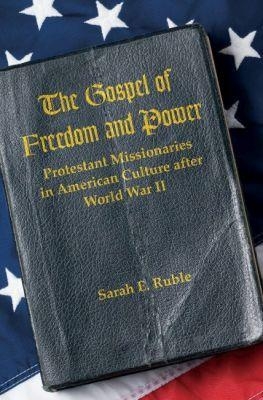
The Gospel of Freedom and Power
Protestant Missionaries in American Culture After World War II
Seiten
2014
The University of North Carolina Press (Verlag)
978-1-4696-1893-7 (ISBN)
The University of North Carolina Press (Verlag)
978-1-4696-1893-7 (ISBN)
In the decades after World War II, Protestant missionaries abroad were a topic of vigorous public debate. In The Gospel of Freedom and Power, Sarah E. Ruble traces and analyzes these public discussions about what it meant for Americans abroad to be good world citizens, placing them firmly in the context of the United States' postwar global dominance.
In the decades after World War II, Protestant missionaries abroad were a topic of vigorous public debate. From religious periodicals and Sunday sermons to novels and anthropological monographs, public conversations about missionaries followed a powerful yet paradoxical line of reasoning, namely that people abroad needed greater autonomy from U.S. power and that Americans could best tell others how to use their freedom. In The Gospel of Freedom and Power, Sarah E. Ruble traces and analyzes these public discussions about what it meant for Americans abroad to be good world citizens, placing them firmly in the context of the United States' postwar global dominance.
Bringing together a wide range of sources, Ruble seeks to understand how discussions about a relatively small group of Americans working abroad became part of a much larger cultural conversation. She concludes that whether viewed as champions of nationalist revolutions or propagators of the gospel of capitalism, missionaries - along with their supporters, interpreters, and critics - ultimately both challenged and reinforced a rhetoric of exceptionalism that made Americans the judges of what was good for the rest of the world.
In the decades after World War II, Protestant missionaries abroad were a topic of vigorous public debate. From religious periodicals and Sunday sermons to novels and anthropological monographs, public conversations about missionaries followed a powerful yet paradoxical line of reasoning, namely that people abroad needed greater autonomy from U.S. power and that Americans could best tell others how to use their freedom. In The Gospel of Freedom and Power, Sarah E. Ruble traces and analyzes these public discussions about what it meant for Americans abroad to be good world citizens, placing them firmly in the context of the United States' postwar global dominance.
Bringing together a wide range of sources, Ruble seeks to understand how discussions about a relatively small group of Americans working abroad became part of a much larger cultural conversation. She concludes that whether viewed as champions of nationalist revolutions or propagators of the gospel of capitalism, missionaries - along with their supporters, interpreters, and critics - ultimately both challenged and reinforced a rhetoric of exceptionalism that made Americans the judges of what was good for the rest of the world.
Sarah E. Ruble is assistant professor of religion at Gustavus Adolphus College.
| Erscheint lt. Verlag | 1.8.2014 |
|---|---|
| Verlagsort | Chapel Hill |
| Sprache | englisch |
| Maße | 137 x 213 mm |
| Gewicht | 286 g |
| Themenwelt | Geisteswissenschaften ► Geschichte ► Regional- / Ländergeschichte |
| Religion / Theologie ► Christentum ► Kirchengeschichte | |
| Sozialwissenschaften ► Politik / Verwaltung ► Europäische / Internationale Politik | |
| Sozialwissenschaften ► Politik / Verwaltung ► Politische Theorie | |
| ISBN-10 | 1-4696-1893-1 / 1469618931 |
| ISBN-13 | 978-1-4696-1893-7 / 9781469618937 |
| Zustand | Neuware |
| Informationen gemäß Produktsicherheitsverordnung (GPSR) | |
| Haben Sie eine Frage zum Produkt? |
Mehr entdecken
aus dem Bereich

aus dem Bereich
eine andere Geschichte der Papststadt
Buch | Softcover (2024)
C.H.Beck (Verlag)
CHF 25,20
die Macht des Dunklen in unserer Zeit und wie wir ihr entgegentreten
Buch | Hardcover (2025)
Verlag Herder
CHF 27,90


