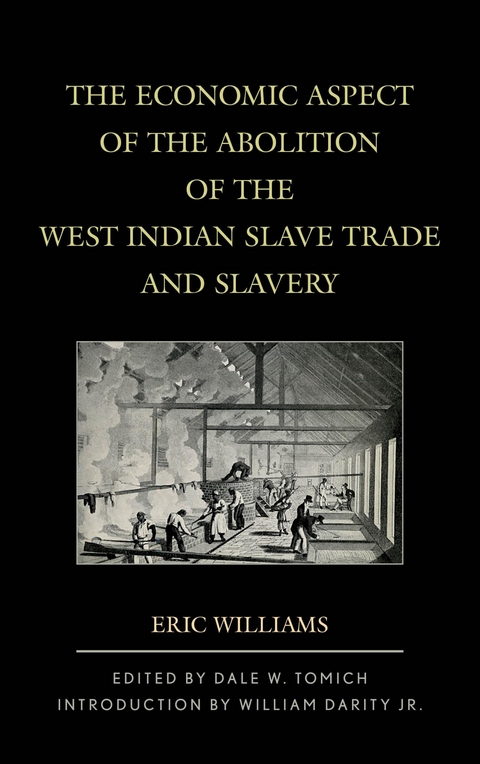
Economic Aspect of the Abolition of the West Indian Slave Trade and Slavery (eBook)
278 Seiten
Rowman & Littlefield Publishers (Verlag)
978-1-4422-3140-5 (ISBN)

In his influential and widely debated Capitalism and Slavery, Eric Williams examined the relation of capitalism and slavery in the British West Indies. Binding an economic view of history with strong moral argument, his study of the role of slavery in financing the Industrial Revolution refuted traditional ideas of economic and moral progress and firmly established the centrality of the African slave trade in European economic development. He also showed that mature industrial capitalism in turn helped destroy the slave system. Establishing the exploitation of commercial capitalism and its link to racial attitudes, Williams employed a historicist vision that has set the tone for an entire field. Williams's profound critique became the foundation for studies of imperialism and economic development and has been widely debated since the book's initial publication in 1944. The Economic Aspect of the Abolition of the West Indian Slave Trade and Slavery now makes available in book form for the first time his dissertation, on which Capitalism and Slavery was based. The significant differences between his two works allow us to rethink questions that were considered resolved and to develop fresh problems and hypotheses. It offers the possibility of a much deeper reconsideration of issues that have lost none of their urgency-indeed, whose importance has increased.
Eric Williams was the most prominent intellectual from the English-speaking Caribbean in the twentieth century. He was a leader of West Indian independence and the prime minister of Trinidad and Tobago from 1955 to 1981. His groundbreaking book, Capitalism and Slavery, was first published in 1944 and most recently reissued in 1994. Dale W. Tomich is professor of sociology and history at Binghamton University, State University of New York, and deputy director of the Fernand Braudel Center. William Darity Jr. is Arts and Sciences Professor of Public Policy, African and African American Studies, and Economics at Duke University.
PrefaceDale TomichIntroduction: From the Dissertation to Capitalism and Slavery: Did Williams's Abolition Thesis Change?William Darity Jr. The Economic Aspect of the Abolition of the West Indian Slave Trade and SlaveryEric WilliamsIntroductionPart IChapter 1: The Impolicy of the Slave SystemChapter 2: The Superiority of the French West IndiesChapter 3: East India SugarChapter 4: The Attempt to Secure an International AbolitionChapter 5: The West Indian ExpeditionsChapter 6: The Significance of the West Indian ExpeditionsChapter 7: The Abolition of the Slave TradePart IIChapter 8: The Abolitionists and EmancipationChapter 9: The Foreign Slave TradeChapter 10: East India SugarChapter 11: The Distressed AreasChapter 12: The Industrialists and EmancipationEpilogueAppendix I: "The Influential Men"Appendix II: Ramsay as an AuthorityAppendix III: The Intercolonial Slave TradeBibliography
| Erscheint lt. Verlag | 7.2.2014 |
|---|---|
| Reihe/Serie | World Social Change |
| Einführung | William Darity |
| Zusatzinfo | 22 Illustrations including: - 2 Black & White Illustrations; - 20 Tables. |
| Sprache | englisch |
| Themenwelt | Geschichte ► Allgemeine Geschichte ► Neuzeit (bis 1918) |
| Geisteswissenschaften ► Geschichte ► Regional- / Ländergeschichte | |
| Geschichte ► Teilgebiete der Geschichte ► Wirtschaftsgeschichte | |
| Naturwissenschaften | |
| Sozialwissenschaften ► Soziologie ► Spezielle Soziologien | |
| Schlagworte | Caribbean Studies • Latin American Studies |
| ISBN-10 | 1-4422-3140-8 / 1442231408 |
| ISBN-13 | 978-1-4422-3140-5 / 9781442231405 |
| Informationen gemäß Produktsicherheitsverordnung (GPSR) | |
| Haben Sie eine Frage zum Produkt? |
 EPUB (Adobe DRM)
Kopierschutz: Adobe-DRM
Adobe-DRM ist ein Kopierschutz, der das eBook vor Mißbrauch schützen soll. Dabei wird das eBook bereits beim Download auf Ihre persönliche Adobe-ID autorisiert. Lesen können Sie das eBook dann nur auf den Geräten, welche ebenfalls auf Ihre Adobe-ID registriert sind.
Details zum Adobe-DRM
Dateiformat: EPUB (Electronic Publication)
EPUB ist ein offener Standard für eBooks und eignet sich besonders zur Darstellung von Belletristik und Sachbüchern. Der Fließtext wird dynamisch an die Display- und Schriftgröße angepasst. Auch für mobile Lesegeräte ist EPUB daher gut geeignet.
Systemvoraussetzungen:
PC/Mac: Mit einem PC oder Mac können Sie dieses eBook lesen. Sie benötigen eine
eReader: Dieses eBook kann mit (fast) allen eBook-Readern gelesen werden. Mit dem amazon-Kindle ist es aber nicht kompatibel.
Smartphone/Tablet: Egal ob Apple oder Android, dieses eBook können Sie lesen. Sie benötigen eine
Geräteliste und zusätzliche Hinweise
Buying eBooks from abroad
For tax law reasons we can sell eBooks just within Germany and Switzerland. Regrettably we cannot fulfill eBook-orders from other countries.
aus dem Bereich