Zum Hauptinhalt springen
Nicht aus der Schweiz? Besuchen Sie lehmanns.de
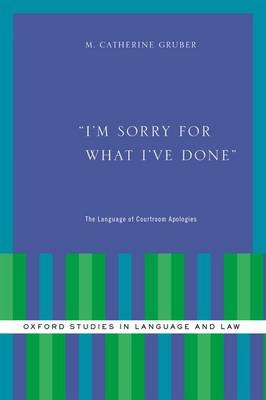
I'm Sorry for What I've Done -  M. Catherine Gruber

I'm Sorry for What I've Done (eBook)

The Language of Courtroom Apologies
eBook Download: PDF
2014
304 Seiten
Oxford University Press (Verlag)
978-0-19-932567-2 (ISBN)
Systemvoraussetzungen
49,49 inkl. MwSt
(CHF 48,35)
Der eBook-Verkauf erfolgt durch die Lehmanns Media GmbH (Berlin) zum Preis in Euro inkl. MwSt.
  • Download sofort lieferbar
  • Zahlungsarten anzeigen
This book examines 52 apologetic allocutions produced during federal sentencing hearings. The practice of inviting defendants to make a statement in their own behalf is a long-standing one and it is understood as offering defendants the opportunity to impress a judge or jury with their remorse, which could be a factor in the sentence that is imposed. Defendants raised the topics of the offense, mitigation, future behaviour and the sentence in different ways and this book explores the pros and cons associated with the different strategies that they used. Because there is no way of ascertaining exactly how effective (or ineffective) an individual allocution is, case law, sociolinguistic and historical resources, and judges' final remarks are used to develop hypotheses about defendants' communicative goals as well as what might constitute an ideal defendant stance from a judge's point of view. The corpus is unique because, unlike official transcripts, the transcripts used for this study include paralinguistic features such as hesitations, wavering voice, and crying-while-talking. Among its highlights, the book proposes that although a ritualized apology formula (e.g., "e;I'm sorry"e; or "e;I apologize"e;) would appear to be a good fit for the context of allocution and even appears to be expected, the use of these formulas carries implications in this context that do not serve defendants' communicative goals. I argue that the application of Austin's (1962) performative-constative continuum reveals that offense-related utterances that fall closer to the constative end are more consistent with the discursive constraints on the speech event of allocution. Further, I propose that the ideologies associated with allocution, in particular the belief that allocution functions as a protection for defendants, obscures the ways in which the context constrains what defendants can say and how effectively they can say it.
PDFPDF (Adobe DRM)

Kopierschutz: Adobe-DRM
Adobe-DRM ist ein Kopierschutz, der das eBook vor Mißbrauch schützen soll. Dabei wird das eBook bereits beim Download auf Ihre persönliche Adobe-ID autorisiert. Lesen können Sie das eBook dann nur auf den Geräten, welche ebenfalls auf Ihre Adobe-ID registriert sind.
Details zum Adobe-DRM

Dateiformat: PDF (Portable Document Format)
Mit einem festen Seiten­layout eignet sich die PDF besonders für Fach­bücher mit Spalten, Tabellen und Abbild­ungen. Eine PDF kann auf fast allen Geräten ange­zeigt werden, ist aber für kleine Displays (Smart­phone, eReader) nur einge­schränkt geeignet.

Systemvoraussetzungen:
PC/Mac: Mit einem PC oder Mac können Sie dieses eBook lesen. Sie benötigen eine Adobe-ID und die Software Adobe Digital Editions (kostenlos). Von der Benutzung der OverDrive Media Console raten wir Ihnen ab. Erfahrungsgemäß treten hier gehäuft Probleme mit dem Adobe DRM auf.
eReader: Dieses eBook kann mit (fast) allen eBook-Readern gelesen werden. Mit dem amazon-Kindle ist es aber nicht kompatibel.
Smartphone/Tablet: Egal ob Apple oder Android, dieses eBook können Sie lesen. Sie benötigen eine Adobe-ID sowie eine kostenlose App.
Geräteliste und zusätzliche Hinweise

Buying eBooks from abroad
For tax law reasons we can sell eBooks just within Germany and Switzerland. Regrettably we cannot fulfill eBook-orders from other countries.

Mehr entdecken
aus dem Bereich