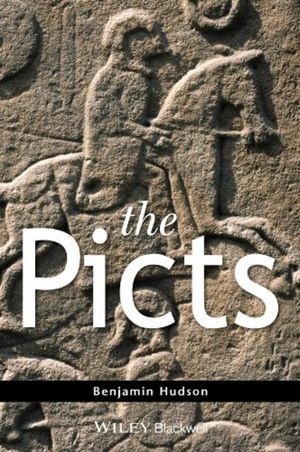
The Picts is a survey of the historical and cultural developments in northern Britain between AD 300 and AD 900. Discarding the popular view of the Picts as savages, they are revealed to have been politically successful and culturally adaptive members of the medieval European world.
- Re-interprets our definition of 'Pict' and provides a vivid depiction of their political and military organization
- Offers an up-to-date overview of Pictish life within the environment of northern Britain
- Explains how art such as the 'symbol stones' are historical records as well as evidence of creative inspiration.
- Draws on a range of transnational and comparative scholarship to place the Picts in their European context
Benjamin Hudson's books include Irish Sea Studies (2006), and Viking Pirates and Christian Princes (2005).
The Picts is a survey of the historical and cultural developments in northern Britain between AD 300 and AD 900. Discarding the popular view of the Picts as savages, they are revealed to have been politically successful and culturally adaptive members of the medieval European world. Re-interprets our definition of Pict and provides a vivid depiction of their political and military organization Offers an up-to-date overview of Pictish life within the environment of northern Britain Explains how art such as the symbol stones are historical records as well as evidence of creative inspiration. Draws on a range of transnational and comparative scholarship to place the Picts in their European context
Benjamin Hudson's books include Irish Sea Studies (2006), and Viking Pirates and Christian Princes (2005).
List of Figures and Tables vi
List of Lineages and Maps vii
Preface and Acknowledgments viii
Methodology x
Abbreviations xii
Introducing the Picts 1
1 Picts and Romans 15
2 Myth and Reality 40
3 The Early Middle Ages 57
4 People and Work 95
5 Spirituality 134
6 Art 162
7 Conquest and Obscurity 182
8 Literature and Remembrance 207
Conclusion 233
Select Bibliography 240
Index 255
"This exercise completes a superb and comprehensive survey of what is currently known about the Picts. The book also contains a lucid summary, and will be useful for both scholars and the general public." (Hereditasnexus, 6 October 2015)
Introducing the Picts
The best known pictures of the Picts come from a book about North America. Among the members of an expedition to Virginia in 1585 was Thomas Harriot who had been commissioned to gather data about the new land. His A Briefe and True Report of the New Found Land of Virginia was a report of his findings, which his patron, Sir Walter Raleigh, hoped would entice people to invest. Accompanying the expedition was the artist John White, who later became the governor of the lost Roanoke River colony.1 His watercolors of the people and countryside of this new world became famous and were included in printed editions of Harriot’s narrative. Among the images of colorful birds, a Potomack (sic) fishing expedition, and a Powhatan chieftain are pictures of a Pictish warrior, his wife, and daughter. All three are covered in designs and wearing metal bands around their necks and midriffs with no other clothing. The man holds a sword, small shield, and a severed head while the women have swords and spears. White had never seen a Pict, of course (he had never seen a Powhatan chief either), but based his pictures of the early inhabitants of Britain on “an old history” and his own imagination. The illustrations were included “to showe how that the inhabitants of Great Bretannie have bin in times past as sauvage as those of Virginia,” in other words that the Native Americans differed little from the inhabitants of Britain at the beginning of the Middle Ages. As the cult of the “noble savage” began to develop, some European writers thought that “primitives” wherever and whenever found represented the unsullied spirit of true humanity.2 While there are many representations made by the peoples themselves, they do not have the popular appeal of White’s paintings, which are best known through a later reworking by Theodor de Bry, who published Harriot’s account and redrew White’s images for publication.
As White’s watercolors reveal, the Picts have been the mystery savages of Britain for a long time. The name Pict was coined by the Romans for a people who lived in northern Britain beyond Hadrian’s Wall. The name first appears at the end of the third century AD and for the next 600 years they fought the Romans, southern Britons, Irish, Anglo-Saxons, and Vikings. The Picts were more than just warriors; they had an artistic culture that was acknowledged by their name: “the painted people.” Their art ranged from monumental stone carvings to designs on jewelry. They were also the last people in the British Isles to convert to Christianity. White’s inclusion of the Picts with the native peoples of North America is testimony to their place in the minds of educated men by the sixteenth century. One did not have to travel far to find further examples. White’s older contemporary the antiquarian John Leland referred to Hadrian’s Wall as “the Picts’ wall,” a name based on his reading of the sixth-century author Gildas’ Ruin of Britain, and knowledge of medieval maps; that of Matthew Paris has both the Hadrian and Antonine walls separating the Picts from the southern lands. He seems to be unaware that it had been built centuries before the name “Pict” was first used to describe anyone in the British Isles.3 Leland was not alone – moving back a millennium to the sixth century, Gildas believed the Picts to be so wild and primitive that only a physical structure such as a wall was capable of keeping them at bay. The sheer extent of the construction was enough to increase respect for the people it was thought to have held back. Even a cursory reading of Bede’s Ecclesiastical History (a work that every educated person in the British Isles after the eighth century was expected to know) leaves the impression of the Picts as formidable warriors with few rivals.
There are two assumptions behind the historical views and popular perceptions of White or Leland, which have continued to the present and which this book will examine. The first is that there was a single race of Picts, a homogeneous population which extended throughout the northern part of Britain with exactly the same beliefs, costumes, methods of waging war, and patterns of everyday life. Connected with that supposition is a second one, that the Picts lived unchanged in a state of chronological grace for 600 years from the first appearance of the name Pict to the last “king of the Picts” at the beginning of the tenth century. Like the characters encountered by St. Brendan in his famous voyages, the political geography never altered in the land of the ageless Pict while military evolution and cultural development were unknown even as the societies round them were undergoing momentous transformations. Simply observing the significant alterations in culture and political geography of the other peoples in the British Isles during the same period leads to the conclusion that something similar was happening in northern Britain. To give just a couple of examples from the last years of the Imperial Roman administration to the beginning of the High Middle Ages, there were important movements of people (such as the Anglo-Saxons) as well as advances in technology (stirrups) together with changes in religion (Christianity).
As the following chapters show, there were many aspects to the peoples known as “the Picts.” One of these is also the best known: the Picts were the ruthless warriors of Britain for almost five centuries. Their raids south of Hadrian’s Wall hastened the end of Roman control of Britain. The fourth-century soldier-turned-memoirist Ammianus Marcellinus claimed that much of the turmoil in Britain involved the Picts somewhere. Moving forward several centuries, the destruction of an invading Anglo-Saxon army at the battle of Dun Nechtan in 685 ended the northern expansion of the Northumbrians. This paved the way for successful Pictish princes such as the eighth-century empire-builder Angus son of Fergus to ally with the Anglo-Saxons on conditions of equality; together they forced terms on the neighboring kingdom of Strathclyde. The victory at Dun Nechtan was even more impressive because the Angles were at their military peak and had conducted a successful raid on Ireland.
The martial aspect to the Picts must be set beside their art. Unlike many warrior societies of the period, which are known only through written descriptions of victorious battles, these fighters had a culture that valued the creative. Whether sculpture stones or intricate metal work, the Picts produced some of the finest pieces of art in the early Middle Ages. Artistic remains reveal technical and cultural development, as well as suggesting centers of political or ecclesiastical patronage. The “Pict at home” is literally visible on massive boulders (the sheer size of which sparked comment from early travelers through Scotland who remarked on their magnificence) to small rocks that can be held in the hand where there are obscure symbols, animals both real and fantastic, and scenes of everyday life such as the hunt or craftsmen with the tools of their trade. Imaginative sophistication, often in the area of ecclesiastical sculpture, provides insight into the classes of people and society in general. Stone carving in the northeastern Atlantic was ancient and the Pictish symbol stones have aspects in common with other northern European sculpture, such as the Gotland Picture Stones. The important symbol stones remain intriguing, yet controversial, sources of information. The individual images on the stones have been collected, collated, and sorted, often in efforts to show that they support someone’s particular theory in connection with social organization or political succession. Recent archaeological excavations have produced new interpretations of the symbol stones’ importance for understanding settlement patterns as well as evidence of the relationship between land divisions and political organization.
Another aspect to the Picts is their North Sea or northern European context. While it is true that the world for many people was little more than the immediate neighborhood where they lived and died, few people were in complete isolation. Warriors accompanied by their retinues fought battles sometimes a hundred miles or more from their homes while artists could travel even greater distances to be trained or to pursue their craft. Especially after the conversion to Christianity the Picts were drawn into an international community and their clergy subscribed to ideas, symbols, and rituals found from the Mediterranean to the North Sea. Before that, however, the Picts were by far the most northerly of the Romans’ neighbors and were a part of a world that was bounded on the north by the sub-Arctic seas. Pictish fleets are mentioned several times in the Irish annals and the people were acknowledged as a formidable presence along the eastern Atlantic. Naval power allowed them to indulge in diplomacy, initially to form confederations against the Romans and then to deal with two powerful groups of immigrants to Britain: the Irish colonists on the west coast in Dál Riata and the Angles on the east coast moving northwards from the Tyne. Because of their northern situation the Picts were also the first to face the raiders/settlers from Scandinavia now known as the Vikings, who hastened...
| Erscheint lt. Verlag | 13.1.2014 |
|---|---|
| Reihe/Serie | The Peoples of Europe |
| The Peoples of Europe | The Peoples of Europe |
| Sprache | englisch |
| Themenwelt | Geschichte ► Allgemeine Geschichte ► Vor- und Frühgeschichte |
| Geschichte ► Allgemeine Geschichte ► Mittelalter | |
| Geisteswissenschaften ► Geschichte ► Regional- / Ländergeschichte | |
| Sozialwissenschaften ► Ethnologie | |
| Sozialwissenschaften ► Soziologie | |
| Schlagworte | began • Beyond • britons • Classical Authorities • ConText • Empire • enigmatic • European • Folk • Geschichte • Geschichte des Mittelalters (500-1500) • hadrians • History • later roman • Little • Living • Long • many • Medieval History (500-1500) • Mysteries • Mystery • Name • North • northern people • People • PICT • Picture • Pikten • Romans • savages • Shadowy • Wall |
| ISBN-10 | 1-118-59832-6 / 1118598326 |
| ISBN-13 | 978-1-118-59832-0 / 9781118598320 |
| Informationen gemäß Produktsicherheitsverordnung (GPSR) | |
| Haben Sie eine Frage zum Produkt? |
 EPUB (Adobe DRM)
Kopierschutz: Adobe-DRM
Adobe-DRM ist ein Kopierschutz, der das eBook vor Mißbrauch schützen soll. Dabei wird das eBook bereits beim Download auf Ihre persönliche Adobe-ID autorisiert. Lesen können Sie das eBook dann nur auf den Geräten, welche ebenfalls auf Ihre Adobe-ID registriert sind.
Details zum Adobe-DRM
Dateiformat: EPUB (Electronic Publication)
EPUB ist ein offener Standard für eBooks und eignet sich besonders zur Darstellung von Belletristik und Sachbüchern. Der Fließtext wird dynamisch an die Display- und Schriftgröße angepasst. Auch für mobile Lesegeräte ist EPUB daher gut geeignet.
Systemvoraussetzungen:
PC/Mac: Mit einem PC oder Mac können Sie dieses eBook lesen. Sie benötigen eine
eReader: Dieses eBook kann mit (fast) allen eBook-Readern gelesen werden. Mit dem amazon-Kindle ist es aber nicht kompatibel.
Smartphone/Tablet: Egal ob Apple oder Android, dieses eBook können Sie lesen. Sie benötigen eine
Geräteliste und zusätzliche Hinweise
Buying eBooks from abroad
For tax law reasons we can sell eBooks just within Germany and Switzerland. Regrettably we cannot fulfill eBook-orders from other countries.
aus dem Bereich