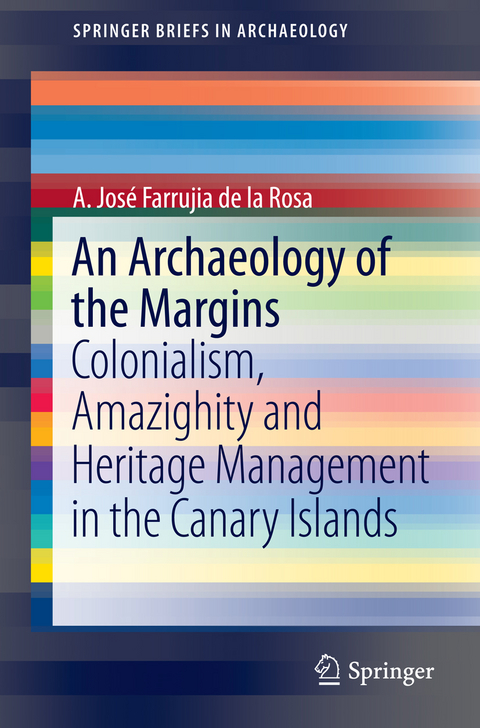
Archaeology of the Margins (eBook)
X, 119 Seiten
Springer New York (Verlag)
978-1-4614-9396-9 (ISBN)
José Farrujia de la Rosa holds a PhD in Prehistory and a PhD Premio Extraordinario (Extraordinary award) in Humanities (2003), both awarded by the University of La Laguna. He was the winner of the Antonio Rumeu de Armas Historical Research Prize (2009) and is a Member of the Spanish Society for the History of Archaeology. He received a research grant from the Ministry of Education and Culture University Teacher program (2000-2003) and taught in the Department of Prehistory, Anthropology and Ancient History at the same university, as well working as a Senior Archaeological Conservation Technician at the Archaeological Museum of Tenerife and Historical Heritage Officer at the La Laguna City Council. He currently works in the field of heritage management. He has been involved in numerous archaeological surveys and excavations in the Canarian Archipelago and elsewhere in Europe. His research focuses on the archaeology of the Canary Islands, including studies on heritage management, the history of the archaeology of the islands, the early colonization of the islands, archaeological theory and methodology, rock art and identity issues. He is the author of many articles published both in Spanish journals (including Trabajos de Prehistoria, Complutum, Tabona, and Revista Atlántica y Mediterránea de Prehistoria y Arqueología Social) and foreign journals (including the Oxford Journal of Archaeology, African Archaeological Review, Sahara, and Nouvelles de l'Archeologie, amongst others). He is also the author of the following books: El poblamiento humano de Canarias en la obra de Manuel de Ossuna y Van den Heede (2002); Ab initio (1342-1969) (2004), Imperialist Archaeology in the Canary Islands. French and German studies on Prehistoric colonization (2005), which is the first academic book written in English on Canarian archaeology; Arqueología y franquismo en Canarias: política, poblamiento e identidad (2007), and En busca del pasado guanche. Historia de la Arqueología en Canarias (1868-1968), with a prologue by Alain Schnapp. This last book was presented at Sorbonne University (Paris) on 1 December 2011.
This book analyses the problematics of archaeological heritage management in the Canary Islands, which are echoed in other parts of the world where the indigenous heritage is under-represented. The present-day management of Canarian archaeological heritage has a very specific and unusual context given that the archipelago is located on the fringes of Europe, belonging to Spain and therefore to the European Union, but geographically and in terms of early history being part of Africa. From a theoretical perspective, then, the proposed book analyzes issues such as the effects of colonialism and eurocentrism on the management of the archaeological heritage. It also examines the evolutionist and historico-cultural models used to analyze past societies and, ultimately, used to create identities that influence archaeological heritage management itself. From a practical point of view, the book presents a proposal for enhancing the archaeological heritage of the Canary Islands through the creation of archaeological parks (providing some concrete examples in the case of the city of La Laguna) and the active involvement of the local community. Parallel to this, the book considers the Canarian Archipelago as part of a problematic that is not unique to this area but is an example of poor indigenous heritage management overall. It demonstrates how the course of history and the politics of the past still have an excessive influence on the way in which the present-day archaeological heritage is interpreted and managed. Therefore, this book provides an almost unique opportunity for uncovering the history of archaeology within the margins of Europe (in fact, in an African region) and exploring colonial and foreign influences. In many ways it is a mirror of archaeological mainstreams and an exercise in (re)thinking the aim and status of present-day archaeology.
José Farrujia de la Rosa holds a PhD in Prehistory and a PhD Premio Extraordinario (Extraordinary award) in Humanities (2003), both awarded by the University of La Laguna. He was the winner of the Antonio Rumeu de Armas Historical Research Prize (2009) and is a Member of the Spanish Society for the History of Archaeology. He received a research grant from the Ministry of Education and Culture University Teacher program (2000-2003) and taught in the Department of Prehistory, Anthropology and Ancient History at the same university, as well working as a Senior Archaeological Conservation Technician at the Archaeological Museum of Tenerife and Historical Heritage Officer at the La Laguna City Council. He currently works in the field of heritage management. He has been involved in numerous archaeological surveys and excavations in the Canarian Archipelago and elsewhere in Europe. His research focuses on the archaeology of the Canary Islands, including studies on heritage management, the history of the archaeology of the islands, the early colonization of the islands, archaeological theory and methodology, rock art and identity issues. He is the author of many articles published both in Spanish journals (including Trabajos de Prehistoria, Complutum, Tabona, and Revista Atlántica y Mediterránea de Prehistoria y Arqueología Social) and foreign journals (including the Oxford Journal of Archaeology, African Archaeological Review, Sahara, and Nouvelles de l’Archeologie, amongst others). He is also the author of the following books: El poblamiento humano de Canarias en la obra de Manuel de Ossuna y Van den Heede (2002); Ab initio (1342-1969) (2004), Imperialist Archaeology in the Canary Islands. French and German studies on Prehistoric colonization (2005), which is the first academic book written in English on Canarian archaeology; Arqueología y franquismo en Canarias: política, poblamiento e identidad (2007), and En busca del pasado guanche. Historia de la Arqueología en Canarias (1868-1968), with a prologue by Alain Schnapp. This last book was presented at Sorbonne University (Paris) on 1 December 2011.
Introduction.- Chapter I: The invention of Canarian prehistory and early archaeological heritage management in the 19th century (1868-1936).-Chapter II: Archaeology and dictatorship: the centralisation of archaeological heritage management (1939-1975).- Chapter III
In search of the indigenous culture of the Canary Islands (1975-2012).
| Erscheint lt. Verlag | 26.11.2013 |
|---|---|
| Reihe/Serie | SpringerBriefs in Archaeological Heritage Management |
| SpringerBriefs in Archaeological Heritage Management | |
| SpringerBriefs in Archaeological Heritage Management | |
| SpringerBriefs in Archaeology | SpringerBriefs in Archaeology |
| Zusatzinfo | X, 119 p. 37 illus., 26 illus. in color. |
| Verlagsort | New York |
| Sprache | englisch |
| Themenwelt | Geisteswissenschaften ► Archäologie |
| Geschichte ► Allgemeine Geschichte ► Vor- und Frühgeschichte | |
| Geschichte ► Allgemeine Geschichte ► Altertum / Antike | |
| Sozialwissenschaften | |
| Technik | |
| Schlagworte | archaeology in the Canary Islands • colonial archaeology • cultural resource management in the Canary Islands • Europeanization of Mediterranean islands • Indigenous Archaeology • public policy in the Canary Islands |
| ISBN-10 | 1-4614-9396-X / 146149396X |
| ISBN-13 | 978-1-4614-9396-9 / 9781461493969 |
| Informationen gemäß Produktsicherheitsverordnung (GPSR) | |
| Haben Sie eine Frage zum Produkt? |
 PDF (Wasserzeichen)
DRM: Digitales Wasserzeichen
Dieses eBook enthält ein digitales Wasserzeichen und ist damit für Sie personalisiert. Bei einer missbräuchlichen Weitergabe des eBooks an Dritte ist eine Rückverfolgung an die Quelle möglich.
Dateiformat: PDF (Portable Document Format)
Mit einem festen Seitenlayout eignet sich die PDF besonders für Fachbücher mit Spalten, Tabellen und Abbildungen. Eine PDF kann auf fast allen Geräten angezeigt werden, ist aber für kleine Displays (Smartphone, eReader) nur eingeschränkt geeignet.
Systemvoraussetzungen:
PC/Mac: Mit einem PC oder Mac können Sie dieses eBook lesen. Sie benötigen dafür einen PDF-Viewer - z.B. den Adobe Reader oder Adobe Digital Editions.
eReader: Dieses eBook kann mit (fast) allen eBook-Readern gelesen werden. Mit dem amazon-Kindle ist es aber nicht kompatibel.
Smartphone/Tablet: Egal ob Apple oder Android, dieses eBook können Sie lesen. Sie benötigen dafür einen PDF-Viewer - z.B. die kostenlose Adobe Digital Editions-App.
Buying eBooks from abroad
For tax law reasons we can sell eBooks just within Germany and Switzerland. Regrettably we cannot fulfill eBook-orders from other countries.
aus dem Bereich