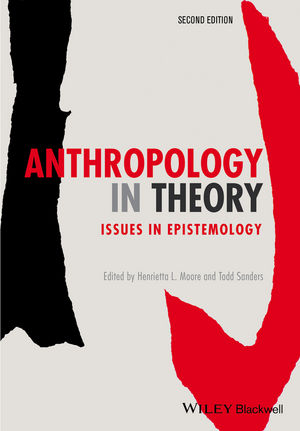
Anthropology in Theory (eBook)
616 Seiten
Wiley-Blackwell (Verlag)
978-1-118-78059-6 (ISBN)
- Provides a comprehensive selection of 60 readings and an insightful overview of the evolution of anthropological theory
- Revised and updated to reflect an on-going strength and diversity of the discipline in recent years, with new readings pointing to innovative directions in the development of anthropological research
- Identifies crucial concepts that reflect the practice of engaging with theory, particular ways of thinking, analyzing and reflecting that are unique to anthropology
- Includes excerpts of seminal anthropological works, key classic and contemporary debates in the discipline, and cutting-edge new theorizing
- Reveals broader debates in the social sciences, including the relationship between society and culture; language and cultural meanings; structure and agency; identities and technologies; subjectivities and trans-locality; and meta-theory, ontology and epistemology
Henrietta L. Moore is the William Wyse Chair of Social Anthropology at the University of Cambridge. Her most recent book is Still Life: Hopes, Desires and Satisfactions (2011).
Todd Sanders is Associate Professor of Anthropology at the University of Toronto, and has worked in Africa for two decades. His books include Those Who Play with Fire: Gender, Fertility and Transformation in East and Southern Africa (2004) and Beyond Bodies: Rainmaking and Sense Making in Tanzania (2008).
Henrietta L. Moore is the William Wyse Chair of Social Anthropology at the University of Cambridge. Her most recent book is Still Life: Hopes, Desires and Satisfactions (2011). Todd Sanders is Associate Professor of Anthropology at the University of Toronto, and has worked in Africa for two decades. His books include Those Who Play with Fire: Gender, Fertility and Transformation in East and Southern Africa (2004) and Beyond Bodies: Rainmaking and Sense Making in Tanzania (2008).
"This volume has few precedents and no rival. It is of
singular breadth. The editors are at once discriminating and
judicious in their selections: no playing favorites here. Their
introductory essays are masterful--accessible enough that the
uninitiated can engage them but also so well informed and argued
that even the professional can learn from them. It offers a record
of anthropological theory past and present and manages to point as
well to possible theoretical futures. By illustration and by
design, it offers an answer to the question that is as common as it
is distressing: "Just what is anthropology, anyway?"
It's an indispensable pedagogical resource." - James D.
Faubion, Professor of Anthropology, Rice University, USA
"A thoughtfully selected, persuasively organized and
refreshingly original collection that illuminates the generative
assumptions, debates and practices from which anthropological
knowledge has been and continues to be produced." -
Mary Hancock, University of California, Santa Barbara,
USA
General Introduction
Henrietta L. Moore and Todd Sanders
Theory as Practice
This collection attests to the strength and diversity of anthropological theorizing in the twentieth and early twenty-first centuries. We use the term “theorizing” rather than the more usual noun form “theory” because the pieces collected here are intended to reflect the practice of engaging with theory, particular ways of thinking, analyzing, and reflecting that have emerged in the context of writings over this period. Anthropology as a discipline has a number of subdivisions or “traditions.” These may be broadly cast as national – as in British, American, Japanese, Brazilian anthropology – and regional – as in the particular theoretical concerns of specific regions, such as “persons,” “cross-cousin marriage,” “gift exchange,” and so on. The boundaries between these different “traditions” are far from fixed, and indeed are being constantly transcended. The writings collected here draw on a variety of perspectives. Our aim is not to provide a representative sample of any – and certainly not all – traditions, but to make available a flavor of the intellectual conversations and debates on specific epistemological issues that formed the practice of theorizing in twentieth- and early twenty-first-century anthropology.
No one collection could ever hope to be representative of anthropological theories per se. The question “What is anthropological theory?” is inextricably tied to the question “What is anthropology?” (Moore 1999: 2; Moore and Sanders, this volume). Anthropology has been variously defined as the study of “other cultures,” “cultural difference,” “social systems,” “world views,” “ways of life,” and “forms of knowledge.” Sometimes these abstractions are given more concrete referents, such as political systems, livelihoods, kinship systems, family structures, and religious beliefs. The only difficulty is that neither the more abstract conceptual categories nor the empirical entities are the exclusive domain of anthropology, which immediately raises the issue of how we would delineate specifically anthropological theories. This is obvious in the practice of anthropology, since most anthropology courses begin by teaching students about Durkheim, Weber, and Marx, whose writings have been formative for the discipline. Contemporary anthropological theorizing also engages in extensive theoretical borrowing, and recent examples would include the work of Bourdieu, Foucault, Gramsci, Bakhtin, Agamben, and many others. We make no attempt in this collection – it would in any case be impossible – to provide examples of all the theories from the humanities, social sciences, and sciences that have influenced anthropological theorizing. Rather, we have integrated extracts from writers outside anthropology where their thinking contributes to particular debates or discussion points within a specific set of epistemological difficulties under discussion within the volume. For example, in section 2 on structure and system, we have included an extract from Durkheim (5), not only because his writings had a profound influence, albeit in different ways, on the work of Radcliffe-Brown (6) and Lévi-Strauss (8), but also because it discusses the relationship between the individual and society, which is one of the concerns of section 1. The extract from Durkheim thus provides both a context for readers engaging with the work of Radcliffe-Brown and Lévi-Strauss and an indirect commentary on the vexed question of what distinguishes social structures from social relations. Our intention throughout has been to portray anthropological theorizing as a set of dialogues – dialogues that are not only internal to the discipline, but also engage with writings outside the discipline from which anthropology has often sought inspiration. Thus we have included extracts that not only reflect a writer’s theoretical position – or at least one of her or his positions – but can also be maintained in a productive relation with positions taken by other writers elsewhere in the volume. Consequently, individual extracts should not be taken as necessarily representative of an individual’s entire oeuvre.
In designing a collection of this kind, it is evident that a plethora of organizational principles proffer themselves, all with strengths and weaknesses. It might have been feasible – if somewhat constraining – to have divided anthropological theorizing into anthropological theories of “kinship,” “politics,” “economics,” and so on. Equally, it might have been appropriate to divide disciplinary endeavor into “schools of thought,” such as functionalism, structural-functionalism, and structuralism. Another possible set of categorizations might have been suggested by reference to specialist sub-fields, such as the anthropology of cognition, art, nationalism, psychology, development, gender, the body, medical anthropology, and so on. All these sub-fields borrow extensively from other disciplines and many of them require specialist theoretical knowledge. Every one of these ways of organizing the collection was considered. They were ultimately abandoned not just because as categorizations and principles of organization they can be readily contested, but because we wanted to emphasize what might be distinctive about anthropological theorizing, that is, the practice of it.
How This Book is Organized
Anthropology is not anthropology because it studies kinship or cognition or politics or art, or because it has had practitioners who are structuralists or post-structuralists. What is distinctive about anthropology is the way it has created and constructed itself, the particular history of the formation of ideas that have given rise to a distinctive discipline and a set of associated practices. It is this process of theorizing that this volume seeks to capture. Today’s conversations are clearly different from those of the past, and while it is difficult to understand contemporary concerns without some knowledge of the origins of the debates, the volume is not organized on a purely historical basis. The aim has been to show the recursive and enduring nature of key questions, principally the lasting search for a more complete understanding of the anthropological object of inquiry; in other words, the extent to which anthropological theorizing has always been driven by the question “What is anthropology?” The volume thus aims to demonstrate both the variations and the continuities in the key questions anthropologists have asked: “what is the relationship between the individual and society”; “what is the difference between society and culture”; “what makes us distinctively human”; “how are we to comprehend cultural difference in the context of a universal humanity”; “what is the relationship between models and reality”; “what is the relationship between the models of the observer and those of the observed”?
The collection as a whole provides an introduction to these questions for readers inside and outside anthropology. It also builds up a dialogue about specific sets of assumptions on which theorizing in anthropology is based, the methods appropriate to address certain questions, and the theoretical frameworks through which they are received. So, for example, in section 2, structure and system, we have included extracts from different writers discussing the term “structure” and what it encompasses and entails. A concept such as “structure” not only defines the kinds of questions that can be asked of data, but also determines the methods used to collect data. The aim of each section is to provide a kind of minor “genealogy of knowledge” where the extracts explore through dialogue with each other not only what certain concepts and the pre-theoretical assumptions on which they are based reveal, but also what they remain silent on, the questions that do not get asked. The overall structure of the book is, as we have said, not historically oriented, but is, rather, based on a series of counterpoints or questions, so that issues on which certain sections are silent get picked up later in subsequent sections. The contributions can, of course, be read in any order, but the volume’s layout is intended to provide a pathway through a series of interlinked debates for readers less familiar with anthropology. We provide an overview of the theoretical development of anthropology in the twentieth and early twenty-first century and its epistemological concerns in the next chapter (Moore and Sanders, this volume).
In part I, the debates are animated by the question of the relationship between society and culture, and indeed the issue which divided British and American anthropology in the first half of the twentieth century: whether it was culture or society that formed the object of anthropological inquiry. Different writers in the sections in part I discuss the definition of these terms and how they relate to the individuals who comprise them. One major difficulty here is the fact of cultural difference and how it relates to our common humanity, to the environment in which we live, and to our individual natures. What is crucial is the way that cultural determinism and cultural relativism interact in the thinking of individual authors. While one could characterize the basic trend...
| Erscheint lt. Verlag | 16.12.2013 |
|---|---|
| Sprache | englisch |
| Themenwelt | Geisteswissenschaften ► Archäologie |
| Geschichte ► Allgemeine Geschichte ► Vor- und Frühgeschichte | |
| Sozialwissenschaften ► Ethnologie | |
| Sozialwissenschaften ► Politik / Verwaltung | |
| Sozialwissenschaften ► Soziologie | |
| Technik | |
| Schlagworte | Anthropological Theory & Methods/Ethnography • Anthropologie • Anthropologie / Theorie u. Methoden, Ethnographie • Anthropology • theory and method, ethnography, society and culture, behavior, anthropological data, language and method, neuroanthropology, objects, objectification, ethics, subjectivity, body, gender, linguistics, environment, history of anthropology |
| ISBN-10 | 1-118-78059-0 / 1118780590 |
| ISBN-13 | 978-1-118-78059-6 / 9781118780596 |
| Informationen gemäß Produktsicherheitsverordnung (GPSR) | |
| Haben Sie eine Frage zum Produkt? |
 EPUB (Adobe DRM)
Kopierschutz: Adobe-DRM
Adobe-DRM ist ein Kopierschutz, der das eBook vor Mißbrauch schützen soll. Dabei wird das eBook bereits beim Download auf Ihre persönliche Adobe-ID autorisiert. Lesen können Sie das eBook dann nur auf den Geräten, welche ebenfalls auf Ihre Adobe-ID registriert sind.
Details zum Adobe-DRM
Dateiformat: EPUB (Electronic Publication)
EPUB ist ein offener Standard für eBooks und eignet sich besonders zur Darstellung von Belletristik und Sachbüchern. Der Fließtext wird dynamisch an die Display- und Schriftgröße angepasst. Auch für mobile Lesegeräte ist EPUB daher gut geeignet.
Systemvoraussetzungen:
PC/Mac: Mit einem PC oder Mac können Sie dieses eBook lesen. Sie benötigen eine
eReader: Dieses eBook kann mit (fast) allen eBook-Readern gelesen werden. Mit dem amazon-Kindle ist es aber nicht kompatibel.
Smartphone/Tablet: Egal ob Apple oder Android, dieses eBook können Sie lesen. Sie benötigen eine
Geräteliste und zusätzliche Hinweise
Buying eBooks from abroad
For tax law reasons we can sell eBooks just within Germany and Switzerland. Regrettably we cannot fulfill eBook-orders from other countries.
aus dem Bereich