


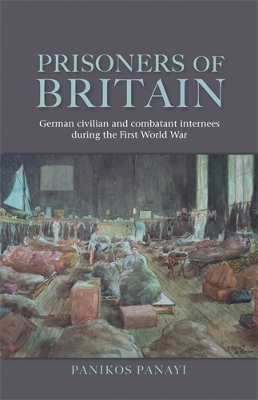
Prisoners of Britain
German Civilian and Combatant Internees During the First World War
Seiten
2014
Manchester University Press (Verlag)
978-0-7190-9563-4 (ISBN)
Manchester University Press (Verlag)
978-0-7190-9563-4 (ISBN)
During WWI hundreds of thousands of Germans faced incarceration in hundreds of camps on the British mainland. This is the first book on these German prisoners, and covers 3 different types of internees in Britain: civilians already present in the country in August 1914; civilians brought to Britain from all over the world; and combatants. -- .
During the First World War, hundreds of thousands of Germans faced incarceration in hundreds of camps on the British mainland. This is the first book on these German prisoners, available in paperback, almost a century after the conflict. The book covers the three different types of internees in Britain in the form of: civilians already present in the country in August 1914; civilians brought to Britain from all over the world; and combatants. Using a vast range of contemporary British and German sources, the volume traces life experiences through initial arrest and capture, to life behind barbed wire, to return to Germany or to the remnants of the ethnically cleansed German community in Britain. The book will prove essential reading for anyone interested in the history of prisoners of war or the First World War and will also appeal to scholars and students of twentieth-century Europe and the human consequences of war. -- .
During the First World War, hundreds of thousands of Germans faced incarceration in hundreds of camps on the British mainland. This is the first book on these German prisoners, available in paperback, almost a century after the conflict. The book covers the three different types of internees in Britain in the form of: civilians already present in the country in August 1914; civilians brought to Britain from all over the world; and combatants. Using a vast range of contemporary British and German sources, the volume traces life experiences through initial arrest and capture, to life behind barbed wire, to return to Germany or to the remnants of the ethnically cleansed German community in Britain. The book will prove essential reading for anyone interested in the history of prisoners of war or the First World War and will also appeal to scholars and students of twentieth-century Europe and the human consequences of war. -- .
Panikos Panayi is Professor of European History at De Montfort University -- .
1. Forgetting, remembering and the beginnings of a history
2. Arrest, transportation and capture
3. The camp system
4. Barbed wire disease and the grim realities of internment
5. Prison camp societies
6. Employment
7. Public opinion
8. Escape, release and return
9. The meaning of internment in Britain during the First World War
Bibliography
Index -- .
| Erscheint lt. Verlag | 30.4.2014 |
|---|---|
| Zusatzinfo | Illustrations, black & white|Tables, black & white |
| Verlagsort | Manchester |
| Sprache | englisch |
| Maße | 138 x 216 mm |
| Gewicht | 422 g |
| Themenwelt | Geschichte ► Allgemeine Geschichte ► Neuzeit (bis 1918) |
| Geschichte ► Allgemeine Geschichte ► 1918 bis 1945 | |
| Geisteswissenschaften ► Geschichte ► Regional- / Ländergeschichte | |
| Sozialwissenschaften ► Politik / Verwaltung | |
| ISBN-10 | 0-7190-9563-8 / 0719095638 |
| ISBN-13 | 978-0-7190-9563-4 / 9780719095634 |
| Zustand | Neuware |
| Informationen gemäß Produktsicherheitsverordnung (GPSR) | |
| Haben Sie eine Frage zum Produkt? |
Mehr entdecken
aus dem Bereich


aus dem Bereich
Geschichte einer wilden Handlung
Buch | Hardcover (2024)
C.H.Beck (Verlag)
CHF 47,60


