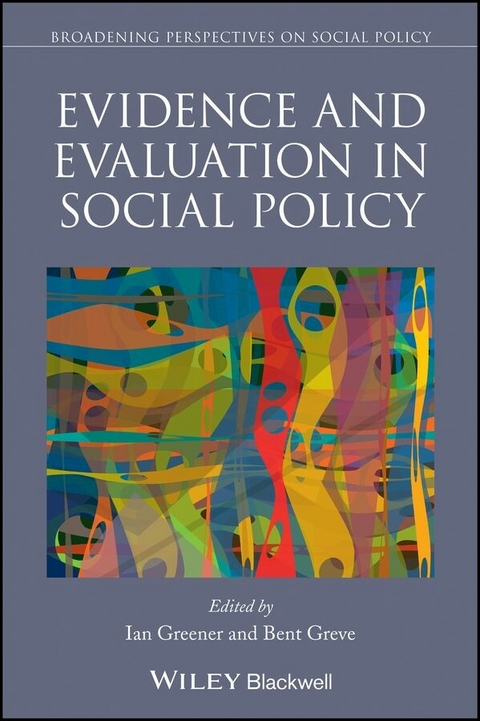
Evidence and Evaluation in Social Policy (eBook)
John Wiley & Sons (Verlag)
978-1-118-81651-6 (ISBN)
By examining the role of evidence in social policymaking and the extent of its influence, Evidence and Evaluation in Social Policy delves deeply into one of the central questions of the field for the last 20 years.
- Chronicles the trend towards evidence-based policy over the last decade
- Assesses the ways in which scarce resources can best be used for the best care, particularly in times of austerity
- Describes methodological innovation, the ways in which researchers and politicians are working together effectively, and suggestions for future improvement
- Covers topics such as the role of randomized controlled trials in shaping public policy; the pitfalls of evidence-based policy as a prescriptive ideal; the challenges of measuring public support for policy interventions; and the benefits of engaging local government decision-makers with evaluation research
Bent Greve is Professor in Social Science with an emphasis on Welfare State Analysis at Roskilde University, Denmark. He is Regional and Special Issues Editor of Social Policy & Administration and has published extensively on social and labor market policy, social security, tax expenditures, public sector expenditures, and financing of the welfare state. He is the author of Happiness (2011) and the editor of The Routledge Handbook of the Welfare State (2013) and Happiness and Social Policy in Europe (2010).
Ian Greener is Professor in the School of Applied Social Sciences at Durham University, UK, as well as being Director of the ESRC North-East Doctoral Training Centre there. His research interests include the use of evidence in policy, healthcare reorganization, and the means by which policymaking can become more evidence-driven. He is the author of three books on research methods, public management, and healthcare, including Designing Social Research: A Guide for the Bewildered (2011). He is also the author of over 50 peer-reviewed journal articles, mostly concerned with health policy.
By examining the role of evidence in social policymaking and the extent of its influence, Evidence and Evaluation in Social Policy delves deeply into one of the central questions of the field for the last 20 years. Chronicles the trend towards evidence-based policy over the last decade Assesses the ways in which scarce resources can best be used for the best care, particularly in times of austerity Describes methodological innovation, the ways in which researchers and politicians are working together effectively, and suggestions for future improvement Covers topics such as the role of randomized controlled trials in shaping public policy; the pitfalls of evidence-based policy as a prescriptive ideal; the challenges of measuring public support for policy interventions; and the benefits of engaging local government decision-makers with evaluation research
Bent Greve is Professor in Social Science with an emphasis on Welfare State Analysis at Roskilde University, Denmark. He is Regional and Special Issues Editor of Social Policy & Administration and has published extensively on social and labor market policy, social security, tax expenditures, public sector expenditures, and financing of the welfare state. He is the author of Happiness (2011) and the editor of The Routledge Handbook of the Welfare State (2013) and Happiness and Social Policy in Europe (2010). Ian Greener is Professor in the School of Applied Social Sciences at Durham University, UK, as well as being Director of the ESRC North-East Doctoral Training Centre there. His research interests include the use of evidence in policy, healthcare reorganization, and the means by which policymaking can become more evidence-driven. He is the author of three books on research methods, public management, and healthcare, including Designing Social Research: A Guide for the Bewildered (2011). He is also the author of over 50 peer-reviewed journal articles, mostly concerned with health policy.
List of Contributors vii
Introduction: Evidence and Evaluation in Social Policy
1
Ian Greener and Bent Greve
1 Trials and Tribulations: The 'Use' (and
'Misuse') of Evidence inPublic Policy 5
Christopher Deeming
2 Understanding the Influence of Evidence in Public Health
Policy: What Can We Learn from the 'Tobacco Wars'?
29
K. E. Smith
3 Caught in the Same Frame? The Language of Evidence-based
Policy in Debates about the Australian Government
'Intervention' into Northern Territory Aboriginal
Communities 47
Emma Partridge
4 A Systematic Review of Comparative Studies of Attitudes to
Social Policy 63
Trude Sundberg and Peter Taylor-Gooby
5 Public Opinion and Policy-making 81
Ray Pawson and Geoff Wong
6 Obstacles to Evidence-based Policy-making in the EU
Enlargement Countries: The Case of Skills Policies 97
Will Bartlett
7 Understanding Employment Barriers for Lone Parents in Great
Britain: Research Gaps and Missed Opportunities 115
Tina Haux
8 Putting the Research Boot on the Policymakers' Foot:
Can Participatory Approaches Change the Relationship between
Policymakers and Evaluation? 129
Liz Richardson
Index 147
Introduction: Evidence and Evaluation in Social Policy
Ian Greener and Bent Greve
What counts as evidence in social policy, and how evidence does, or perhaps more often, does not, influence policy-making, have become central questions in the last 20 years. The evidence-based medicine movement gathered momentum in the 1980s and 1990s (Sackett et al. 1997), creating a framework for the assessment of research in that field and how it might lead to a more robust basis for clinical decision-making, and even health policy. This led to policymakers, especially the New Labour government in the UK, suggesting that the ideological and interest-based politics of the past were now to be jettisoned in favour of an approach that was based instead on a pragmatic, ‘what works’ basis instead (Davies et al. 1999).
Still, in times of austerity, policy suggestions that are based on solid evidence, especially where they offer opportunities for efficiency savings, will, all other things being equal, have a higher chance of being accepted. The counter-argument naturally being that this also implies a risk that policymakers will only use evidence pointing in the same direction as their existing biases, especially given that evidence is seldom straightforward in its interpretation to policy ends, and this is likely to result in policymakers wanting to be cautious and so tending towards policies that are based on conclusions they feel most comfortable with.
This last issue is especially prevalent in many areas of social policy services where the relation between user and producer, at least to a certain extent, is still a kind of black-box where it can be difficult from the ‘outside’ to see exactly what is going on, and so to track how policy is being influenced. However, this does not reduce the need for knowing more about what does and does not work in social policy as a way of not only using scarce resources in the best way possible, but also to be able to give users the best possible type of care.
From the perspective of 2013, looking back at a decade of evidence-based policy-making, we should be able to see clear examples of improved policy-making through an increased use of evidence, and a transformation in which research and evaluation drive the policy process, alongside methodological innovation and closer working between researchers and policymakers. Is this actually the case?
The chapters in this book, which were responses to a call asking researchers to specifically address the role of evidence and evaluation in policy-making, suggest a less rosy picture than we might hope.
Chris Deeming's chapter considers the role of randomized controlled trials (RCTs) in shaping public policy, exploring why RCTs have become regarded as the gold standard in many low- and middle-income countries, but not necessarily in the richer, liberal democracies. Deeming also considers a range of issues associated with the use of RCTs in social policy, including ethical and methodological issues, and the use and misuse of evidence and evaluation in social policy. It is a good introduction to the full range of issues covered in the book, as well as making a contribution in its own right through its comparison of the use of RCTs in the global north and developing south.
Katherine Smith's chapter on the ‘tobacco wars’ suggests that, rather than being based on research, policy-making with respect to public health and tobacco is perhaps better explained using the methods of political science, in which coalitions and interest groups work to secure their demands, and that evidence is enrolled to those ends rather than driving the process. Nevertheless, one could argue that without many years of substantive evidence on the link between smoking and health, changes would not have been possible.
From an entirely different context, Emma Partridge presents the case of policy-making from the Northern Territory of Australia where the language of evidence-based policy has been used by both the government and its critics. Similarly to Smith's work, in some respects, Partridge emphasizes the political basis of the relationship between knowledge, evidence and policy-making. More than this, in Partridge's view, using evidence-based policy as a prescriptive ideal can make policymakers lose sight of other possible strategies for improving policy towards indigenous people.
Trude Sunberg and Peter Taylor-Gooby's chapter calls into question the idea that systematic reviews can straightforwardly inform policy-making, suggesting that they require considerable care in their use because of potential biases toward US-based research, and the weaker reporting of book-based research compared to articles. Where secondary research is based on research summary and review, this can be a quick and effective way of generating evidence – but, as the authors demonstrate, it is not without significant problems.
Ray Pawson has been at the centre of methodological innovation with respect to the review and evaluation of social policy since the 1990s. Here, his chapter with Geoff Wong considers many of the concerns of Smith, Sunberg and Taylor-Gooby's work in considering the problems of measuring public support for policy interventions. Pawson and Wong suggest that systematic reviews can be useful, but that we need to take a more considered approach to measure not only snapshots of public opinion, but also how opinion is formed. To illustrate their approach, the authors explore public support for legislation banning smoking in cars carrying children. They show how public opinion data can supplement or even supplant a limited scientific research base through a diachronic assessment of public opinion formation that suggests that public opinion can play a wider role in policy-making than is often assumed to be the case.
Turning to a different set of challenges, Will Bartlett's chapter considers skills policies in EU enlargement areas, but even more saliently, the consequences of the economic crisis on countries in periods of rapid change for policy-making more generally. He suggests that, in these circumstances, state capture and a coercive form of policy transfer occur that are a considerable distance from models of evidence-based policy-making. This apparently depressing story, however, can represent an opportunity for research to play a greater role in policy-making, especially for the evaluation of government programmes, but in a context where advocacy coalitions are a central feature of the political process.
Tina Haux's chapter is an illuminating case study of the relationship between evidence, research and social policy, considering work commissioned by the UK Labour government between 1997 and 2010 to explore the employment barriers for lone parents not in work. Haux finds that research often appears to have been commissioned in areas where it was not taken up by policy, but also that significant gaps occurred where policymakers needed research which was not commissioned. Even though, under the post-2010 Coalition government, policy has ‘intensified’, continuing and expanding many of Labour's ideas, there is still a lack of robust data and research supporting the government's approach, while at the same time the main research vehicle for monitoring changes to the composition and outlook of lone parents has come to an end, giving us incomplete data series. All in all, this is not an encouraging picture.
Lastly, Liz Richardson's chapter presents an innovative perspective in exploring how local government decision-makers can engage more fully with evaluation research – through the use of participative and co-productive methods. The research finds that these methods helped increase local politicians' awareness of their own ideological biases, and even an enhanced capacity for learning. It is important to note, however, the policymakers in the case study struggled to achieve robust research designs and methods, which may in turn have actually increased their appreciation of the value of academic expertise (something which we can enthusiastically endorse). Richardson suggests that politicians' belief in positivism does not have to be a barrier to more participative evaluation, and offers helpful suggestions for how this can be more successfully achieved. Her work offers the special edition an upbeat ending, showing the potential for bridging the gap between research and policy-making.
The work covered in the special edition, then, presents a very mixed picture of the role of evidence and evaluation in social policy in 2013. Politics remains central to decision-making, and in an environment of continued fiscal austerity, the opportunities for conducting funded research for central government are diminished. There is potential for the synthesis of existing research, but such syntheses need to be treated with care and caution rather than simply trying to import methods from systematic reviews and RCTs in scientific and clinical work. However, these kinds of reviews are often also useful in attempting to systematize what we know at least something about and what we do not know anything about, as well as highlighting areas where there is a stronger need for more research.
Naturally, we also need to take greater account of the specific policy and economic context when exploring the role of evidence in policy-making, and trying to assume such variables away does little to increase the persuasiveness or potential to work of our research. Although this is not a counter-argument of using evidence, it is more a word of caution in the way one can use evidence. This also implies a stronger need for students of...
| Erscheint lt. Verlag | 10.12.2013 |
|---|---|
| Reihe/Serie | Broadening Perspectives in Social Policy |
| Broadening Perspectives in Social Policy | Broadening Perspectives in Social Policy |
| Sprache | englisch |
| Themenwelt | Sozialwissenschaften ► Pädagogik ► Sozialpädagogik |
| Sozialwissenschaften ► Politik / Verwaltung ► Staat / Verwaltung | |
| Sozialwissenschaften ► Soziologie | |
| Schlagworte | Policymaking, evidence-based practice, austerity policy, evaluation research, randomized control trials, research methodology, public health, policy intervention, government programs, public opinion, welfare state • Rechtssoziologie • Social Policy • Social Policy & Welfare • Sociology • Sociology of Law • Sozialpolitik • Sozialpolitik u. Wohlfahrt • Soziologie |
| ISBN-10 | 1-118-81651-X / 111881651X |
| ISBN-13 | 978-1-118-81651-6 / 9781118816516 |
| Informationen gemäß Produktsicherheitsverordnung (GPSR) | |
| Haben Sie eine Frage zum Produkt? |
 EPUB (Adobe DRM)
Kopierschutz: Adobe-DRM
Adobe-DRM ist ein Kopierschutz, der das eBook vor Mißbrauch schützen soll. Dabei wird das eBook bereits beim Download auf Ihre persönliche Adobe-ID autorisiert. Lesen können Sie das eBook dann nur auf den Geräten, welche ebenfalls auf Ihre Adobe-ID registriert sind.
Details zum Adobe-DRM
Dateiformat: EPUB (Electronic Publication)
EPUB ist ein offener Standard für eBooks und eignet sich besonders zur Darstellung von Belletristik und Sachbüchern. Der Fließtext wird dynamisch an die Display- und Schriftgröße angepasst. Auch für mobile Lesegeräte ist EPUB daher gut geeignet.
Systemvoraussetzungen:
PC/Mac: Mit einem PC oder Mac können Sie dieses eBook lesen. Sie benötigen eine
eReader: Dieses eBook kann mit (fast) allen eBook-Readern gelesen werden. Mit dem amazon-Kindle ist es aber nicht kompatibel.
Smartphone/Tablet: Egal ob Apple oder Android, dieses eBook können Sie lesen. Sie benötigen eine
Geräteliste und zusätzliche Hinweise
Buying eBooks from abroad
For tax law reasons we can sell eBooks just within Germany and Switzerland. Regrettably we cannot fulfill eBook-orders from other countries.
aus dem Bereich